Get Full Government Meeting Transcripts, Videos, & Alerts Forever!
Get email alerts on the Broadband Policy topic
No spam. Unsubscribe anytime.
OTI defends Big Apple Connect as Council pushes for a new city broadband plan
Summary
At a City Council technology committee hearing, Office of Technology and Innovation officials defended the administration's Big Apple Connect program and raised concerns about resurrecting the prior Internet master plan, while council members and advocates pressed for more data, transparency, and a roadmap to connect more New Yorkers.
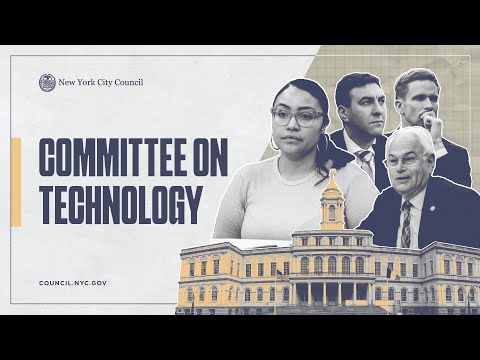
Councilmember Tierra Gutie9rrez convened the New York City Council's Committee on Technology to examine a package of broadband and digital-equity bills and to hear testimony from the Office of Technology and Innovation (OTI). Brett Sykoff, OTI's executive director for broadband and franchise administration, told the committee the Adams administration has prioritized rapid, low-cost connections for residents through Big Apple Connect and a new $2,400,000 digital equity roadmap rather than rebuilding the prior Internet master plan.
The committee heard that Big Apple Connect supplies free in-home broadband and basic cable to roughly 330,000 NYCHA residents and has about an 80% adoption rate, according to OTI testimony. Sykoff said the city's approach leverages existing cable infrastructure and master service agreements with providers to speed access and lower cost: "We evaluated how we could provide the best service to the largest amount of people as quickly as possible, not 5 or 10 years down the road." He added the city has entered 13 information-services franchises in the last year and is exploring other delivery models through a request for information.
Council members and advocates pressed OTI on several gaps. Chair Gutierrez and others asked for a public, up-to-date map of broadband adoption and for data showing how many households remain unconnected or rely only on mobile. Sykoff and associate commissioner Samantha Wright said OTI uses a public asset map and state and census sources but does not currently publish a citywide adoption map; they offered to provide additional data to the committee and said recent household survey work and in-person outreach are under way.
Members also questioned procurement and contracting for Big Apple Connect. Committee members said they had repeatedly asked for the underlying procurement documents and master services agreements with the participating companies. OTI staff described the procurement as a "mini-bid" among existing telecom enterprise contractors (Altice, Charter/Spectrum, Verizon) and said the contracts were structured to obtain bulk pricing for services on city-owned property. Sykoff emphasized the city did not fund capital construction for cable infrastructure and that contracts were intended to be nonexclusive and opt-in for residents.
OTI officials answered questions about costs and sustainability. Witnesses said Big Apple Connect costs roughly $38,000,000 per year to serve NYCHA households and that continuing the program long term would require funding commitments; OTI said it was in active discussions with providers about continued service and rates. The agency also warned that some elements proposed in Chair Gutie9rrez's bill (intro 11-22) would have budget implications and possibly duplicate ongoing work in the digital equity roadmap.
Outside witnesses at the hearing urged the council to strengthen outreach, digital skills training, and support for smaller community-based ISPs. Andrew Rachey of Civic Hall and Michael Santarelli of New York Law School said availability alone is not sufficient: adoption, device access and skills training remain major barriers. TechNYC and other industry speakers voiced support for a city plan and multi-stakeholder advisory board. Community advocates including Smart Community Initiative leaders and NYC Mesh volunteers pressed for continued funding for community-led pilots and noncommercial providers.
The committee also discussed a set of related bills: intro 1-98 (reporting on discounted internet program utilization), intros 4-81, 4-83 and 4-86 (information dissemination and agency wifi access proposals), intro 8-78 (broadband/cable franchise transparency map), and intro 11-22 (requires a published five-year plan and advisory board to pursue universal affordable equitable in-home broadband). OTI said it supports many goals in the bills but requested refinements and coordination to avoid duplication with the digital equity roadmap.
What happened next: Committee members directed OTI to provide more detailed data requested in the hearing record, including copies of procurement materials where available, the list of franchise agreements and clarifications on public asset maps. No formal council votes were recorded during this hearing.
Why it matters: New York City is balancing short-term subsidized connections for the most underserved residents with the longer-term question of whether to invest in city-owned or shared broadband infrastructure. The choices affect how quickly people gain access, which companies are paid, and how the city can ensure affordability and local, community-based options.
Sources and evidence: Testimony and questions at the May hearing by Chair Tierra Gutie9rrez; Councilmember Bob Holden; Brett Sykoff, Samantha Wright and Chantal Senatus of OTI; testimony from Civic Hall, NYC Mesh, New York Law School, TechNYC and community advocates.
Ending note: Committee members said they will follow up with OTI staff for the requested data and documents and that the council will continue to pursue legislation to increase transparency and digital-equity outcomes.