Get Full Government Meeting Transcripts, Videos, & Alerts Forever!
Get email alerts on the Election Audits topic
No spam. Unsubscribe anytime.
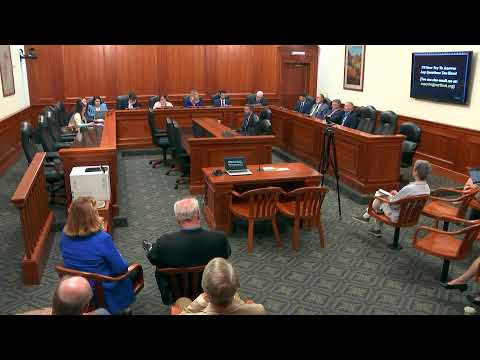
House election-integrity committee hears push for forensic post‑election audits; reports HB 4136 out of committee
Summary
The House Committee on Election Integrity heard extended testimony from outside expert John Drozd urging forensic post‑election audits and warning that risk‑limiting audits are limited in scope. The committee also voted unanimously to report House Bill 4136 with recommendation.
The House Committee on Election Integrity on Monday heard testimony urging broader, forensic post‑election audits and voted unanimously to report House Bill 4136 with recommendation.
Outside expert John Drozd, testifying by video, told the committee that “election integrity is not a Republican or a Democrat issue” and argued Michigan should pursue more thorough post‑election forensic audits rather than rely solely on risk‑limiting audits (RLAs). Chairperson Smith said she found Drozd’s presentation “very insightful” and indicated the committee will look into more extensive post‑election auditing.
Drozd summarized work his team did after the 2020 election and described three categories of election inaccuracies — voter, machine and process — that he said are best revealed by “meaningful post‑election audits.” He argued that small percentage errors can alter close races and said a target of roughly 99.9% accuracy would be needed to reduce the chance that inaccuracies change outcomes. “We have election integrity when we have highly accurate election results,” he said.
Drozd criticized RLAs as commonly presented to lawmakers, saying they “are only barely scratching the surface” because they check the math of machine tallies against paper ballots but do not assess voter legitimacy, machine‑level changes or many ballot‑processing steps. He told members that his team’s work — posted at election‑integrity.info — cataloged what he described as partial forensic audit findings in Nevada, Michigan and New York and recommended states adopt more extensive, representative forensic procedures.
Drozd cited specific figures during his testimony attributed to audits his team referenced: ‘‘1,500 dead people were all recorded as voting; 4,000 noncitizens voted; 8,000 people voted from nonexistent addresses; 15,000 votes were cast from commercial or vacant addresses; 19,000 people voted who did not live in Nevada; and approximately 42,000 people voted more than once,’’ which he described as findings from a Nevada review. He also discussed the Antrim County, Mich., machine investigation and a New York federal‑court process review of a U.S. House race in which a judge identified multiple process failings. These numbers and case descriptions were presented by Drozd as evidence of the limits of the audits actually performed after 2020 and as rationale for broader forensic auditing.
Committee members questioned Drozd about the provenance and admissibility of some findings. Representative Wooden noted that several claims cited in the presentation have been challenged in public reporting and litigation and referenced a law professor’s critique of the Nevada figures and the outcome of litigation involving Dominion Voting Systems. Wooden said some claims in public circulation have been “debunked” and pointed to defamation litigation over Dominion coverage. Drozd responded that, in his view, many critiques are politically framed and emphasized the need for objective third‑party forensic standards instead of political disputes.
Representative Fox and other members asked whether 2020 or 2024 elections were certifiable; Drozd said he could not conclude most states had a “high degree of confidence” absent broader forensic audits. Representative Colazar asked Drozd to define a full forensic audit; Drozd said the term lacks a single accepted definition and recommended jurisdictions adopt well‑established forensic methodologies similar to forensic accounting.
Votes at a glance: House Bill 4136 — Motion to report with recommendation (moved by Representative Fox). Roll call: Chair Smith — yes; Representative Fox — yes; Representative Altman — yes; Representative Alexander — yes; Representative Hoadley — yes; Representative Pablo — yes; Representative Wooden — yes; Representative Polzart — yes; Representative Song — yes. Tally: 9 yeas, 0 nays, 0 present but not voting. Outcome: reported with recommendation.
The meeting concluded after additional questions; Chairperson Smith said the committee will examine options for strengthening Michigan’s post‑election audit practices and thanked Drozd for his testimony. No formal statutory changes were adopted at the meeting; the committee’s reporting of HB 4136 sends that bill to the next step in the legislative process.