Get Full Government Meeting Transcripts, Videos, & Alerts Forever!
Get email alerts on the Helium Taxation topic
No spam. Unsubscribe anytime.
Senate tax committee advances helium extraction tax bill after adopting technical amendment; bill would create gross‑proceeds tax and local relief formula
Summary
The Senate Committee on Taxes adopted an author’s amendment and recommended Senate File 2530 to pass April 29; the bill would impose a gross‑proceeds tax on helium, carbon dioxide and hydrogen and direct substantial shares to local governments, schools and a new property‑tax relief account.
The Senate Committee on Taxes on April 29 adopted an author's amendment to Senate File 2530 and recommended the bill to pass and be sent to the Committee on Finance. The bill would establish a new gross‑proceeds tax on helium, carbon dioxide and hydrogen extraction, set a distribution formula for proceeds, and create property‑tax relief for homeowners in areas affected by production.
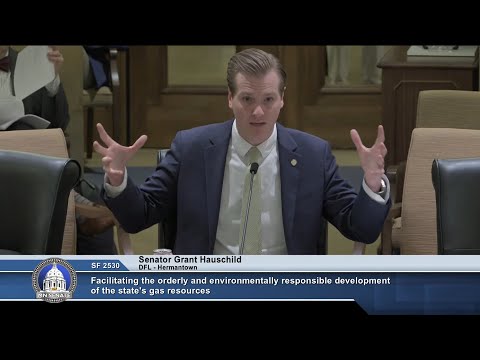
Senator Grant Hauschildt (sponsor) described the bill as a comprehensive taxation and local relief package for a recent helium discovery near Babbitt and for other future gas production. The A21 amendment (author’s amendment) was adopted; the committee then deleted article 3 as part of the agreed path for the bill and moved the remaining articles forward. Committee staff confirmed the procedural path would keep the tax article in the taxes committee and send the remaining articles to the finance committee as appropriate.
Key tax provisions described in the hearing include:
- A gross‑proceeds tax on helium, carbon dioxide and hydrogen with a rate of 7% for the first three years and 9% thereafter. - Distribution of gross‑proceeds revenue: 10% to the Iron Range Resources and Rehabilitation Board (IRRRB) when production occurs in taconite assistance areas (otherwise, that share flows to a fallback formula); 45% distributed to counties, school districts, cities and towns located in a defined “helium relief area” (a radius defined as 17 miles from a gas well and applied to school district geography); and 45% to a Helium Property Tax Relief Account that would fund a $50 helium homestead credit modeled on the taconite homestead credit. - An occupation (corporate) tax on gas mining, with 40% constitutionally dedicated to schools statewide and 10% to the University of Minnesota; the remaining 50% would be split 25% to counties within the helium relief area and 25% to tribes located within the helium relief area. - Property‑tax exemptions, sales‑tax exemptions, and targeted corporate/income tax exemptions for processing and production activities similar to existing taconite law.
Senator Hauschildt and witnesses emphasized the bill’s design to direct benefits to communities near production. Rich Veil, chair of the Lake County Board of Commissioners, testified the county supports the bill and said a gross‑proceeds tax is a reasonable way to capture value at the source and direct it toward local public education and services.
Committee discussion clarified that the “helium relief area” would be dynamic: as new wells are discovered the relief area would expand and revenues would be allocated to newly included school districts, cities and counties. Committee members also discussed the constitutional distribution of occupation‑tax proceeds (40% to schools; 10% to the University of Minnesota) as consistent with mineral taxation precedents.
After adopting the A21 amendment and deleting article 3 as described in committee, senators recommended Senate File 2530 to pass and be sent to the Committee on Finance. The motion carried by voice vote; no roll‑call tally appears in the transcript.
Votes at a glance: The committee adopted A21, then deleted article 3, and recommended SF 2530 to pass and be referred to the Committee on Finance (voice votes recorded; no roll call).
Next steps: The bill’s tax article remains under the taxes committee’s jurisdiction while the non‑tax articles will proceed to finance; sponsors said additional technical drafting and coordination with the Department of Revenue and interested local governments is expected.