Get Full Government Meeting Transcripts, Videos, & Alerts Forever!
Get email alerts on the City Budget topic
No spam. Unsubscribe anytime.
Richmond assessor recommends 6% taxable assessment increase; council agrees to mixed budget changes, rejects pay-cap consensus
Summary
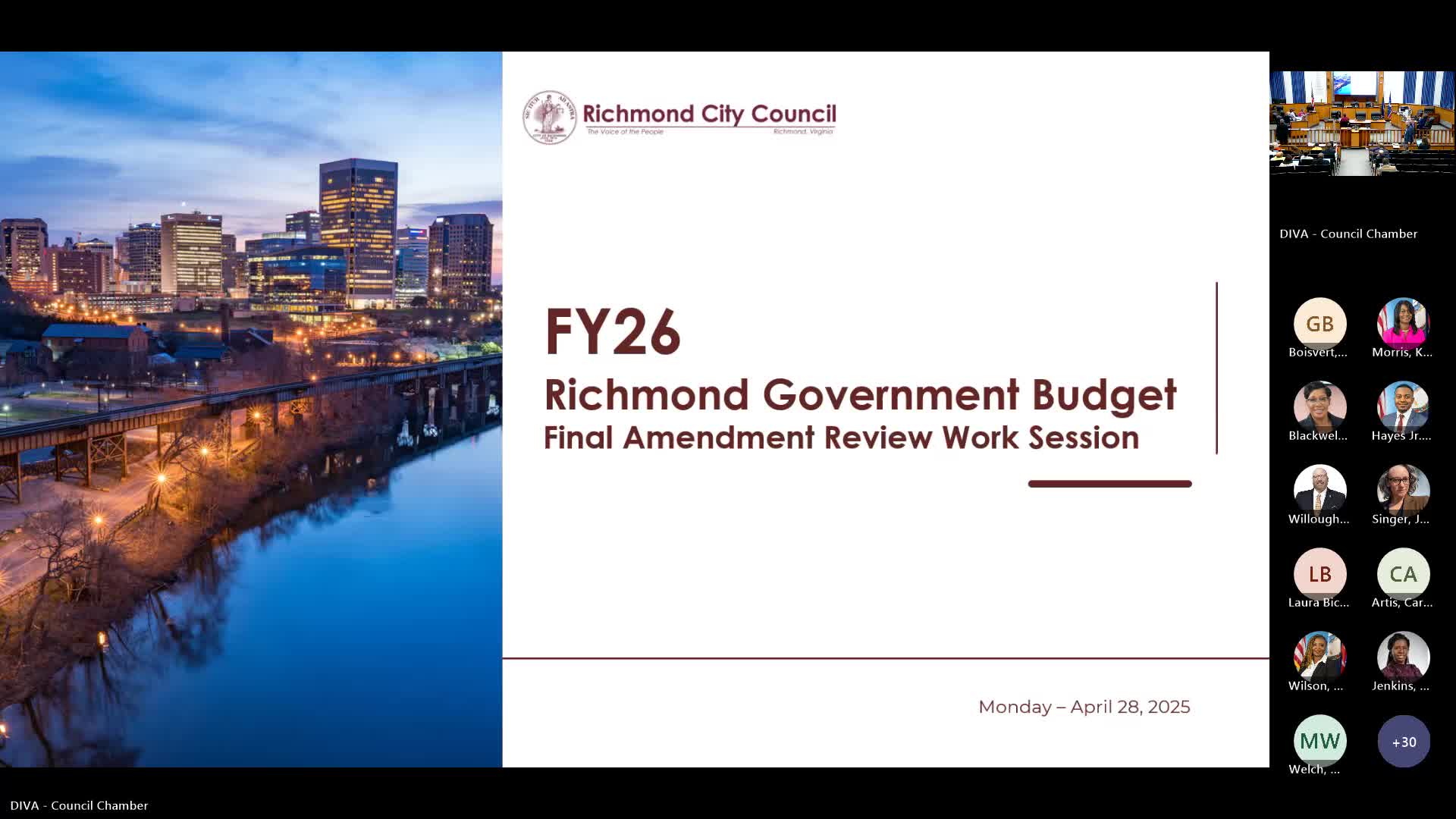
At a Richmond City Council budget work session, City Assessor Richard McKeith presented a forecast calling for a 6% increase in taxable real estate land‑book values effective Jan. 1, 2026, and council members discussed and tentatively agreed on multiple capital and operating changes ahead of budget introduction and adoption.
At a Richmond City Council budget work session, City Assessor Richard McKeith presented a forecast calling for a 6% increase in taxable real estate land‑book values effective Jan. 1, 2026, and council members discussed and tentatively agreed on multiple capital and operating changes ahead of budget introduction and adoption.
McKeith said his 6% forecast reflects recent assessment trends and current assessment‑to‑sale price ratios. “I’m comfortable with the 6%,” he said, citing recent years of 13%, 7.7% and 6.77% taxable assessment growth and telling council he had cross‑checked his outlook with the city economist.
The forecast matters because the land‑book baseline feeds property‑tax revenue estimates the city will use to set a tax rate. Budget adoption steps noted in the meeting schedule include introduction of amendments on May 5 and adoption of the FY2026 Richmond government budget on May 12.
Capital and fleet changes
Council and administration settled on a set of capital reductions and enhancements aimed at funding parts of the “people’s budget” while protecting long‑lived assets financed with bonds. Daniel Wagner, interim deputy chief of staff, said council would remove the Laburnum widening/parking project from the GO bond program and reallocate the remaining $959,617 toward other priorities including Pine Camp facilities in the Third District. The overall proposed capital reduction tied to that reallocation and other items totaled $2,214,617, of which roughly $1,255,000 was cash‑funded.
Wagner and staff also proposed a reduction to the city’s non‑emergency fleet replacement bucket, retaining funds for emergency and refuse vehicles but reducing replacement funding for about 25 other vehicles. Administration officials said refuse trucks and public‑safety vehicles (fire and police) would be held harmless. Gail Johnson, director of general services, said remaining funds still could be used to prioritize some acquisitions — for example two animal care vans or boom trucks for bulk pickup — but administrators could not guarantee every item would be purchased under the reduced budget.
Administration staff confirmed ambulances for the Richmond Ambulance Authority would continue to be funded via debt service/lease purchase, not by cutting ambulance replacement.
Operating reductions and program funding
On the operating side, the administration proposed roughly $1.944 million in reductions across several departments, including vacant personnel and operating line items. Notable points: - The Richmond Resilience Initiative had $500,000 available from FY25 for an existing cohort; staff said UpTogether is negotiating a $60,300 match that would allow 42 families to be served using existing funds. - The Office of Community Wealth Building provided confirmation that four positions listed as proposed cuts were vacant; department leadership said they had aligned staff so direct services remain prioritized. - A proposed cut of one vacant park‑ranger position drew repeated concern from council members because the James River Park system is large and park rangers carry a public‑safety role; Parks Director Chris Farulke said the department would focus on filling other vacancies first and has used contracted security while recruiting. - Small reductions were proposed for resiliency grants, signage, planning, and consultant services for economic development; administration said these cuts would leave limited remaining funds for those programs but not eliminate them.
Council also agreed on a slate of enhancements that the administration said could be accommodated without deeper reductions. The enhancements identified by council members and staff included (total targeted amounts shown as discussed): - Right to Counsel (legal representation for tenants in eviction): increase to $700,000 (council proposed $200,000 additional to the mayor’s $500,000) - Family Crisis Fund: increase to $1,000,000 (+$480,000) - Eviction Diversion program: restore to $1,000,000 (+$200,000) - Salary adjustments for deputy clerks at Circuit Court: +$164,000 - Caritas (year‑round shelter services): $200,000 (+$50,000) - HOME unit/voucher enforcement and testing: $250,000 to investigate housing voucher discrimination - OAR (reentry services): restore to $100,000 - Positive youth development programs: increase to $900,000 (may include an earmark for a specific program cited by council)
Councilmembers and administration discussed how earmarks would be implemented. Administration staff said if an item is specifically named and placed in the budget (for example a contract for a named nonprofit), staff can draft the contract without a separate re‑appropriation; if funding is left as a general program line (for example “after‑school programming”) an RFP or contract award later would require returning to council for appropriation. Councilmembers asked staff to include explicit language or a text amendment where they intended a named organization to receive funds so award timing would not be delayed.
Pay‑cap proposal fails to reach consensus
Councilmember Abubaker (listed on the record as the amendment sponsor) proposed a targeted restraint on the 3.25% cost‑of‑living adjustment for employees earning more than $175,000, arguing the move would prioritize funds for frontline workers and help practice equity in compensation. She described a compromise that reduced the original $750,000 proposal down to $250,000 in savings. Several council members urged a measured, data‑driven approach and supported commissioning an independent salary study; others voiced concern about singling out certain employees or disrupting previously negotiated pay structures. The council did not reach consensus to adopt the pay‑cap amendment during this session.
Process, follow‑up and next steps
Staff recorded multiple follow‑up commitments: the assessor agreed to provide the land‑book baseline number used to compute the 6% figure; administration pledged to provide more detailed breakdowns of fleet and vehicle replacement lists (including how many animal control, DPW, and other vehicles would be affected); and the CAO’s office committed to prepare re‑appropriation papers for certain FY25 funds and to work with the city attorney and council staff to convert the agreed‑upon enhancements and earmarks into the text amendments and ordinance language needed for introduction.
One formal roll‑call vote was taken early in the session: council approved a motion permitting Councilmember Kenya Gibson to participate electronically for medical reasons under the council’s rules of procedure. The work session concluded with staff and council agreeing to move the negotiated text to the city attorney’s office for drafting of ordinance amendments ahead of the May 5 introduction and the May 12 adoption vote.
Ending
Council members and staff left the session with multiple outstanding items to document: the assessor’s underlying land‑book numbers, a vehicle‑by‑vehicle breakdown for fleet priorities, the final language and placement for nonprofit earmarks (to avoid contract delays), and a plan and timeline for a review of contracted janitorial/security wage levels. Several council members said they would pursue an independent salary study and other policy reviews after the budget is finalized.
Quotes used in this report are from the public transcript of the Richmond City Council budget work session.