Get Full Government Meeting Transcripts, Videos, & Alerts Forever!
Get email alerts on the Labor And Contracting topic
No spam. Unsubscribe anytime.
Local contractors urge council to revise Bill 54, say community workforce agreement would exclude merit-based firms
Summary
Local contractors told the Budget, Finance and Economic Development Committee that Bill 54, which would require community workforce agreements on county projects over $500,000, could shut out experienced local merit contractors and raise costs. Supporters say the measure aims to prioritize local hires and ensure labor standards.
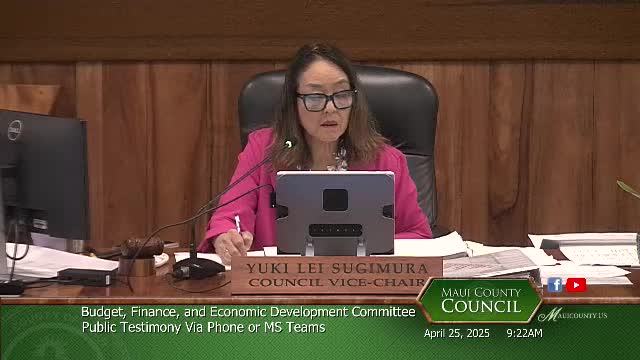
Testimony at the Maui County Council’s Budget, Finance and Economic Development Committee on April 25 centered on Bill 54 — proposed language that would require responsive bidders on county capital projects over $500,000 to be signatories to a community workforce agreement. Contractors who came to the hearing said the bill, as written, would effectively mandate union participation and exclude long-standing locally owned merit contractors.
The most pointed opposition came from Jenny Sullivan, who testified she represents P.B. Sullivan Construction. “This bill hands over authority for all county capital improvement projects over $500,000 to the unions at the cost and expense of local experienced merit based contractors,” Sullivan said. “Bill 54 is going to eliminate competition, shut out qualified local contractors, and drive up costs.”
Contractors at the hearing repeatedly raised two concerns: (1) the bill’s language is ambiguous on whether nonunion, merit-based contractors could participate without joining a union; and (2) if a requirement to sign a community workforce agreement effectively obliges merit firms to accept union-only terms, the added labor costs and pension/health contributions could make many local firms uncompetitive.
Kelly O’Keefe, who also testified for a local contracting firm, described the language as full of “buzzwords,” and said contractors in his office had been alarmed that the measure could be read as a mandate for union labor on projects above the $500,000 threshold. “We’re absolutely committed to hiring local,” O’Keefe said. “If we misunderstood the intent of the bill, then the frenzy we've been going through the last couple of days will absolutely mellow out.”
Some speakers urged the council to rewrite the measure to explicitly protect contractors of all labor affiliations while still advancing local hire goals. “If you can rewrite it to include all labor sectors, union and nonunion, I think there’s a lot of potential in this,” Sullivan said. Several speakers noted that Davis-Bacon prevailing-wage requirements already apply to many public projects and questioned whether the community workforce agreement requirement would add tangible protections beyond existing state and federal labor rules.
Council members and staff acknowledged ambiguity in the current draft and several urged more time for stakeholder input. Committee discussion during the hearing focused on clarifying the bill’s language, defining what a community workforce agreement will require, and whether the council intends to guarantee preference for local workers without excluding nonunion contractors.
No final committee vote on Bill 54 occurred at the April 25 meeting; members directed staff and counsel to review the draft and to return with clearer language and options for amendments.
Ending — next steps: Committee staff said they will confer with the bill’s sponsor and interested stakeholders and bring revised language back for the council’s consideration. Contractors and union representatives suggested a rewrite and additional public meetings before the council advances the proposal.