Get Full Government Meeting Transcripts, Videos, & Alerts Forever!
Get email alerts on the Mtss Implementation topic
No spam. Unsubscribe anytime.
Director outlines MTSS rollout: universal screening, data meetings and behavior supports
Summary
Will Jones, the district director of student growth and instructional support, updated the committee on rollout of a multi-tiered system of supports (MTSS) including a guidebook, a steering committee, standardized cut scores, Intervention Compass data dashboards and scheduled data meetings to monitor students.
NISKAYUNA, N.Y. — Will Jones, director of student growth and instructional support for the Niskayuna Central School District, told the Academic Programs Committee on April 28 that the district is moving from a patchwork of response-to-intervention practices to a unified multi-tiered system of supports (MTSS) with standardized screening, data meetings and implementation tools.
"MTSS is a framework, and it provides support for all of our students, both in their academic and their social emotional domains," Jones said, summarizing the district's rationale for adopting MTSS and replacing its prior AIS/RTI practices.
Jones described a steering committee formed to draft district guidance and an internal guidebook completed in July. The district has standardized screening tools: kindergarten through fifth grade take AIMSweb screening three times a year and all K–8 students take the i-Ready diagnostic; the district is using Intervention Compass as a data dashboard to visualize student trends and to apply uniform cut scores for tier decisions.
Jones said the district runs standardized data meetings four times per year in each building (September, November, after January benchmarking, and March) and that the meetings include school psychologists, principals, intervention teachers, the behavior specialist and rotating classroom teachers. The district uses three tiers of intervention: tier 1 for universal instruction, tier 2 for small-group interventions (up to five students, two to three days per week) and tier 3 for more intensive instruction (smaller groups and more frequent sessions).
Staff reported program and staffing changes already under way: math specialists were hired, a behavior coach began in March, and elementary-level interventionists are being used for push-in supports in kindergarten to reduce early-year gaps. Jones said the district has increased the number of students seen for reading intervention from 95 in fall to 263 in winter; math intervention caseloads fell to 114 in winter, figures Jones presented as part of the implementation update.
Jones also discussed plans for improving note-taking and historical records in the data system so teacher-facing records follow students more reliably across grades and buildings. He said district staff are intentionally controlling access and will model objective note-taking before enabling teacher input: "For the first year, I will be the one that enters the notes, so that it will be modeling, and then there will be guidelines for what information gets entered and what doesn't get entered," Jones said.
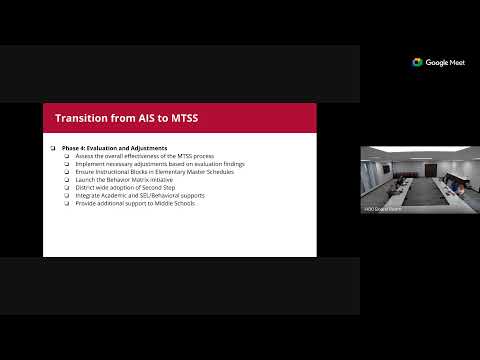
Committee members asked whether the system flags attendance or grade trends automatically; Jones said the dashboard shows trend graphs and attendance data, but the district is still evaluating software options for automated alerts. He emphasized that the next steps include evaluating the effectiveness of MTSS interventions at year end, ensuring instructional blocks exist in elementary master schedules for intervention time, and continuing professional development for staff.
Speakers in this segment included Will Jones (director of student growth and instructional support), Laurel (staff member), Ashley Rickert (staff member), Meg Collins (staff member) and Nicole (staff member).