Get AI Briefings, Transcripts & Alerts on Local & National Government Meetings — Forever.
Grand County officials revise HDHO draft to ease lending hurdles and broaden eligibility
Loading...
Summary
Grand County Planning Commission Chair Tony Mancuso convened a joint workshop April 28 to review proposed revisions to Land Use Code 4.7, the High Density Housing Overlay, aimed at improving mortgageability, clarifying residency and employment eligibility, and creating administrative remedies for deed-restriction violations.
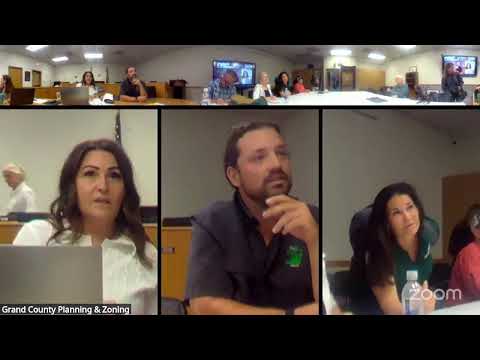
Grand County Planning Commission Chair Tony Mancuso opened a joint workshop April 28 to review proposed changes to Land Use Code 4.7, the county—s High Density Housing Overlay (HDHO), saying he would call the meeting to order and turn discussion over to staff.
The draft revisions focus on two aims flagged repeatedly by the county task force: making HDHO units easier to finance and widening the pool of residents eligible to live in HDHO housing. County staff framed the package as an attempt to preserve the overlay—s goal of primary-residence workforce housing while removing language that lenders have identified as a barrier to conventional mortgages.
"There's bound to be mistakes because I'm human," said Christine Simcox, the staff presenter, as she introduced the revised language and described the draft as the product of recent task-force meetings and stakeholder input. Simcox said the draft has not yet completed legal review and that staff would revise wording after further feedback.
Key changes and points discussed
- Definitions and local employment: The draft expands and clarifies definitions at 4.7.0.3 to explicitly include remote employment and several categories of "local employment" and "local businesses/organizations." Commissioners and task-force members discussed a proposed 75-mile local-area radius intended to cover the county while giving some guidance about where employers must be located to count as local. Staff said HOSU (the county housing authority) would have administrative discretion to apply those definitions in borderline cases.
- Residency and work-time thresholds: The draft retains a primary-residential-occupancy standard of nine months out of any 12-month period but would reduce a prior look-back requirement (previously five years in draft language) to two years in some eligibility subsections. Commissioners and stakeholders debated trade-offs for seasonal workers and whether to instead reference the state—s 185-day rule for residency. Staff repeatedly noted they expect HOSU and the cooperative agreement to be able to interpret edge cases.
- Lendability and deed restrictions: Lenders and developers raised that recorded deed restrictions in earlier HDHO projects made conventional mortgage underwriting difficult. The draft removes language that would automatically revoke certificates or permits as an enforcement first response and instead points enforcement readers to a new section (4.7.0.11) that describes remedies, cures and an administrative process intended to allow lenders time and an avenue to cure violations. Staff described that change as intended to preserve county enforcement authority while giving lenders a path to underwrite mortgage loans.
- Remedies, enforcement scope and developer obligations: The draft keeps county enforcement tools for discretionary approvals issued to developers during construction but staff signaled removal of automatic post-occupancy revocation language that lenders flagged as a barrier. Instead, staff proposed detailed remedy-and-cure procedures to be referenced by deed restrictions and development agreements so lenders can see how a defect could be cured without immediate loss of occupancy.
- Cooperative agreement with HOSU: Several speakers urged that operational details (how HOSU will administer occupancies, requalification and enforcement notifications) be handled in a cooperative agreement between the county and HOSU rather than embedded in the land-use code. Staff said they and the county attorney had discussed that approach and recommended it for administrative clarity.
- Owner-occupancy, exemptions and rental vs. sale: The draft clarifies several exemptions (for owners/managers of rental developments, for developers, and for units governed by condominium/HOA documents). Staff proposed — and the commission debated — language that would allow a portion of units (one example number discussed was 50% in HOA-governed developments) to be exempt from the qualified-household requirement if a supermajority of owner-occupancy were preserved. Supporters said the change improves marketability and brings capital into stalled projects; opponents warned it could erode the overlay—s purpose and push prices up. Multiple speakers asked the county to test different percentage options and to gather lender feedback before finalizing a number.
What commissioners and stakeholders emphasized
- Lenders and developers: Several participants urged clearer remedy-and-cure language and specific deed-restriction mechanics so conventional lenders could underwrite loans. Staff said the new 4.7.0.11 remedies section and cross-referenced deed-restriction language are intended to address that.
- Local workforce vs. remote workers: Commissioners debated whether remote workers who contribute to the local economy should qualify. The draft includes a compromise allowing part-time local work (for example, roughly 24 hours per week) to be a qualifying factor and gives HOSU discretion to judge contributions in ambiguous cases.
- Enforcement and administrative practice: Stakeholders asked that the county record notices of interest (for example, a county-filed notice when a deed restriction is recorded or a title action occurs) to avoid informational "black holes"; staff agreed that administrative procedures (not the land-use code) would handle routine notifications to HOSU.
Next steps and procedural timeline
No formal votes were taken at the workshop (the meeting later lost a quorum). Commissioners directed staff to produce a revised draft that incorporates the workshop feedback, to route the draft through legal review, and to circulate materials in time to meet the public-hearing noticing requirements (staff emphasized a minimum 10-day packet window before a public hearing). Staff and commissioners discussed scheduling and agreed to return a recommended draft for a Planning Commission public hearing and later referral to the County Commission.
Why it matters
The HDHO overlay was created to increase housing supply for households who live and work in Grand County. The revisions aim to preserve that core objective while removing technical and legal language that has discouraged mortgage lenders and slowed project completion. How the county balances owner-occupancy, allowable outside investment, and enforceable deed restrictions will determine whether stalled developments can attract conventional financing and whether the overlay produces long-term workforce housing rather than short-term or higher-priced units.
Ending
Staff said they will revise the draft, coordinate deed-restriction and remedies language with HOSU and the county attorney, and return with a public-hearing-ready draft that satisfies notice requirements. Planning commissioners and task-force members asked staff to solicit lender feedback on the remedies language and to present alternate numeric options (for example, different owner-occupancy percentages) so the planning body can weigh trade-offs before final adoption.