Get Full Government Meeting Transcripts, Videos, & Alerts Forever!
Get email alerts on the Cannabis Policy topic
No spam. Unsubscribe anytime.
Senate debates omnibus cannabis bill; lawmakers adopt expungement and sober‑home amendments, withdraw potency and labeling proposals
Summary
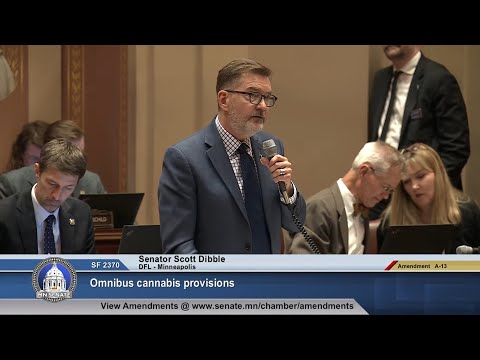
The Minnesota Senate spent more than an hour debating Senate File 2370, an omnibus cannabis bill compiled from agency and member bills. Lawmakers adopted technical expungement and sober‑home amendments, withdrew proposed potency and labeling mandates after rule‑making was cited, and defeated an amendment to expand school buffer distances.
ST. PAUL, Minn. — The Minnesota Senate debated an omnibus cannabis bill, Senate File 2370, on April 28, 2025, considering a package of agency and member provisions including medical patient protections, low‑potency hemp product rules, and technical statutory fixes. Senate floor debate produced multiple amendments: some were adopted, some withdrawn and others were rejected or left pending for further action.
Senator Dibble presented the bill as “a compilation of a number of other bills” and described it as a set of agency bills prepared by the Office of Cannabis Management (OCM) and additional member proposals. He told colleagues the bill consolidates statutory language in “chapter 152 and chapter 342” and moves medical cannabis oversight to the OCM while preserving tribal reciprocity for medical patients.
Why it matters: The omnibus package would set labeling, licensing and product rules for adult‑use and medical cannabis in Minnesota, affect municipal control over retail operations, and add statutory protections and regulatory authority that shape access for patients and consumers.
Floor amendments and outcomes
- A16 (expungement technical changes): Sponsored by Senator Port, the amendment was described as correcting drafting omissions and ensuring the Cannabis Expungement Board’s intent would be carried out, including sealing all counts in a case when eligible. Senator Port said the changes were “recommended by the cannabis expungement board.” The amendment was adopted on the floor.
- A10 (potency limits): Offered by Senator Nelson, A10 would have required the Office of Cannabis Management to enforce THC content and potency limits. Nelson cited scientific reviews and recommended limits. After senators noted that potency and related limits had been the subject of OCM rule‑making, Nelson withdrew the A10 amendment, saying she would return with definitive information from OCM.
- A11 (labeling and point‑of‑sale medical warnings): Nelson described A11 as closing a statutory “loophole” that allowed retailers to provide consumer information not specified by OCM and adding a required eight‑hour driving warning. Senators noted labeling was addressed in recently adopted OCM rules; Senator Nelson withdrew A11 to get precise rule language from OCM.
- A12 (county/local control to prohibit retail cannabis): Senator Nelson framed A12 as restoring local control to allow counties to prohibit retail cannabis operations. Senator Dibble and others argued that the 2023 law intentionally avoided creating a patchwork of availability; the amendment prompted roll‑call consideration on the floor. The transcript records the roll‑call process but does not contain a final outcome for A12 in the excerpt.
- A13 (ban on added flavors in inhaled cannabis products): Nelson said the amendment would prohibit added flavors in smoked/inhaled products to discourage youth use. Senators debated public‑health benefits versus risks of pushing consumers to unregulated illicit markets. The transcript records roll‑call activity related to the amendment but does not contain an explicit final result in the excerpt.
- A14 (sober homes and abstinence environments): Offered by Senator Abler, the amendment would permit sober homes and similar facilities to restrict smoked cannabis use in ways that avoid triggering residents in recovery. Senator Abler said the change “would just allow them not to have to do this.” The A14 amendment was adopted on the floor.
- A15 (increase school buffer from 500 to 1,000 feet): Senator Gruenhagen (floor spelling: Grudenhagen/Gruenhagen in transcript) offered A15 to expand the distance from schools where smoking or public use would be restricted. Proponents cited child protection; opponents noted that a 1,000‑foot buffer would effectively ban many adults from using a legal product on private property because most schools sit inside neighborhoods. The A15 amendment was not adopted.
Other process notes
Senators repeatedly referenced the recently completed rule‑making process led by OCM. Several senators said the agency’s rules already address many of the technical matters raised in amendments (potency limits, labeling) and urged caution about supplanting rules with statute without reviewing the final rules. Multiple senators asked colleagues to consult OCM’s adopted rules before voting on statutory changes.
Senator Port and others repeatedly urged colleagues to consider the practical consequences of some amendments (for example, geographic buffers or local opt‑ins) and to refer unresolved policy questions to committee hearings for additional stakeholder input.
Quotations from the floor
- “The bill before you is a compilation of a number of other bills,” said Senator Dibble as he introduced the omnibus package.
- “This amendment is the cannabis expungement board technical changes ... recommended by the cannabis expungement board,” said Senator Port while describing A16.
- “I will withdraw the A10 ... I will withdraw the amendment at this time,” said Senator Nelson after noting OCM had completed rule‑making and she would confer with the agency.
Ending
Senators completed debate and moved toward final passage procedures for SF 2370 later in the session. Several amendments were adopted on the floor; some were withdrawn after senators cited OCM’s rule‑making, and at least one proposed change to zoning and buffer distances failed. Several other amendments prompted roll‑call votes; the transcript excerpt records roll‑call activity for A12 and A13 but does not include a definitive final result for those specific amendments in the provided excerpt. The bill’s author thanked OCM staff and colleagues for the debate and indicated further deliberations would continue in later stages of the legislative process.
Votes at a glance (from transcript excerpt)
- A16 (expungement technical changes): adopted (floor roll‑call recorded, outcome announced on the floor). - A10 (potency limits): withdrawn by author (Senator Nelson). - A11 (labeling/point‑of‑sale warnings): withdrawn by author (Senator Nelson). - A12 (local control over retail prohibitions): roll‑call recorded; final disposition not specified in excerpt. - A13 (ban on added flavors in inhaled products): roll‑call activity recorded; final disposition not specified in excerpt. - A14 (sober‑home restrictions): adopted. - A15 (increase school buffer to 1,000 feet): not adopted.
(Full roll‑call tallies for some amendments and final passage outcomes were recorded piecemeal in the transcript excerpt; where a final outcome is not recorded in the provided excerpt the article notes that fact rather than inferring a result.)