Get Full Government Meeting Transcripts, Videos, & Alerts Forever!
Get email alerts on the School Budget topic
No spam. Unsubscribe anytime.
Beacon City School District adopts $87.72 million 2025–26 budget; board votes 7-0
Summary
The Beacon City School District Board of Education on April 22 approved a $87,720,000 budget for 2025–26, a 4.61% year‑to‑year increase, while detailing capital projects including expanded classroom cooling, and confirming that the tax levy remains at the state cap.
The Beacon City School District Board of Education on April 22 adopted a $87,720,000 budget for the 2025–26 school year, a 4.61% increase over the prior year, with a 7–0 roll-call vote.
Superintendent Matt told the board that “what the board is voting on tonight is the overall budget number,” and stressed the document reflects the district’s priorities across academics, student supports and facilities.
The budget funds classroom and student supports the administration highlighted at the April 22 workshop, including a fourth elementary math intervention teacher, additional reading intervention staff, continued funding for social workers and middle‑school counseling, expansion of full‑day pre‑K slots, investments in extracurriculars and music, and site‑based mental‑health services. The capital program tied to the 2024 voter‑approved project also includes secure school entrances, upgrades to athletic fields and the Seager Theatre, and a plan to add air conditioning to “up to 50%” of elementary classrooms over multiple years.
Why it matters: Board members and administrators said the budget is intended to sustain programs added in recent years while responding to enrollment, academic gaps and extreme‑heat planning mandated by state law. If state aid or federal revenues change after adoption, the board said it will revisit allocations at a future meeting.
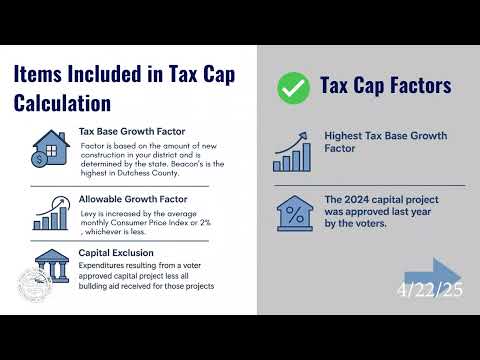
Key figures and fiscal context - Budget total: $87,720,000 (4.61% increase year to year). - Federal funds: approximately $1.7 million; federal revenues are accounted for in separate funds and are not reflected in the general fund totals presented for the voter budget. The administration said those federal dollars currently support reading teachers, English language supports and some special education costs. - Fund balance/reserves: the administration proposes using $2,500,000 of fund balance; current fund balance was described as roughly 5% of the budget (New York State minimum cited as 4%). Auditors advise caution in appropriating fund balance. - Tax levy: the district’s levy remains at the calculated tax cap. Superintendent Matt explained the tax‑cap calculation includes three components: a state‑determined tax base growth factor tied to new construction, an allowable growth factor (consumer price index or 2%), and capital exclusions for debt service less building aid. The district stressed the levy does not exceed the cap and therefore would require only a simple majority to approve. - Median‑household impact (presented as estimates using last year’s assessments): Beacon median home: ~$304,000; estimated annual tax increase for that median home in Beacon: about $175 (with comparative estimates for Fishkill and Wappingers provided on presentation slides). The administration noted final assessments for the current year are not yet available and that actual tax warrants in summer often produce lower per‑household increases because new properties are added to the tax roll.
Programs, capital priorities and timing Administrators gave examples of instructional and student‑support investments covered by the budget: class‑size reductions, expanded music (elementary instrumental program), full‑day pre‑K slots, summer transition workshops, science curriculum rollouts (Science21), targeted professional development focused on the science of reading, and expanded extracurricular clubs. The board also heard details on the 2024 capital project (voter approved last May), which the administration said will fund remaining secure entrances, upgrades to baseball/softball fields (drainage and useability), renovations at the Seager Theatre and staged installation of classroom air conditioning starting in 2026 and continuing through 2028.
On the district’s previous purchase of electric buses, administrators said the grant received offset costs so that purchasing electric buses did not increase taxpayers’ costs compared with diesel buses. The board also decided not to place a bus proposition on this year’s ballot.
Federal and state funding risks Board members asked about the potential loss or reduction of federal funding. Administrators confirmed federal funding is counted separately and that a sudden reduction would require the district to make up the costs from the general fund or reduce programs; they said some scenario planning is underway. Regarding state aid, the administration built the budget using the governor’s proposed aid run (a 2% foundation increase) but noted the legislature had proposed higher amounts; final state aid could change the district’s mid‑year choices on fund balance use or program additions.
Board discussion and support Board members who spoke prior to the vote described the budget as carefully balanced and focused on sustaining recent programmatic gains while maintaining fiscal prudence. Chris said the proposed investments were “really important for our students.” Several board members praised the presentation and outreach plan ahead of the May 6 budget hearing and the district’s plan to hold community events and school concerts to explain the budget to voters.
Votes at a glance - 9.01 Adopt proposed 2025–26 school year budget (motion to adopt the proposed budget as presented). Moved: not specified in the public record; Second: Kristen. Roll‑call vote: Ms. Harrison — Yes; Ms. Flynn — Yes; Mr. Lyon — Yes; McNair — Yes; Mr. Schroeder — Yes; Ms. Sewer — Yes; Ms. Statler — Yes. Outcome: approved, 7–0. - 9.02 Approve property tax report card and school district budget (formal submission items related to the adopted budget). Outcome: approved, voice vote (board recorded: passes 7–0). - 9.03 Approve Dutchess County BOCES 2025–26 administrative budget (district vote on BOCES administrative budget). Outcome: approved, voice/roll call (recorded as passing; board recording: unanimous affirmative responses). - 9.04 Vote for board representation to the Dutchess BOCES board (three seats): the board voted to cast its slate for Gully (Stanford; transcript spelling variable), Mark Fleschauer (transcript spelled “Flushauer/Fleschauer”), and Bryce Holland. Outcome: approved, voice vote (7–0).
What the board did not decide tonight The board moved to executive session to review the employment history of a particular individual. The executive‑session action and personnel details were not discussed in public. Policy items discussed at the prior policy committee meeting will return to a future public agenda; one policy item (inventories and accounting of fixed assets) was noted as needing follow‑up.
Ending Administrators and board members said they will continue community outreach ahead of the May 6 budget hearing and will add slides explaining assessment trends, examples of household impacts at different home‑value levels, the portion of programs supported by federal funds, and how BOCES aid and regional contracts shift cost and aid. The board adjourned after approving the consent agenda and other routine items.