Get Full Government Meeting Transcripts, Videos, & Alerts Forever!
Get email alerts on the Energy Storage topic
No spam. Unsubscribe anytime.
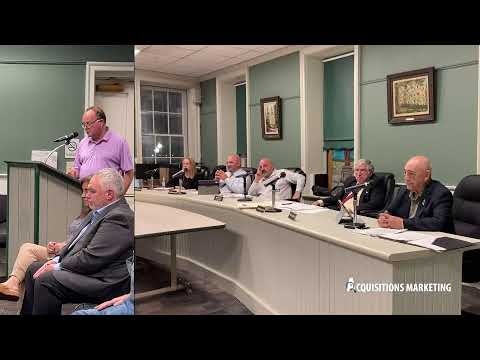
Developer presents proposed 10 MW battery project on Hartley Road; board and residents ask fire-safety and interconnection questions
Summary
New Leaf Energy and consultants gave an initial presentation for a 2x5 MW battery energy storage system at 114 Hartley Road; the board heard questions on fire safety, interconnection, visual screening and decommissioning; no permit decision made.
New Leaf Energy and consultants presented an initial site plan and special-permit concept April 20 for a proposed battery energy storage system (BESS) on property at 114 Hartley Road. The project as described would install two 5-megawatt AC battery systems (10 MW total) in a fenced compound on existing disturbed pavement adjacent to an Orange & Rockland substation; the nearest residence is roughly 700 feet away, the presenters said.
Why it matters: Battery systems provide short-duration grid capacity but have raised public interest about safety, fire response and local siting. The town must consider fire code compliance, visual screening, decommissioning and interconnection points to the local distribution grid.
Project details and local questions Creighton Manning, civil engineer for the project, said proposed site work is limited to pad grading within an existing paved area and that no tree clearing or wetland impacts are anticipated. The team said indoor operations and a load-out tunnel are not part of this project (that language referred to a separate transfer station discussion earlier); for the BESS, all equipment would be located inside fenced compound and connected to the nearby distribution infrastructure. The parcel was described as previously identified by the utility as a priority site for a battery solution.
Fire safety and emergency response Fire-safety questions dominated public comment. Paul Rogers of ESRG, the team’s fire/safety consultant and a former FDNY hazardous-materials lieutenant, said developers will use ASTM/UL destructive-test data and code-prescribed containment measures to limit propagation. He said modern BESS design and testing aim to confine a thermal event to a single module or container and that peer review of manufacturer test data will be required as part of code review. He also said modern guidance allows a defensive tactic of containment in some cases; water can be used but may be of limited utility and may require careful scene control. Rogers said local fire departments will need training and the developers plan to coordinate training and response plans with the three local fire companies.
Other issues: interconnection, screening, decommissioning Presenters said the project team will coordinate an interconnection study with Orange & Rockland; routing of the medium-voltage tie will be determined by the utility and could include underground runs to a nearby distribution line or other arrangements. The team also said visual simulations and tree buffers will be prepared; the nearest parcel to the north is a conservation easement owned by the utility. Decommissioning plans (and a decommissioning bond) will be included in future submissions. The project has not been assigned a final BESS product; presenters said the specific battery modules will be chosen to meet performance and safety standards and that preferences for domestic supply and compliance with applicable federal sourcing rules will be considered.
Next steps This was an initial presentation; the planning board will receive formal site-plan applications and the town board will consider the special permit. Developers plan to provide additional documentation, manufacturer test reports, fire-service coordination, visual simulations and utility interconnection results at subsequent hearings. No permit was granted April 20.