Get Full Government Meeting Transcripts, Videos, & Alerts Forever!
Get email alerts on the Opioid Abatement Grants topic
No spam. Unsubscribe anytime.
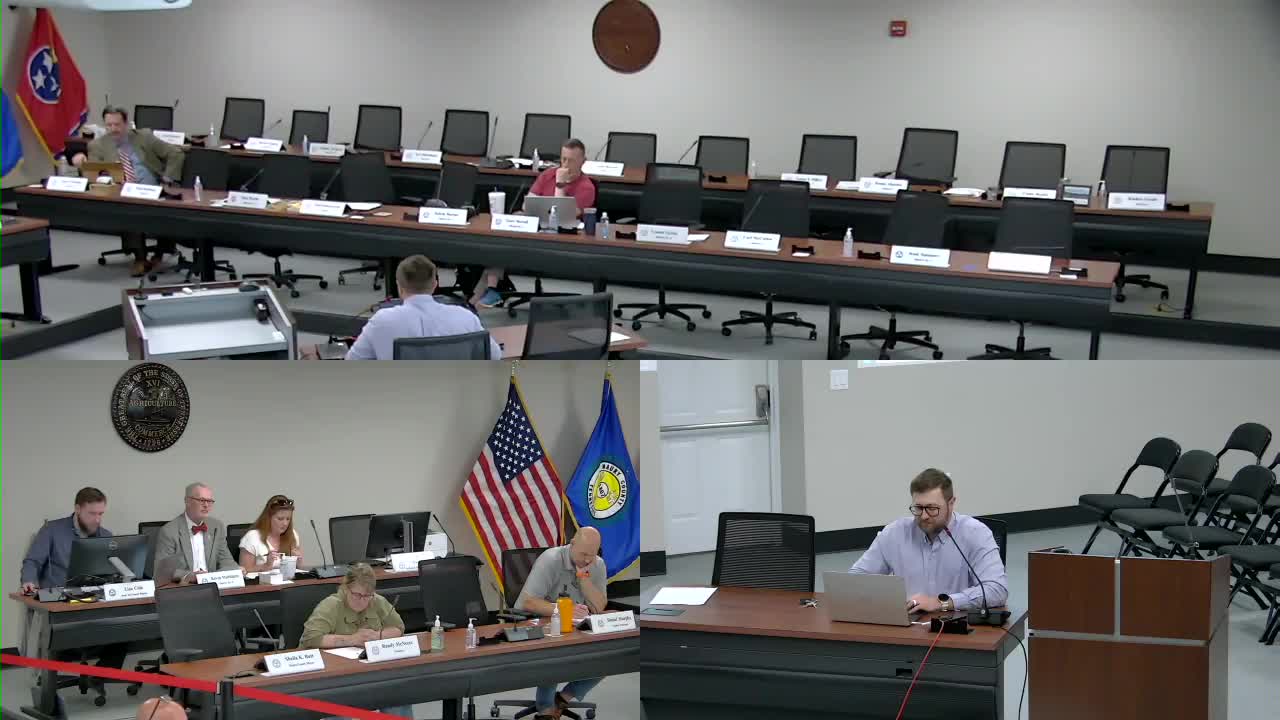
Maury County opioid abatement committee tightens grant documentation, postpones several requests to May 7
Summary
The Maury County Opioid Abatement Committee voted to require additional nonprofit verification for applicants, extended the application deadline to May 7 and tabled several funding requests for more documentation; the committee approved a Safe Baby Court request and heard financial updates from local providers.
At a meeting of the Maury County Opioid Abatement Committee, members voted to require stronger nonprofit documentation for grant applicants, moved an application deadline to May 7 and postponed consideration of several funding requests pending additional materials.
The committee’s action centered on a motion to add a requirement that applicants supply an IRS 501(c)(3) determination letter and a state charitable solicitation permit (where applicable) and to provide at least two years of Form 990s for nonprofits requesting larger awards. The change was paired with a two-week extension of the current application window to May 7 to allow applicants to submit the newly requested documents.
Why it matters: committee staff and members said the changes are meant to protect limited opioid-abatement funds as state and settlement revenues have declined from earlier projections. Committee members described the move as a vetting step to confirm organizations’ legal status before awarding grants.
The meeting included three financial updates and several grant requests. Matt, a Delta Recovery representative, told the committee that Delta has served 28 individuals across 429 encounters (distinct treatment days) and that those encounters “translate to 42,900 in treatment costs.” GWP Recovery Ministries reported having “$6,170 left of the 38,000,” and described roughly $10,000 spent on rent and about $10,000 on vehicle maintenance (including a $4,600 bus motor and roughly $1,000 in van repairs). Committee members pressed GWP for clearer receipts and a simple line-item log showing where funds were spent.
Committee staff presented the program’s revenue picture and warned that state projections for future opioid-related payments are lower than earlier estimates. The staff summary said the county has received settlement and state opioid payments to date (presentation cited a total “around $1.8 million” in distributed and settlement funds), but speakers emphasized those amounts are variable and “not guaranteed” in coming years.
Votes at a glance: - Motion to require IRS determination letter, state charitable solicitation permit (when required) and two years of Form 990s; extend the current application deadline to May 7 — Passed (motion on the floor; voice vote recorded as in favor). - Motion authorizing staff to email applicants and request verification documents (state/business registration and Form 990 where relevant) — Passed (voice vote). - SCHRA request (program support, $30,000) — Tabled to next meeting for a presenter to attend. - GWP Recovery Ministries (funding for two case managers, $90,000) — Tabled to May 7 for additional financial detail and documentation. - Mediation Center application — Tabled to May 7 to allow a presenter to appear. - Safe Baby Court (Maury County program request) — Approved by voice vote at the meeting; committee documented Safe Baby Court’s state grant status and local request details. - Murray County Prevention Coalition / Recovery Fest & staffing request ($14,006.45) — Motion to approve was made but, because two members with ties to the applicant abstained and the committee lacked a full voting quorum, consideration was deferred to the May 7 meeting. - Motion to schedule a committee meet-and-greet for applicants and providers — Passed.
Discussion and context Committee members repeatedly stressed the need for clearer documentation and simpler financial reporting formats. One member said the board does not need to see every receipt but asked for an outline or ledger showing where money is going. Staff and presenters agreed to supply scanned receipts and a more readable accounting format for the next meeting.
Applicants and program updates - Safe Baby Court: Emily Selby, who manages the Safe Baby Court program for Maury County government, told the committee the program “is a fully grant funded program. So we get a hundred thousand dollars a year from the state” and that most caregivers entering the program have substance-use disorders. Selby requested funding to contract a certified peer recovery specialist (CPRS) at about $1,000 per month and to cover treatment-specific costs such as assessments when insurance is not available.
- GWP Recovery Ministries: A GWP representative (Billy) said the organization has spent funds on rent, fuel and vehicle maintenance and will provide a more formal accounting to the committee; GWP requested $90,000 to hire two case managers (one for men, one for women) and said the positions are intended to be self-sustaining after one year through reallocated program income and partnerships.
- Delta Recovery: Presenter Matt summarized client contacts and direct treatment costs and answered questions about the program’s intensive outpatient format and individual sessions.
Administrative and process changes Committee members and staff agreed to send a uniform email to all current applicants asking for: (1) Secretary of State proof of legal existence, (2) IRS determination letter for nonprofits and (3) most recent Form 990 filings (two years where available). The committee voted to accept these as late-filed exhibits for applications already submitted and to make the documentation a requirement for future application cycles.
Next steps and scheduling The committee set May 7 as the immediate follow-up meeting to finalize funding decisions and reserved May 14 as a backup date. Members asked staff to compile and circulate updated applicant documentation and to prepare clearer financial summaries for organizations that requested funds.
Ending note Committee members also scheduled a community “meet-and-greet” for providers and applicants to improve coordination across prevention, treatment and recovery services ahead of local events such as Recovery Fest and a June 27 substance use and mental health conference supported by the committee.