Get Full Government Meeting Transcripts, Videos, & Alerts Forever!
Get email alerts on the Case Closure Witness Support topic
No spam. Unsubscribe anytime.
Witness-support proposal draws federal, executive caution at Council hearing
Summary
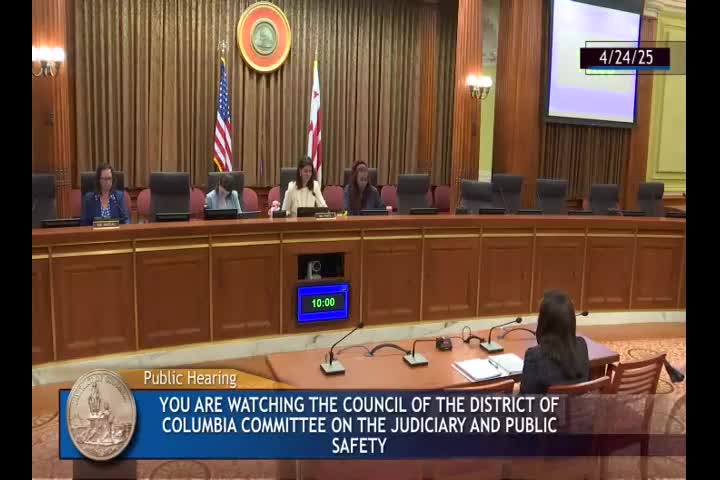
Council Member Brianne Nadeau opened testimony on the Case Closure and Witness Support Amendment Act of 2025 (B26-27), telling the Committee on Judiciary and Public Safety that the bill responds to low homicide closure rates and the absence of a codified witness-assistance program.
Council Member Brianne Nadeau opened testimony on the Case Closure and Witness Support Amendment Act of 2025 (B26-27), telling the Committee on Judiciary and Public Safety that the bill responds to low homicide closure rates and the absence of a codified witness-assistance program. Nadeau said the bill would double the statutory tip maximum in homicide cases from $25,000 to a $50,000 minimum and establish a municipal witness relocation and assistance program including housing, physical protection and identity documents; it would also require a mayoral report on existing programs.
Deputy Mayor Lindsay Appiah told the committee the executive submitted formal opposition "to B26-27," warning that mandatory $50,000 payments could be expensive and that the city should prioritize investments in proven investigatory tools and more detectives. The deputy mayor noted MPD's homicide clearance rates historically exceed many comparably sized cities and that executive priorities include forensic capacity and hiring investigators. Appiah said the city has ad hoc witness and emergency relocation supports but questioned whether the proposed statutory approach would be a cost-effective use of limited funds.
Ilana Suttonberg, Special Counsel for Policy and Legislative Affairs at the U.S. Attorney's Office for the District of Columbia, told the committee USAO shares the goal of increasing witness cooperation but warned a mandatory $50,000 minimum risks undermining prosecutions: "With such a substantial mandatory payment, there could be concerns related to the bias of witnesses receiving these payments in our prosecutions, which could cause juries to doubt the testimony of these witnesses," she said. Suttonberg described federal witness and victim-witness assistance programs that currently provide safety planning, emergency housing, and referrals, and urged collaboration on adding resources rather than prescriptive local mandates.
Discussion focused on what does and does not incentivize witnesses to come forward. Appiah and Suttonberg both emphasized trust, anonymity and concrete safety measures as drivers of cooperation, and cautioned that money alone cannot overcome fear of retaliation. Appiah described MPD tip structures that provide variable awards where reliability and evidentiary value are assessed by detectives. The U.S. Attorney's Office emphasized that its Victim Witness Assistance Unit already operates a range of services and that federal witness security (U.S. Marshals) covers some permanent relocation and identity-change needs.
Why it matters: The bill addresses a core public-safety problem identified by council members — witness reluctance in violent-crime cases — and proposes statutory remedies. Federal and executive witnesses urged caution about mandatory payouts and warned new, costly local programs could produce unintended prosecutorial and budgetary consequences. The committee directed follow-up questions on current tip payment practices, how many cases are closed by tip, and what local-federal program gaps truly exist. The record on the bill remains open for additional documentation and data.