Get Full Government Meeting Transcripts, Videos, & Alerts Forever!
Get email alerts on the Safe Passage topic
No spam. Unsubscribe anytime.
Council committee hears concerns, praise as deputy mayor opposes Safe Passage bill
Summary
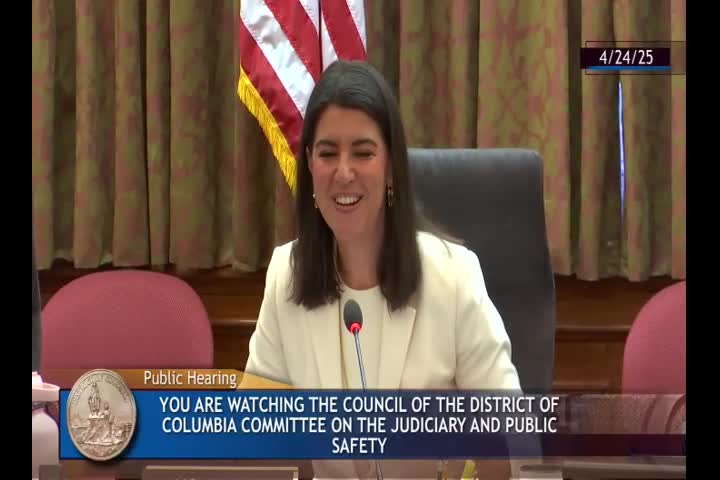
Council Member Brooke Pinto convened a two-day public hearing on April 24 for a package of public-safety bills; the session opened with a round of government witnesses on the Safe Passage Training and School Engagement Amendment Act of 2025 (B26-204).
Council Member Brooke Pinto convened a two-day public hearing on April 24 for a package of public-safety bills; the session opened with a round of government witnesses on the Safe Passage Training and School Engagement Amendment Act of 2025 (B26-204).
Deputy Mayor for Public Safety and Justice Lindsay Appiah told the committee she "offer[s] testimony in opposition, as written, to B26-204," arguing the executive branch needs flexibility to adapt training and service models based on changing local conditions. Appiah said her office already operates a managed Safe Passage program with standard operating procedures and a set of required trainings that are delivered to more than 200 ambassadors and four community-based grantees.
The deputy mayor outlined the program's current structure: one-week onboarding in August, CPR/first aid in September, de-escalation and community engagement in October, periodic refreshers during the school year and additional modules on recognizing child abuse, Narcan, self-care and resilience. "We have SOPs that are incorporated that actually list out what are the mandatory trainings," Appiah said, noting monthly principal meetings and daily reporting channels that link grantees, schools and Metropolitan Police Department staff.
Councilmember Brianne Nadeau, who sponsored a related bill on witness support, praised provisions in the Safe Passage proposal and argued for standardization across schools. Pinto, who chairs the committee, and several council members pressed Appiah about whether the program's roles and boundaries are clear to ambassadors and school staff. Appiah acknowledged variation among providers'"some of them are great at engaging young people" and some are not'and said her office has added youth-development training to address that.
Appiah emphasized the distinction between Safe Passage ambassadors and other roles: "They are not police officers, right? And they also aren't violence interrupters," she said, calling them "trusted eyes and ears" who canvass routes, redirect students, clear unsafe locations and report incidents to supervisors, schools and MPD. She described a daily incident-tracking process and ad-hoc, area-specific trainings when patterns emerge.
Committee members also asked about how Safe Passage interacts with other programs such as violence interrupters, School Connect, DCPS school safety teams and credible messengers. Appiah said the city is trying to build a continuum of supports and to avoid duplicative or conflicting deployments; she said the Safe Passage maps and priority-route approach were adopted after consultation with schools and MPD and are posted at safepassage.dc.gov. Appiah said the program is funded locally and by grants and that decisions about scale must account for limited resources.
Why it matters: Safe Passage workers are often the most consistent adult escorts for students commuting to and from school. The committee heard that standardizing training and ensuring clear school-site coordination are priorities for parents, principals and council members, but the deputy mayor argued statutory mandates could reduce program flexibility and adaptability. The committee left the record open for further follow-up questions about school coordination, neurodivergence training and route-level incident trends.
The committee moved next to the Case Closure and Witness Support bill and other proposals in the PEACEDC package. The record on B26-204 is open through the hearing process.