Get Full Government Meeting Transcripts, Videos, & Alerts Forever!
Get email alerts on the Community Development Funding topic
No spam. Unsubscribe anytime.
City housing & community office outlines recommended cuts; community groups urge restore funding
Summary
MOHCD presented recommended cuts to community development grant portfolios, and dozens of nonprofits and service users urged supervisors to restore funding for legal aid, gender‑based violence services, community building and youth programs.
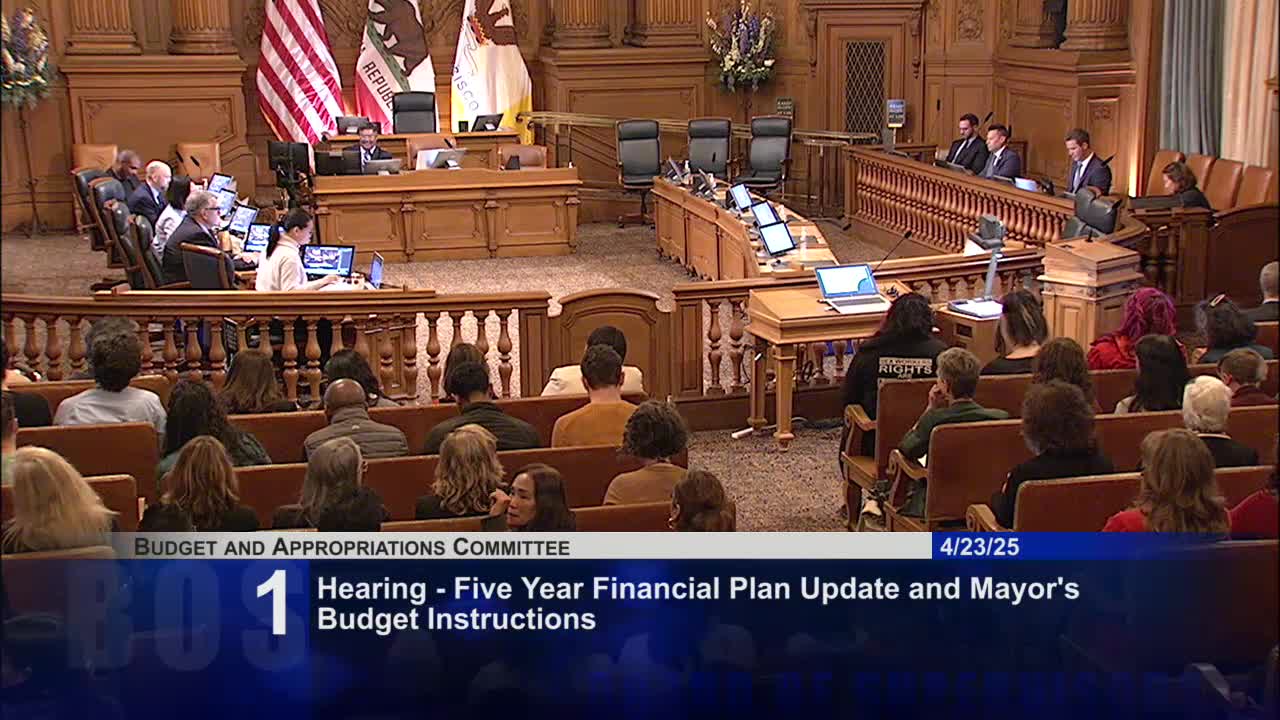
The Budget and Appropriations Committee held a hearing April 23 on the Mayor's Office of Housing and Community Development’s (MOHCD) proposed funding recommendations for community development programs across San Francisco.
Dan Adams, director of MOHCD, told the committee the office funds ‘‘essential services that promote housing stability’’ and that making cuts to community development grants had been painful. He said MOHCD had eliminated 11 positions and tried to move eligible programs to non‑general‑fund sources to reduce the impact of local reductions. Adams said the department had at one point faced an $11 million reduction and had managed to reduce the immediate impact to roughly $5 million through mitigation and one‑time funding sources.
Deputy Director Julia Sabore summarized the department’s grantmaking process, noting MOHCD runs a five‑year funding cycle and launched extensive community needs assessment and RFP work in 2023–24. Sabore told supervisors the department's recommendations were based on scored procurement results and a guiding framework that sought to preserve priority portfolios including eviction defense, immigrant legal services and gender‑based violence services.
Still, the recommendations prompted widespread public opposition. More than 80 public commenters—representatives of legal aid organizations, gender‑violence programs, community builders and clients—told supervisors the proposed cuts would harm low‑income residents, survivors of gender‑based violence, immigrants, LGBTQ people and youth.
Speakers and organizations cited specific impacts and dollar figures mentioned during the hearing and in appeals: the Cooperative Restraining Order Clinic (CROC) said elimination of certain restraining‑order funding would remove services for 341 individual survivors and their children; Deputy Director Sabore and MOHCD staff disputed some characterizations, saying procurement rules constrained pre‑decision outreach and that appeals procedures were available.
Open Door Legal and other legal providers warned that reductions to general civil legal services could increase homelessness and cost the city more in emergency services. Open Door Legal’s representative said the agency faced a $2.2 million cut and projected layoffs and fewer clients served if funding was cut as proposed.
Advocates for gender‑based violence survivors, youth services and community building detailed further impacts: Freedom Forward said its Hype Center faces an 85 percent reduction in MOHCD funding; other speakers described cuts that would reduce mobile outreach to sex workers, curtail restraining‑order representation and reduce financial‑capability and employment programs.
MOHCD officials said that restricted funding sources limit their ability to offset local general‑fund reductions, that some past increases were one‑time federal funds such as CARES Act allocations, and that they had limited ability to change recommendations once the procurement and scoring process was in progress. Sabore acknowledged communication and transparency concerns and said improving outreach on funding changes would be a priority.
After the testimony the committee voted to "hear and file" the item so the record reflects the presentations and public comment. Chair Connie Chan made the motion, which passed on roll call (tally recorded as five ayes). Committee members and MOHCD staff said they will continue engagement as the city finalizes budget proposals ahead of the June deadline.
The hearing record contains dozens of individual accounts and organizational briefs submitted during and after the RFP and appeals process; many groups asked supervisors to restore or prioritize funding during the board’s upcoming budget deliberations.