Get Full Government Meeting Transcripts, Videos, & Alerts Forever!
Get email alerts on the I35 Cap And Stitch topic
No spam. Unsubscribe anytime.
Joint Sustainability Committee urges equity review and cautions city on I‑35 'cap and stitch' investments
Summary
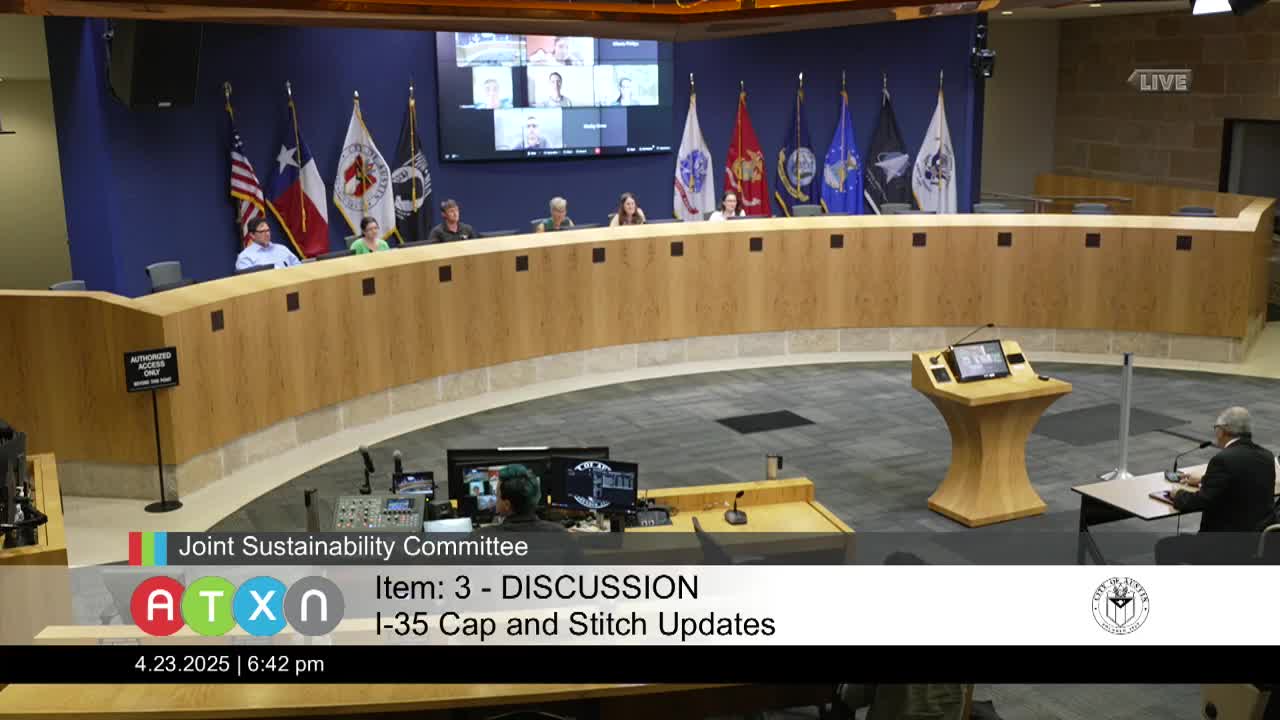
Transportation Public Works Director Richard Mendoza briefed the Joint Sustainability Committee on the city’s options for ‘cap and stitch’ betterments to TxDOT’s Central I‑35 Capital Express project and the committee adopted a resolution urging council to prioritize equity and carefully weigh trade‑offs before committing city funds.
Transportation Public Works Director Richard Mendoza briefed the Joint Sustainability Committee on the city’s options for ‘cap and stitch’ betterments to TxDOT’s Central I‑35 Capital Express project and the committee adopted a resolution urging council to prioritize equity and carefully weigh trade‑offs before committing city funds.
Mendoza described nine potential locations for caps (land bridges) in the Central I‑35 corridor between Ben White and U.S. 183. The central section was presented in three phases and, for planning purposes, city and TxDOT staff developed a 30% design and preliminary cost estimates. Mendoza said the baseline TxDOT project will put the interstate below grade and widen crossings with 30 feet behind the curb at each crossing; those baseline improvements would proceed whether or not the city builds caps. The city must decide by a TxDOT deadline in late May 2025 whether to “future proof” certain locations—committing to structural roadway elements in TxDOT’s contract so decks can be added without expensive change orders later.
Mendoza described project phasing and costs at 30% design: the city already paid $15 million to TxDOT for the 30% design work; TxDOT approved a $41 million State Infrastructure Bank loan that the city may draw on; and the project won a U.S. Department of Transportation Neighborhood Access and Equity (NAE) grant of $105 million for the Cesar Chavez‑to‑Fourth Street cap that would require a $45 million city match. Mendoza said the USDOT grant is temporarily paused pending a federal review of prior IIJA‑era grant awards; if the city delays adding decks beyond TxDOT’s letting schedule, Mendoza said change orders could increase costs by 35–45 percent.
Mendoza also explained the five phases used in the packet: phase 1 covers roadway and structural elements needed to support decks (ventilation, life‑safety, columns and retaining walls); phase 2 is placement of the deck/lid itself; phases 3–5 describe increasing levels of surface amenities (basic turf and trails up to buildings, plazas and programmed facilities). Mendoza said the eight downtown candidate locations together could create roughly 26 acres of new surface area, but the city would also assume ongoing operations and maintenance costs for those surfaces and amenities.
Tom Wald, executive director of the Red Line Parkway Initiative, urged the committee to support caps as mitigation, connectivity and long‑term public‑realm opportunity. Several committee members responded with questions about air quality, health impacts, displacement, trade‑offs with other capital needs, how pedestrian crosswalks would function adjacent to frontage roads, and which funding tools (GEO bonds, certificates of obligation, SIB loans, philanthropic or federal funds) would be used.
After discussion, the Joint Sustainability Committee voted to adopt a resolution that urges City Council to carefully consider environmental, financial and public‑health impacts of the proposed I‑35 cap and stitch projects; to weigh those impacts against alternative investments that could advance climate goals and community priorities (for example, land acquisition, active and public transportation, expanded tree canopy and green space, building energy efficiency, and increased access to clean air and water); and to prioritize areas historically impacted by displacement and disinvestment (including the Eleventh and Twelfth Street area) if caps move forward. The resolution further states that if the project cannot advance equity, repair past harms and align with the Austin Climate Equity Plan, the committee does not believe it should proceed unless external funding can be secured.
The committee approved the resolution by roll call: 11 votes in favor, 1 opposed and 1 abstention.
Ending: Staff reminded the committee that TxDOT needs a funding/commitment decision on structural provisions by a late‑May design/letting deadline and that the USDOT grant decision remained paused; committee members asked staff to bring additional analyses on displacement risk, long‑term maintenance liabilities and environmental health trade‑offs before council action.