Get Full Government Meeting Transcripts, Videos, & Alerts Forever!
Get email alerts on the Human Trafficking topic
No spam. Unsubscribe anytime.
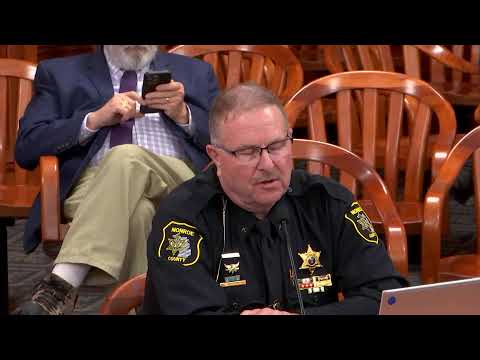
Monroe County sheriff tells Michigan House panel human trafficking exists locally, outlines VIPER task force
Summary
Sheriff Troy Goodenough told the Michigan House Oversight Committee on Homeland Security and Foreign Influence that human trafficking — including labor and child-exploitation cases — occurs in Michigan. He described the Monroe County VIPER task forceand urged lawmakers to consider more victim shelters and resources for law enforcement.
Sheriff Troy Goodenough of Monroe County told the House Oversight Committee on Homeland Security and Foreign Influence that human trafficking occurs in Michigan and described his office—s VIPER task force, which focuses on violent internet predators and exploitation.
VIPER, the Violent Internet Predator and Exploitation Response Task Force, has investigated 55 cases he said; 10 were investigated as human trafficking and 45 involved child exploitation or child solicitation, and the sheriff said one trafficking case had been charged in court. Goodenough said the task force partners with local and federal agencies for operations and uses electronic-device investigations to locate suspected offenders.
The sheriff cited both sex and labor trafficking in southeast Michigan, including recent raids on storefront spas where investigators found three women living at a site and seized more than $30,000 in cash. He described labor exploitation tied to seasonal farm work and said some employers follow H-2A rules while others use cheaper, exploitative labor practices.
"It's there. It's there," Goodenough said, describing the presence of trafficking in communities that may not see it. He added, "I pulled our detectives in and I said, this is what I wanna do. I wanna launch this human trafficking task force," describing the creation of VIPER in 2021 and its ongoing work.
Goodenough told lawmakers that a major barrier to prosecution is victim cooperation: victims often return to their traffickers multiple times and can be reluctant to testify, which complicates building cases that rely on victim testimony. He urged a victim-centered response and said victims frequently lack identification, personal belongings, phone access and housing.
Committee members asked about the distinction between human smuggling and human trafficking; Goodenough said smuggling is typically a one-time facilitation of illegal entry, while trafficking involves maintained control through force, fraud or coercion to generate ongoing revenue. He also described technology—s role in recruitment and stated that investigators can engage hundreds of online contacts within hours during undercover operations.
Lawmakers and the sheriff discussed possible state-level responses. Goodenough repeatedly urged additional shelters or dedicated facilities for trafficking victims so they cannot easily return to traffickers, and said more investment in behavioral health and substance abuse treatment produces measurable returns. He said Monroe County—s jail mental-health programming reduced recidivism among people with serious mental illness by about 37 percent and that the office deploys naloxone (Narcan) and other harm-reduction measures.
Goodenough also discussed the county—s relationship with federal immigration enforcement. He said Monroe County holds ICE detainees under an existing intergovernmental services agreement but declined to enroll in the 287(g) expansion proposed by ICE because it would require the county to fund positions and reassign deputies at significant cost.
The committee recorded no legislative action beyond routine business during the hearing. Representative Conlon moved to approve minutes from the April 16 meeting at the start of the session; hearing no objections, the committee approved the minutes by unanimous consent.
The committee thanked Goodenough and said it would consider recommendations and potential legislation to give law enforcement more tools and to expand victim services. The hearing concluded with a pledge to continue exploring policy options and resources related to trafficking, exploitation and related drug and mental-health issues.