Get Full Government Meeting Transcripts, Videos, & Alerts Forever!
Get email alerts on the Nurse Licensure Compact topic
No spam. Unsubscribe anytime.
Committee hears competing testimony on bill to join Nurse Licensure Compact
Summary
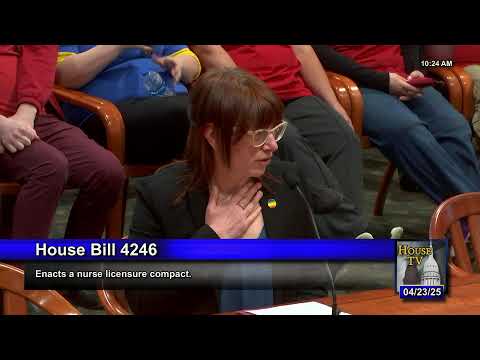
The House Health Policy Committee took testimony on House Bill 4246, which would let Michigan join the Nurse Licensure Compact; witnesses gave extensive pro and con statements on workforce, telehealth and state oversight.
The House Health Policy Committee heard more than two hours of testimony on House Bill 4246, sponsored by Representative Phil Green, a proposal to allow Michigan to join the Nurse Licensure Compact (NLC).
Representative Green introduced the bill and described personal and practical reasons for supporting it, saying the state’s licensure “wall” restricts nurses’ mobility and limits telehealth and cross‑border staffing. “The wall of licensure built around the state … does not serve our residents in the 21st century,” Green said, describing difficulties his wife faced moving nursing licensure across states.
Proponents told the committee the compact would ease recruitment, support telehealth and reduce regulatory barriers. Amy Brown, chief nursing officer for the Michigan Health & Hospital Association, told the committee that as of spring 2025 “hospitals in Michigan had more than 4,900 openings for nurses,” and said joining the compact—already adopted by about 41 states and two territories—would help attract nurses and coordinate care in border communities. Leigh Small, dean of the College of Nursing at Michigan State University and representing the Michigan Association of Colleges of Nursing, said the compact would reduce burdens on nurse educators and ease clinical placements for students. Bethany Campbell Skillen, president‑elect of ANA Michigan, also testified in support, saying the compact “puts patient care, workforce support, and public safety first.”
Opponents—many of them practicing Michigan nurses and union representatives—told the committee the compact would weaken state oversight and could lower care standards. Aaron McCormick, a registered nurse and vice president of the University of Michigan Professional Nurses Council, said Michigan’s current requirements include 27 contact hours of continuing education every two years and mandatory topics such as pain management and implicit bias; he said some compact states have no continuing education requirement. Katie Pontifex of the Michigan Nurses Association said the NLC would “force Michigan to recognize out of state licenses without the ability to independently verify a nurse's education or up to date disciplinary history,” and warned that the compact could make Michigan “under‑represented” on the interstate commission that sets compact rules.
Several speakers cited Operation Nightingale, a federal investigation the witnesses described as uncovering thousands of fraudulent nursing diplomas and transcripts. Katie Pontifex and others told the committee that fraudulent credentials reached multiple states and argued that retaining state‑level oversight was necessary to detect and discipline problematic cases quickly.
Witnesses on both sides addressed workforce impacts and rural care. Supporters, including Patrick Miller of Northstar Care Community (Hospice of Michigan), said compact membership could help recruit out‑of‑state nurses for hard‑to‑fill positions and support hospice and home‑based care. Opponents said the compact can shift nurses toward higher‑paying urban or travel assignments and harm continuity of care in underserved areas.
Committee members asked about continuing education, interstate differences in practice standards, telehealth and the compact’s governance. Supporters said licensees must still follow the practice laws of the state where the patient is located; opponents countered that the compact delegates significant rule‑making authority to an interstate commission and that Michigan could be required to accept rules without broad state amendment authority.
No formal committee vote on House Bill 4246 was recorded in the provided transcript. Committee members indicated they would continue hearings and said several people who could not speak that day would be invited back for subsequent testimony.