Get Full Government Meeting Transcripts, Videos, & Alerts Forever!
Get email alerts on the Reparations Genealogy topic
No spam. Unsubscribe anytime.
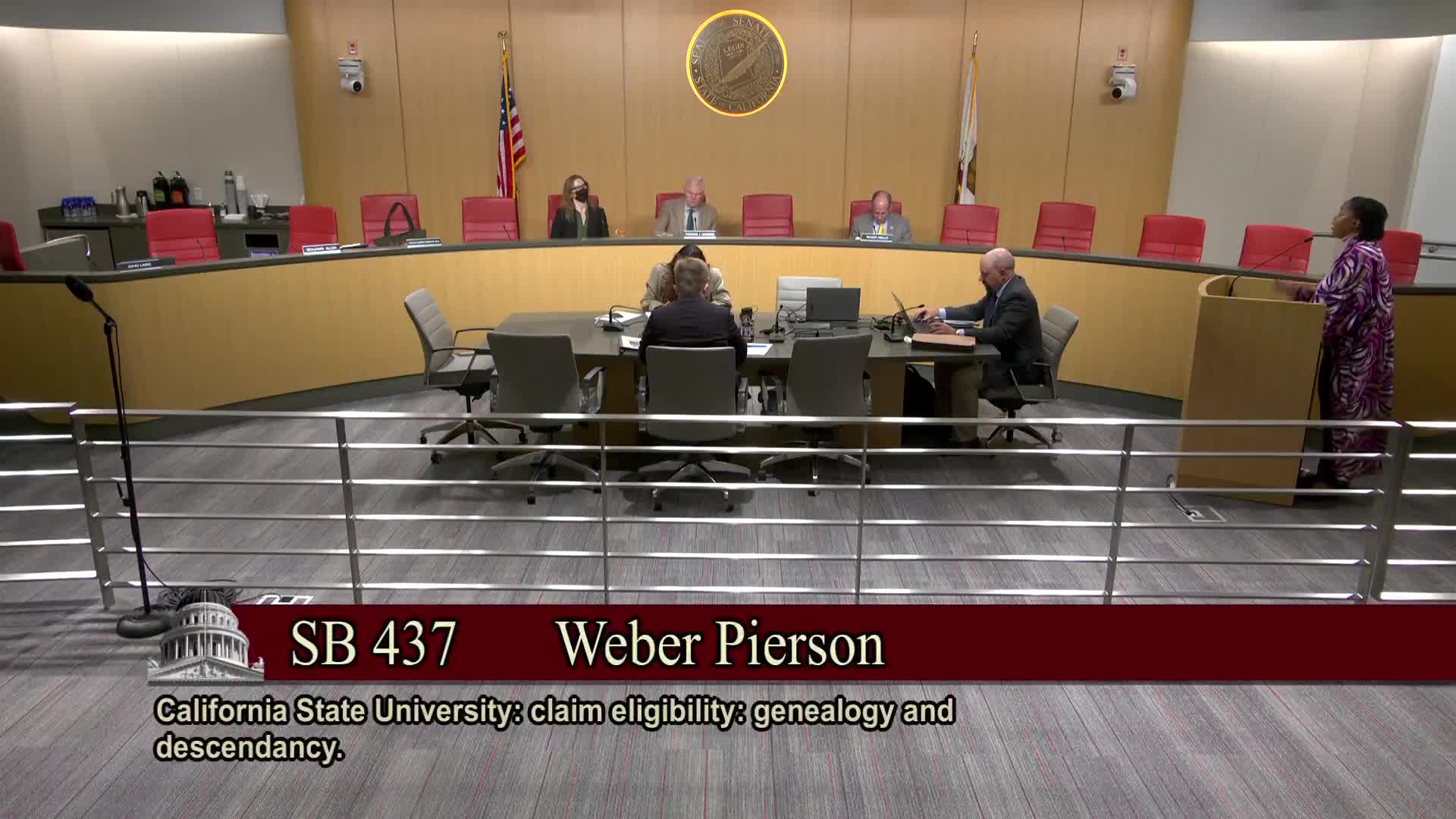
Senate hears SB 437 asking CSU to develop methods to verify lineage for descendants of enslaved people; genealogists and community groups divided
Summary
SB 437 would ask the California State University to design an evidence-based method to verify whether Californians are descendants of people enslaved in the U.S.; the hearing produced sharply divided testimony.
Senate Judiciary heard SB 437, authored by Senator Weber Pearson, a bill that would direct the California State University (CSU) system to begin developing a methodology to confirm genealogical descent from persons enslaved in the United States.
The author and supporters said the task requires professional, public oversight and that placing methodology development in a state institution protects sensitive data from exploitation by private companies. Weber Pearson said placing the work in CSU "ensures expertise, integrity, accountability, and public oversight" and prevents "data from being exploited for profit or misinformation." She cited concerns over private genetic-data handling by commercial firms.
Proponents included genealogists and community organizations. Professional genealogist Rachel Shaw told the committee that rigorous standards exist: "The most effective genealogical research conforms to the board for certification of genealogists' genealogy standards...African American genealogy is considered a specialty research area because of the complications related to slavery." She urged that Afro-American Historical and Genealogical Society expertise be included.
But the bill drew strong opposition from reparations advocates and some genealogists who said the task force already recommended a public implementation pathway and that professional genealogists already apply established standards. Michael Willis, a genealogist, said "There is no difficulty in tracing individuals born prior to 1900 and confirming descendants" and opposed creating a duplicative, multi‑million‑dollar state research program. Community groups argued the measure would divert funds away from reparations implementation and jeopardize privacy if not tightly constrained.
Senator Weber Pearson said SB 437 does not conflict with her related SB 518 and argued CSU reporting would provide public accountability: "For a process as important as determining lineage, the frequency of reporting is necessary to ensure that we have an open and public process and that everyone is held accountable." She said the work would begin with the 2026–27 academic year and include annual reports to the Legislative Black Caucus.
The committee heard multiple speakers both for and against; no vote was taken. Debate centers on whether a public research effort is necessary or whether existing genealogical practice and task-force recommendations make a CSU-led methodology redundant and possibly harmful to implementation and privacy.