Get Full Government Meeting Transcripts, Videos, & Alerts Forever!
Get email alerts on the Accessibility Law topic
No spam. Unsubscribe anytime.
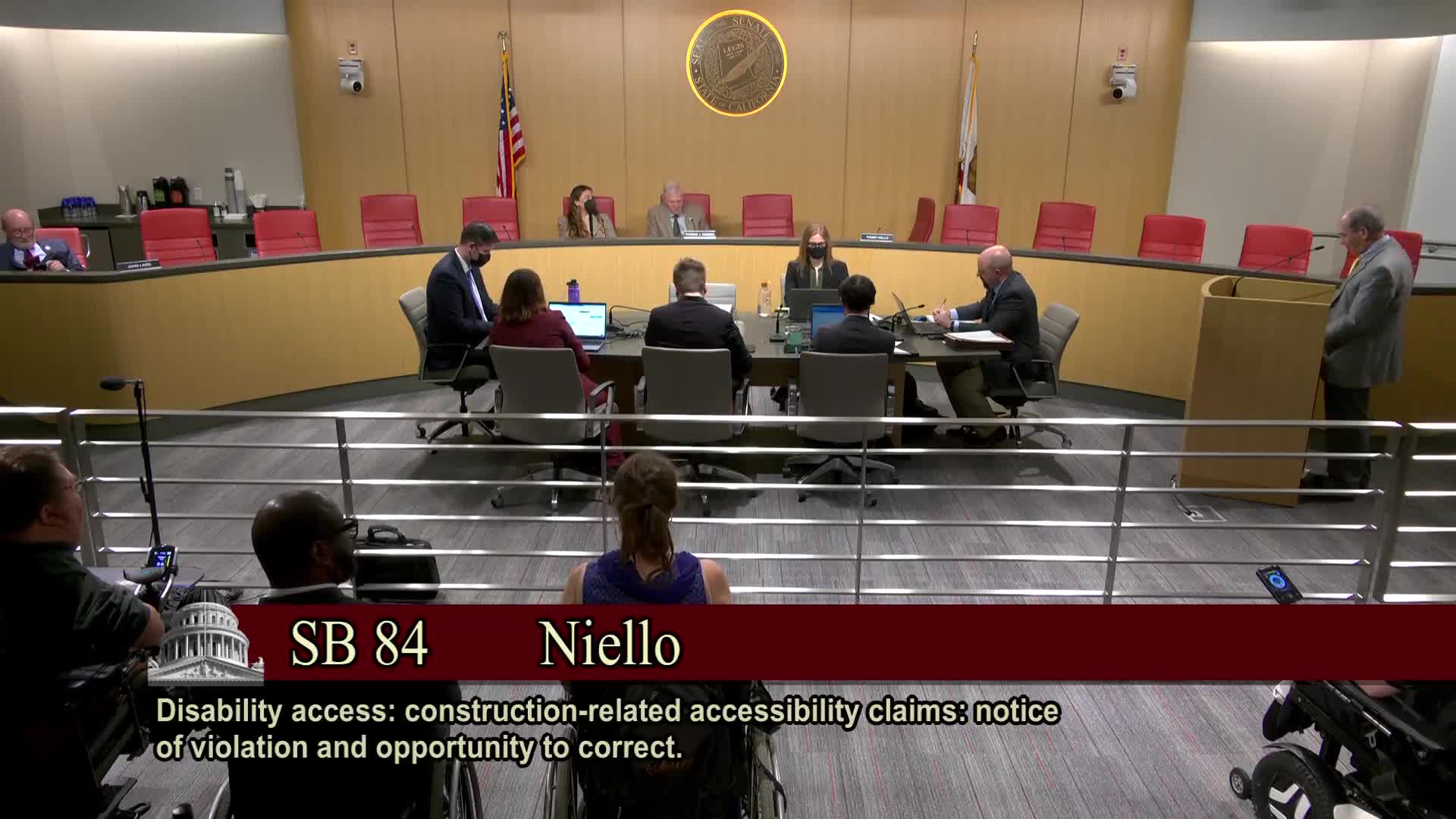
Senate panel hears SB 84 to give businesses 120 days to fix construction-related ADA violations before lawsuits proceed
Summary
Supporters told the Senate Judiciary subcommittee SB 84 would allow businesses a 120-day "right to cure" for construction-related disability-access violations and reduce opportunistic litigation; disability-rights groups warned the delay could prolong barriers to access and reduce incentives to comply.
Senate Judiciary subcommittee Chair Patrick Umberg and members heard testimony on SB 84, a bill presented by Senator Phil Niello that would let entities fix construction-related disability access violations within 120 days of receiving notice before lawsuits advance.
Supporters said the bill would curb a wave of what they called opportunistic litigation and give small businesses time to correct defects. "This bill would grant entities the ability to fix a construction related violation within 120 days of being served with a notice before a lawsuit moves forward," Senator Niello said during his presentation.
Proponents, including small-business owners and business associations, described repeated suits filed by a small number of serial litigants and lawyers. Dore Herrera, owner of Yuka's Restaurants in Los Angeles, said a suit she received during the pandemic claimed "Our table was onesixteen of an inch too low," and that settlements often "simply lined a lawyer's pocket." Another restaurateur, Britney Vaez of Gorilla Tacos and Go Go's Tacos, said she settled an early case for $11,000 after a photograph of a box left on a ramp led to a lawsuit and later closed a restaurant after repeated suits.
Business groups on the record in support included the California Chamber of Commerce (Robert Mucci), the National Federation of Independent Business (Tim Taylor), the California Restaurant Association (Martin Lundar) and multiple local restaurant and retail associations.
Disability-rights organizations strongly opposed the proposal. Russell Dawson Rawlings of the California Foundation for Independent Living Centers testified: "The problems with, SB 84 is that they create that additional hurdle, the hundred and 20 day period, where no access can actually be created." Eric Harris of Disability Rights California said SB 84 "does nothing to stop" unethical litigation practices and that access standards are not arbitrary: "A ramp that is 1 inch off of compliance can make it so I fall out of my wheelchair and injure myself." He urged protecting existing tools such as CASP inspections (Certified Access Specialist Program), which he said already offer businesses a pathway to identify and remedy barriers.
Committee members pressed the author to work with opponents; Senators Laird and Allen urged negotiation on the length of the cure period. Senator Niello said he would continue talks and that he was open to modifying the 120-day window. At the close of the hearing, Niello said he "respectfully ask[ed] for an I vote" when the subcommittee takes the bill up for action at the appropriate time.
Why this matters: The bill attempts to balance two goals—reducing litigation that businesses say is predatory and ensuring that people with disabilities have timely physical access to public accommodations. Opponents say the 120-day delay could be a meaningful barrier to access and that existing remedies (including CASP inspections and court tools against frivolous suits) should be prioritized.