Get Full Government Meeting Transcripts, Videos, & Alerts Forever!
Get email alerts on the Community Violence Intervention topic
No spam. Unsubscribe anytime.
DeKalb County presentation maps violence 'hot spots,' eyes Office of Violence Prevention after federal planning grant
Summary
Acting Chair Commissioner Ted Terry convened DeKalb County's PECS Committee for an update on a $1.5 million DOJ planning grant that mapped violence hot spots, estimated a program ROI and set a path toward a county Office of Violence Prevention.
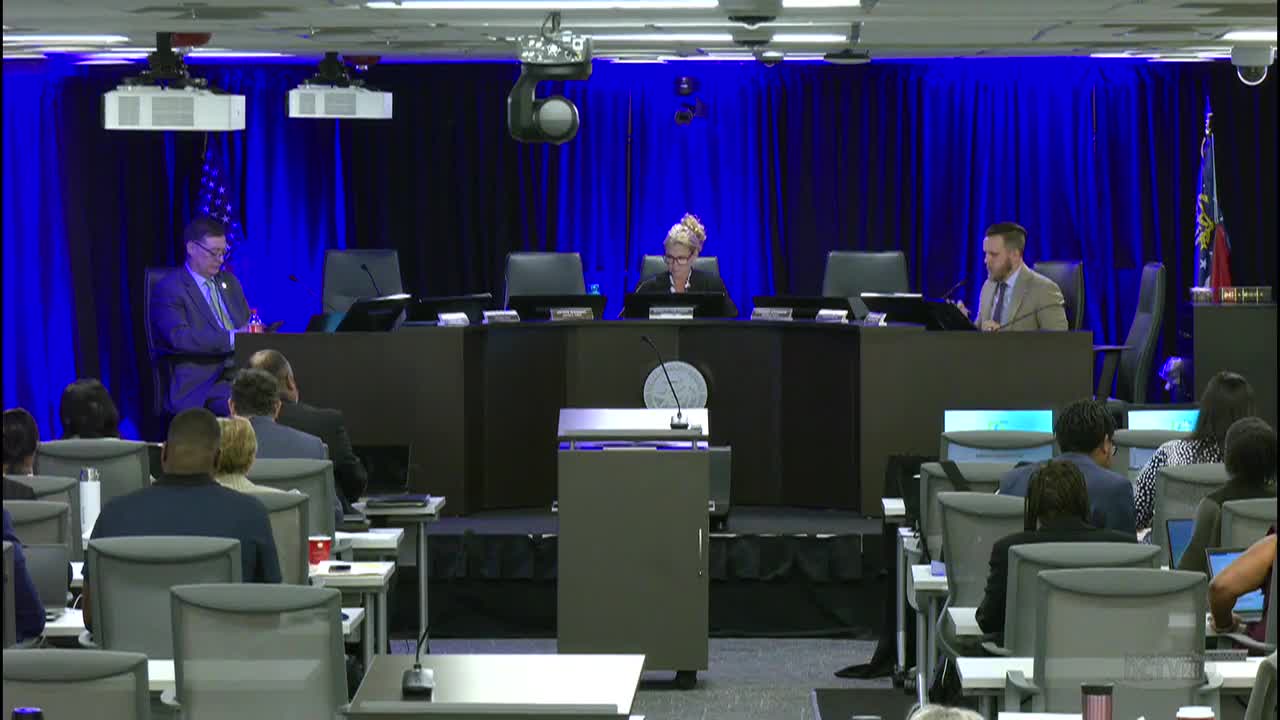
Acting Chair Commissioner Ted Terry convened DeKalb County's Planning, Economic Development and Community Services Committee (PECS) to hear an update on the county's Community Violence Intervention Plan (CVIP), a three-year federal planning grant funded by the U.S. Department of Justice's Bureau of Justice Assistance (BJA).
The county's human services team, led by Director Damon Scott, and partners from Cure Violence Global presented the community readiness assessment, geographic heat maps of gun violence "hot spots," an estimated return-on-investment model and the next steps: an asset-mapping phase and continued pilot work aimed at developing a permanent Office of Violence Prevention (OVP).
Why it matters: The presentation laid out a data-driven case for targeting services and prevention strategies in discrete neighborhoods and for sustaining a county-level coordinating office. Presenters said the planning grant's funding and partnerships let DeKalb test interventions and assemble cross-sector partners (hospitals, schools, law enforcement, public health) ahead of any recommendation about ongoing local funding.
What the county presented
- Grant and scope: Deborah Furtado of DeKalb County Human Services described the grant as a three-year planning award received in 2022 and cited the grant amount: "$1,500,000" for planning and related activities. She said the work follows a public-health approach and that the team is moving into an "asset mapping" phase to catalog strengths and gaps within target neighborhoods.
- Assessment approach: Keyonus "Q" Cornel, regional associate director for national programs at Cure Violence Global, said the assessment combined in-person community meetings (residents, business owners, community centers, barbershops), stakeholder interviews and data analysis to test local readiness and adapt Cure Violence's model to DeKalb. Cornel said the model is standardized but "it really does take that community visit to really figure out how to fine tune it to make it right for you all's community."
- Hot-spot identification and data: Dr. Charles Elliott, director of data management at Cure Violence Global, described heat maps of nonfatal shootings and homicides across several years and said the team identified distinct target areas (catchment zones) sized to match recommended staffing and outreach coverage. He said the mapping used available boundaries (census tracts where possible) and that a forthcoming needs assessment will give exact population counts for each catchment.
- Cost and ROI modeling: Dr. Elliott presented a cost model drawing on national costing research (costofviolence.org / National Institute for Criminal Justice Reform) and said the team used a 20% expected reduction in shootings and homicides over two years for each target area to estimate a program-level return on investment. "We have a 20% expected change or reduction over the course of 2 years for each part of the program," he said, and the combined ROI figure on the slide was presented as roughly $150 million in avoided costs under the modeling assumptions.
- Pilots and partnerships: County staff and partners described an ongoing pilot that deployed services in hot-spot areas over six months and said the pilot showed promise; presenters said full pilot results will be presented to commissioners at a later meeting. The team described an existing hospital violence-intervention partnership at Grady, work with local organizations including Hope Hustlers, and a $50,000 NACCHO award to support youth violence prevention in two high schools (Redan and McNair).
Questions and follow-up requested from commissioners
Commissioners pressed for more localized, DeKalb-specific numbers and for details on implementation and sustainability. Commissioner Michelle Long Spears asked, "How many folks do you serve, who live in the hot spot areas?" and was told population counts will be part of phase 4 (the needs/asset mapping) and are "to be determined" while Emory University and county staff finalize the analysis.
Commissioner Long Spears and others asked for additional details the team committed to provide in follow-up materials: exact catchment population counts; overlays of extended-stay hotels and problem apartment complexes; school-cluster impacts (the county is already mapping where students live relative to hot spots); and other neighborhood features such as sidewalks and tree canopy to be added to hot-spot profiles.
Presenters and staff also discussed potential funding paths for a permanent OVP. The Cure Violence team pointed to other jurisdictions where neighborhood-level programs have coincided with measurable reductions, but they acknowledged that national and local crime trends (including shifts during and after the COVID-19 period) vary by neighborhood and must be controlled for in impact analysis.
Voices from the meeting
- Deborah Furtado, CBIP team (DeKalb County Human Services): explained the grant trajectory and said the asset-mapping phase will identify both strengths (service providers, community anchors) and gaps (food access, other social determinants).
- Keyonus "Q" Cornel, regional associate director for national programs, Cure Violence Global: described the assessment process and community outreach; he also shared a personal anecdote about why community-based prevention matters, describing a pre-CVI law-enforcement experience that led him to leave policing to support CVI work.
- Dr. Charles Elliott, director of data management, Cure Violence Global: walked commissioners through heat maps, hotspot boundaries and the ROI modeling assumptions.
Next steps
Presenters said they will complete asset mapping and provide detailed needs-assessment numbers for each catchment area; return with complete pilot results (staff suggested a future PECS date for a pilot presentation); and draft a final planning report the county can use to recommend whether and how to fund a permanent Office of Violence Prevention.
Votes at a glance (committee-level motions and outcomes during the same meeting)
- Item 0564 (meeting minutes for April): Motion to approve moved by Commissioner Michelle Long Spears; seconded by Commissioner Ted Terry. Vote: unanimous; motion carries.
- Item (authorization to increase fee deposit schedule, 0500): Motion to defer for two weeks. Outcome: deferred (motion carried).
- Item 0485 (resolution expressing support for DeKalb County's immigrant communities): Motion to recommend approval out of committee moved by Commissioner Michelle Long Spears; seconded by Commissioner Ted Terry. Vote: unanimous; motion carries.
- Item 0521 (resolution supporting specific recommendations in the DeKalb racial equity study): Commissioner recused from this item; committee held the item in committee (no action taken in committee).
- Item 0815 (zoning minimum unit size amendment discussion): Committee discussed the proposed revision and then voted to defer further action for two weeks to allow staff analysis and a focused dataset on infill/substandard lots.
- Item 1137 (one-time allocation, reproductive care funding): Motion to defer to the June/July mid-year budget process; outcome: deferred to the second meeting in May for committee discussion (administration to provide funding-source guidance).
What was not decided
Presenters did not request any immediate county appropriation for a permanent office; they recommended finishing the planning deliverables, completing the pilot report, finishing asset mapping and then returning to the board with a recommended plan and budget. Commissioners asked staff and the presenters for additional DeKalb-specific data before any funding or structural recommendation.
Ending
County staff and Cure Violence Global emphasized that the next substantive deliverables will be the asset-mapping phase (to show populations and services inside each catchment), the pilot results (to be presented at a future PECS date) and the final readiness report that will inform whether DeKalb moves forward with a funded Office of Violence Prevention. Commissioners asked for more DeKalb-specific overlays (schools, extended-stay hotels, known problem apartment complexes) and for the pilot report before deciding on new sustained county funding.