Get Full Government Meeting Transcripts, Videos, & Alerts Forever!
Get email alerts on the Housing topic
No spam. Unsubscribe anytime.
Pittsburg commission approves $405,000 loan and sales-tax exemption request for Villas at Wellington Springs senior housing
Summary
The commission approved a $405,000 loan at 1% interest to MBL Development to support the Villas at Wellington Springs senior housing project and authorized consideration of industrial revenue bonds; the loan and sales-tax exemption are intended to strengthen the project's housing tax-credit application.
The Pittsburg City Commission on April 22 approved a recommendation from the Economic Development Advisory Committee to provide a repayable loan of $405,000 at 1% interest to MBL Development for the Villas at Wellington Springs, a proposed senior independent‑living complex on Bradshaw Way. The commission also approved a resolution determining the advisability of issuing industrial revenue bonds related to commercial/residential facility financing (Resolution 1293).
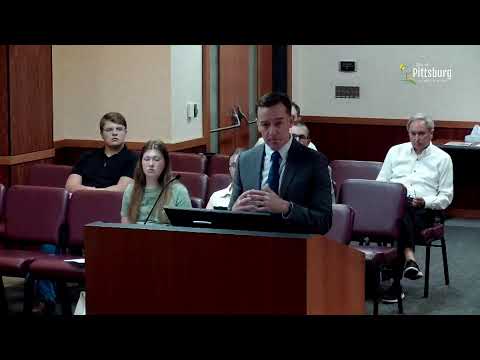
MBL representative Kim Lingle described the project as a two‑phase development; each phase would include 40 independent‑living units, two community buildings (one per phase) with a full kitchen and a 700‑square‑foot concrete “safe house” tornado shelter. Lingle said the overall project is a roughly $24,000,000 development and that phase 1 would include approximately 40 units, with a mix of market‑rate and units targeted at 60% of area median income.
Why it matters: City staff and MBL framed the package—loan plus a sales‑tax exemption on construction materials—as a mechanism to increase the project’s competitiveness for state and federal housing credits administered by the Kansas Housing Resources Corporation (KHRC). The sales‑tax exemption component was described by staff as a scoring element in KHRC applications.
Funding and terms discussed: The approved loan is structured to be amortized over 20 years with a 7‑year term; staff said the loan would be disbursed at the start of construction and that the developer expects to repay earlier if financing milestones are met. Lingle said the developer has applied for federal and state low‑income housing tax credits and indicated they would reapply if necessary. When asked about rents and affordability, Lingle estimated unit rents would be “under a thousand dollars,” in the range of $800 to $900, depending on interest‑rate and financing outcomes.
Commissioners questioned whether the KHRC application would directly compete with other local applicants; Lingle said the project is applying in a rural‑housing category and would not directly compete with another nearby applicant referenced by a commissioner.
Votes and procedure: The commission moved and approved the loan and the sales‑tax exemption request by voice vote. The loan was described in the staff recommendation as a 1% interest loan, amortized over 20 years with a seven‑year term; the commission’s approval included authorization to proceed with the sales‑tax exemption paperwork as requested by the developer. The commission later approved Resolution 1293 determining the advisability of issuing industrial revenue bonds; staff explained IRBs are a financing tool and do not place taxpayer debt obligation on the city.
The developer and staff said the project would include supportive services, transportation options and on‑site amenities; the proposal noted that about half of independent residents typically do not own a car, so carports (rather than garages) and transportation were factored into site design. The project’s final timing and completion are contingent on tax‑credit awards, financing and construction scheduling.