Get Full Government Meeting Transcripts, Videos, & Alerts Forever!
Get email alerts on the Public Transit topic
No spam. Unsubscribe anytime.
LexTran outlines clean-fuel fleet progress, service gaps and microtransit feasibility
Summary
LexTran General Manager Fred Combs told the committee that the agency has increased CNG capacity, added vehicles and is studying microtransit, a downtown circulator and bus rapid transit while continuing service improvements and paratransit reforms.
Fred Combs, general manager of LexTran, told the Environmental Quality and Public Works Committee on April 22 that the agency has advanced clean-fuel vehicle purchases, doubled CNG fueling capacity and is pursuing technology and planning efforts to improve service and reduce emissions.
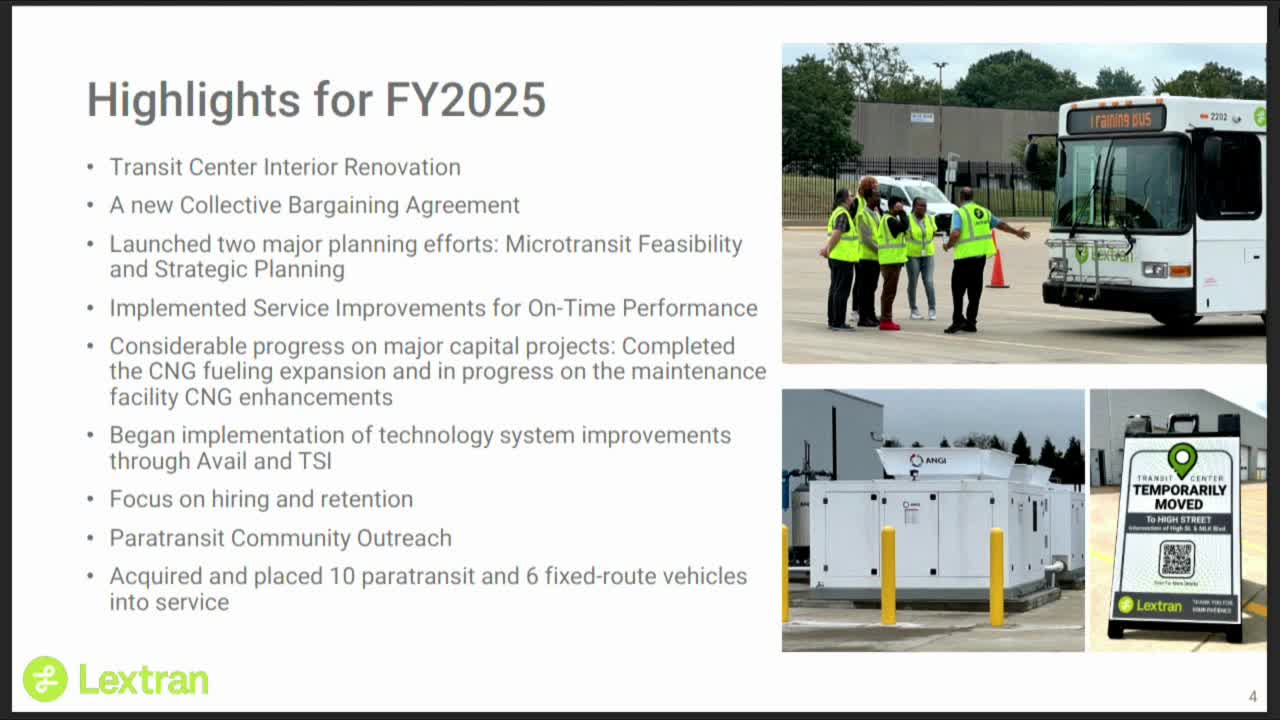
Combs said LexTran now runs about half of its fixed-route fleet on compressed natural gas (CNG), has installed solar lighting at select bus stops and has expanded CNG fueling and CNG maintenance capacity. He said the agency placed 10 new paratransit vehicles into service this year and acquired six fixed-route CNG buses; 10 additional fixed-route buses are on order (six CNG and four electric), and a capital plan includes 10 paratransit cutaway vehicles.
On service, Combs said LexTran operates 25 fixed routes 365 days a year between roughly 5:30 a.m. and 12:30 a.m. He said about 54% of Fayette County households are within a quarter-mile of a bus stop, and about 80% of households fall within a half-mile. Combs described frequency as the agency’s biggest remaining challenge: most core arterial routes run on 35-minute headways during peak times and 70-minute headways at night and on weekends; Nicholasville Road is the agency’s most frequent corridor at about 15–20 minutes.
Combs outlined planning work on three initiatives: a downtown circulator (a trolley-like loop for core destinations, with capital funds identified but operating funds still needed), a microtransit feasibility study (on-demand, zone-based service to address first/last-mile and transit deserts) and longer-term bus rapid transit (BRT) planning along Nicholasville Road. On microtransit, staff said the feasibility study is near completion and recommended starting small with a pilot zone. In the Q&A, Combs estimated that an external pilot for a single zone could cost in the mid-hundreds of thousands of dollars per year and that a pilot should ideally run two to three years to provide robust results.
Combs described operational improvements underway: a transit center interior renovation, computer-automated dispatch and vehicle-location systems, new in-vehicle displays, operator hiring and retention efforts, and plans for an operator barrier installation to improve safety. He noted that moving riders from cars to transit is the largest environmental gain and cited last year’s figure of more than 11 million passenger miles traveled as central to reducing vehicle-miles traveled.
On paratransit, Combs said the agency has been addressing complaints by upgrading vehicles (cutaway buses with larger capacity) and improving outreach, scheduling and contractor coordination; he told committee members the agency has seen improvements but work continues. Committee members asked about fares for a potential downtown circulator (Combs said it would likely be the standard $1 fare), pilot timelines (he said the microtransit study should wrap within a month) and vehicle-technology tradeoffs for CNG, battery-electric and hydrogen fuels. Combs said battery-electric vehicles now perform better than earlier pilots and that CNG remains an appropriate choice for long-service schedules, while hydrogen is emerging industry-wide but not currently planned for LexTran.
Council members also raised practical concerns about the transit-center renovation and temporary passenger accommodations; Combs said staff are evaluating options such as temporary shelters and distribution of ponchos/umbrellas with city coordination. Combs said the agency will present budget details at an early-May work session and is seeking funding partners for operating components of new services.
Ending: Combs asked the committee for continued engagement as planning studies conclude and budget requests are finalized; staff will return in May with budget detail and follow-up on the microtransit study.