Get Full Government Meeting Transcripts, Videos, & Alerts Forever!
Get email alerts on the Housing topic
No spam. Unsubscribe anytime.
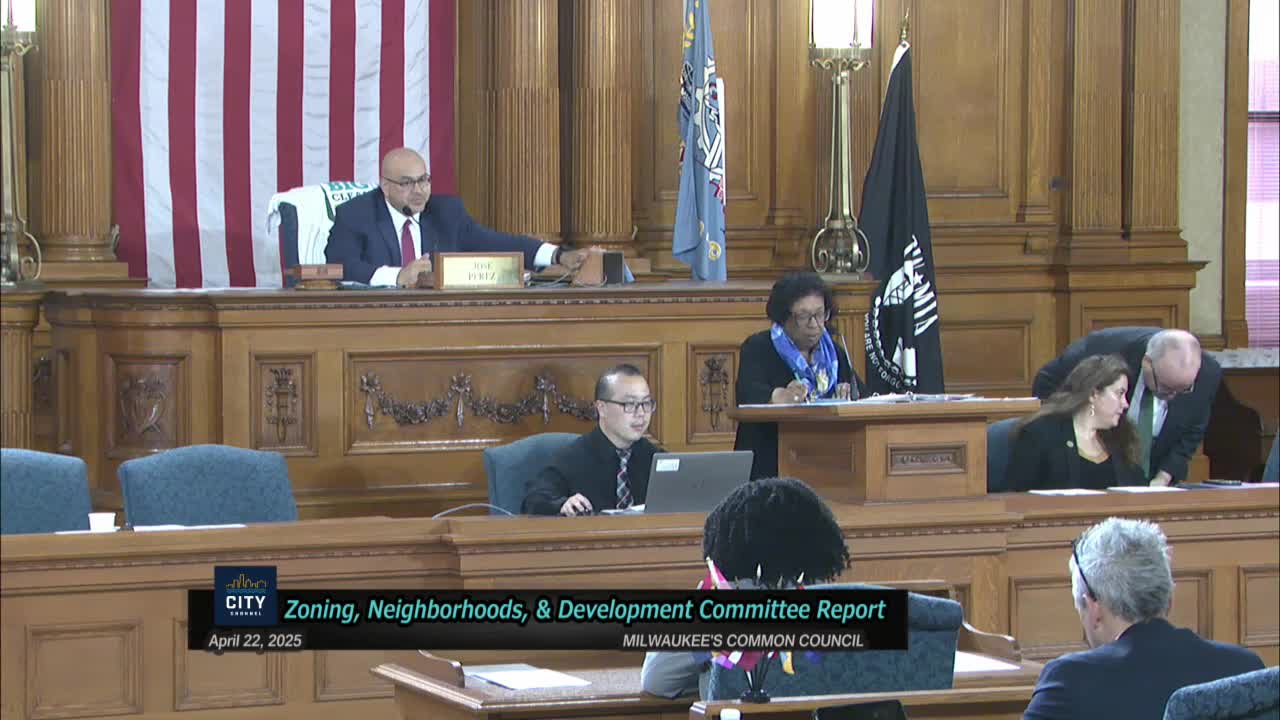
Council sends accessory-dwelling ordinance back to committee after heated debate
Summary
Milwaukee Common Council debated a substitute ordinance to allow accessory dwelling units (ADUs) and voted 10-5 to send the file back to the Zoning, Neighborhoods and Development Committee after members raised concerns about internal/attached ADUs, conflicts with state building codes, and owner-occupancy safeguards.
The Milwaukee Common Council debated a proposed change to the city zoning code that would allow accessory dwelling units and voted 10-5 to send the item back to the Zoning, Neighborhoods and Development Committee for more work.
Alderman Robert Baumann, sponsor of the file addressing accessory dwelling units (ADUs), told the council the amendment sought to create a clear definition and a “limited use” pathway so qualifying ADUs could be permitted without additional hearings. “We have been discussing the issue of housing for a year, year and a half,” Baumann said, adding that zoning changes alone do not create housing but can provide tools the market can use when economics allow.
Council members who opposed the substitute raised three recurring concerns: allowing interior or attached ADUs in single-family zones could effectively change single-family lots into duplexes; converting existing multi-unit buildings could trigger state commercial building-code requirements (including sprinklers) that make conversions cost-prohibitive; and internal or attached ADUs could accelerate investor-owned rentals or short-term rentals in neighborhoods with large student or rental populations.
The substitute that Councilmembers debated removed internal and attached ADUs from the “limited use” category for parcels zoned single-family and added an owner-occupancy requirement at the time the building permit is applied for. Baumann said the changes aimed to avoid inadvertently converting duplexes into three-unit buildings and to reduce potential misuse by investors. He noted that converting duplexes into three-unit buildings “triggers the commercial building code,” which carries substantial added costs and therefore limited practical application.
Alderperson Jocasta Samaripa and Alderman Coggs were among those who objected to the late-hour substitute and asked for more time for public and technical review; Samaripa said she had discussed the file with Baumann the day before and was surprised by the substitute’s timing. “I just met with Alderman Baumann yesterday ... I expressly brought up this file ... and to not be given a heads up about this substitute, I find it highly disappointing,” Samaripa said.
Several council members said they supported the ADU concept in principle but wanted fuller evaluation of how the zoning changes would interact with state building codes and neighborhood impacts. Alderman Scott Spiker and others urged the council to send the substitute back so planners and building-code staff could answer technical questions before the ordinance moved forward.
On a motion to send the file back to committee, the council voted 10 in favor and 5 opposed. The clerk’s roll call during the referral recorded the outcome as 10 ayes and 5 nos; the file was returned to the Zoning, Neighborhoods and Development Committee for further consideration.
What the council debated
- Internal and attached ADUs: The substitute removed those forms from the “limited use” pathway on parcels zoned for single-family use, leaving detached ADUs as the limited-use option for single-family parcels. That change was made to avoid creating new multi-unit buildings that might trigger state commercial building requirements. - Owner-occupancy: The substitute includes an owner-occupancy requirement at the time the building permit is applied for; sponsors described that as the practical point the city could regulate to limit investor conversion of ADUs. - Enforcement and financing concerns: Sponsors said deed restrictions and other long-form owner-occupancy controls can be legally and practically difficult for banks and owners during financing or foreclosure, which influenced the approach.
Why it matters
Advocates and city officials have flagged ADUs as one tool—among many—to increase housing options without large-scale new construction. Opponents on the council and some neighborhood representatives worried that poorly designed rules could encourage absentee ownership, short-term rentals, or unregulated density increases in single-family neighborhoods. Council members said they want technical briefings on the intersection of the municipal zoning code and state building codes before approving new allowances.
Next steps
The file will return to the Zoning, Neighborhoods and Development Committee for additional review and public input. Committee staff, the Department of Neighborhood Services, and building-code officials are expected to answer questions about code triggers, permitting costs, financing implications, and potential enforcement measures.
Votes at a glance
- Motion to send ADU substitute back to committee: Outcome — passed (10 ayes, 5 nos).
Ending
Council members who supported sending the file back said the move gives staff time to produce clearer guidance on building-code impacts and enforcement options; members who wanted immediate action said they fear delaying zoning changes will slow a potential tool for adding housing supply. The committee will schedule follow-up briefings and hearings before any ordinance returns to the full council.