Get Full Government Meeting Transcripts, Videos, & Alerts Forever!
Get email alerts on the Higher Education topic
No spam. Unsubscribe anytime.
House committee adopts DE1 for higher education omnibus bill, shifts funding and policy for state grants and student supports
Summary
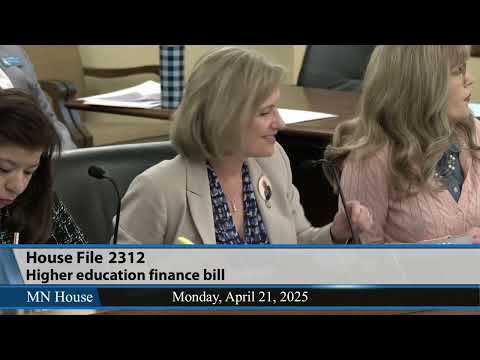
The House Higher Education Finance and Policy Committee on April 17 adopted the DE1 amendment to House File 2312 and voted to re‑refer the amended bill to the House Ways and Means Committee after a voice vote.
The House Higher Education Finance and Policy Committee on April 17 adopted the DE1 amendment to House File 2312 and voted to re‑refer the amended bill to the House Ways and Means Committee after a voice vote.
The package, described by nonpartisan staff as a mix of finance and policy changes, moves money among higher education programs, adjusts how the state calculates some student aid awards and changes the structure of several competitive grants and transfers. Committee members and dozens of public testifiers discussed the bill’s effect on state grant awards, foster‑youth higher‑education supports, medical training in Greater Minnesota and university research funding.
Ken Savory of the House Fiscal Analysis Department reviewed the spreadsheet attached to the DE1 amendment for committee members. Savory said the amended state grant program shows a change to the base of $33,448,000 for the upcoming biennium (with tails of $35,282,000), bringing the program’s totals to about $483.58 million in FY 2026–27 and $485.41 million in the tails. He also listed line‑by‑line changes for dozens of smaller programs, noting some items were held at base, some were reduced and others reallocated to different accounts.
The amendment moves some emergency assistance funds directly to institutions rather than routing them through the Office of Higher Education (OHE). It reappropriates $15,262,000 that had been canceled in FY 2025 for ALS research to the University of Minnesota in FY 2026. The DE1 also contains a one‑time and ongoing mix of appropriations for the University of Minnesota, Minnesota State and Minnesota’s tribal and private college programs.
On policy, the DE1 contains several substantive changes flagged by the committee. Among the most consequential for student aid: (1) any negative parental or student contribution calculated by the FAFSA would be treated as zero in the assigned family responsibility (AFR) calculation used for state grants, and (2) the maximum lifetime credit cap for state grant eligibility is lowered from 180 credits to 120 credits. The amendment also places a maximum tuition/fee change rule for state grant calculations for four‑year programs in FY 2026–27 (the committee described this as a limit that would prevent the state grant from covering unconstrained tuition increases beyond the cap).
Committee members and agency witnesses said the bill was negotiated under a “zero target” for net change versus the February budget forecast; Savory confirmed the DE1’s net general fund change in column R was presented to meet that constraint. Members noted the package uses a mix of formula adjustments and one‑time transfers to hold base funding for institutions while addressing a projected shortfall in the state grant program.
Public testimony focused heavily on the Fostering Independence Grants (FIG). Multiple former‑and‑current foster‑youth speakers and advocates said the program has driven college enrollment and persistence among foster youth but warned of a projected shortfall that could place many applicants on a wait list. Ariana Shimon of Foster Advocates told the committee that “FIG did exactly what it set out to do” and asked the panel to increase the base appropriation to meet demand. Travis Matthews of Youthprise and former FIG recipient described the program as “transformational” and said many students exhaust federal ETV awards quickly and still need FIG to cover costs that keep them enrolled.
Representatives of Mayo Clinic, CentraCare and the University of Minnesota also testified. Mayo’s government‑relations director asked lawmakers to reconsider removal of base funding for Mayo‑related medical education and a long‑standing university‑clinic research partnership. CentraCare and the University of Minnesota described a planned St. Cloud medical campus and rural residency programs; the DE1 includes an ongoing appropriation for that partnership and one‑time funding in prior bills was discussed.
Committee members pressed the Office of Higher Education on several technical points and on projections for FIG. Commissioner Dennis Olsen and OHE staff confirmed OHE had transferred prior one‑time funds into FIG in 2024 to meet demand and provided program‑usage numbers: roughly 492 students received FIG awards in FY 2023, 679 in FY 2024, and OHE projected about 700 recipients in FY 2025 at an estimated cost near $8.0 million. Committee members and advocates said the DE1’s base funding level would leave a gap unless additional resources were added in conference with the Senate.
After discussion the committee approved the DE1 by voice vote and voted to re‑refer the amended House File 2312 to Ways and Means. Committee co‑chairs urged continued conversation as the bill moves to the next stage of negotiations.
Votes at a glance - Approval of minutes (April 10): motion moved and approved by voice vote. - Approval of minutes (April 3): motion moved and approved by voice vote. - Adoption of DE1 amendment to House File 2312: motion moved and adopted by voice vote. - Motion to re‑refer House File 2312, as amended, to Ways and Means: motion renewed and passed by voice vote.
The committee record shows several line‑item and statutory changes that will now be subject to Ways and Means and, later, conference committee review before final enactment.