Get Full Government Meeting Transcripts, Videos, & Alerts Forever!
Get email alerts on the Sanitary Sewer topic
No spam. Unsubscribe anytime.
Cedar Falls moves forward on South Main sewer work for Area 1; areas 2 and 3 fail to pass
Summary
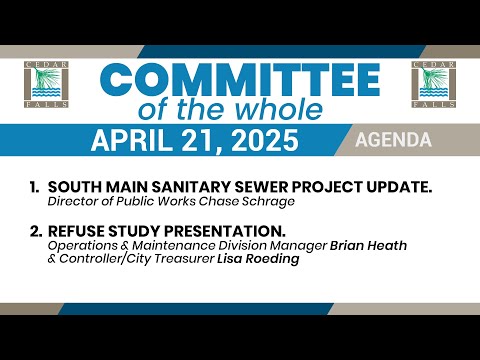
The Cedar Falls Committee of the Whole voted April 21 to proceed with construction of the South Main sanitary sewer in Area 1 only, rejecting comparable measures for Areas 2 and 3 after public comment and debate over costs, easements and household tapping fees.
The Cedar Falls Committee of the Whole voted April 21 to move ahead with construction of the South Main sanitary sewer for Area 1 only, after hearing a presentation from Director Chase Schrage and extended public comment from residents in the affected neighborhoods.
The proposal would extend a gravity sewer to properties currently served by septic systems across three adjacent zones that together include 18 parcels and about 23 acres; 13 of the parcels contain existing homes. ‘‘The project goal was to extend gravity sewer to properties that are currently unserved,’’ Director Chase Schrage said during the presentation. Council members approved proceeding with Area 1 and rejected separate motions to proceed with Areas 2 and 3.
The decision follows months of outreach and revised cost estimates. Staff presented the full three‑area cost picture: construction estimates for all three areas combined total about $425,000 and estimated permanent and temporary easement payments around $185,000. After deductions (including one parcel already connected) the city estimates it would recoup roughly $320,000 through tapping fees; the city would absorb remaining project costs. Schrage said the city currently has a design contract with AECOM for $107,000 and an easement contract with JCG Land Services.
Staff described how the three areas break down on a per‑acre tapping basis: Area 1 was presented at roughly $140,000 serving about 6 acres (a maximum tapping fee of about $23,960 per acre), Area 2 at about $52,000 serving 5.77 acres (about $9,000 per acre after a city deduction), and Area 3 at about $149,000 serving 13.36 acres (about $11,000 per acre after deductions). Schrage said the city set those tapping figures as maximums the property owners would be charged; if bids come in lower, ‘‘that number would go down.’’
Staff outlined three homeowner scenarios for connection: 1) a property owner who elects to connect during construction could have onsite decommissioning and service‑line work included under the city’s construction contract at no charge to the owner (the property owner would still owe the tapping fee); 2) owners who elect to connect later (for example within 10–15 years) would be eligible for up to $5,000 in reimbursement for decommissioning and service line costs; and 3) owners who wait longer than 20 years would not be eligible for the reimbursement or for the fee‑amortization option. The city also proposed permitting individual tapping fees to be amortized on Cedar Falls Utilities bills over 10 years at 3% interest.
Council discussion focused on equity, precedent and environmental risk. Councilor Ganfield framed the item as a public‑health and watershed issue: ‘‘For me, this is a public health situation,’’ he said, noting the neighborhood is now surrounded by development and sits near the Dry Run watershed. Several council members asked for more data on alternatives to per‑acre tapping (for example per‑household or per‑bedroom assessments) and whether grants exist to offset homeowner costs; staff said they were not aware of grant funding for conversion of septic to sewer for this project.
Public comment included emotional appeals from residents who said they had not understood the full cost exposure when they bought their homes. Elizabeth Ackerson (4111 South Main) said she and her family had replaced a septic system before buying and later learned they might face additional tapping and service connection costs: ‘‘I don't feel like this is my property,’’ Ackerson said, describing the prospect of a permanent easement across her yard and the financial burden of thousands of dollars of connection work.
After debate, councilors rejected a motion to proceed with all three areas, then approved a motion to proceed with Area 1 only. Motions to move forward with Areas 2 and 3 both failed on separate votes.
Staff outlined next steps if Area 1 proceeds: adopt a residential septic‑to‑sanitary sewer policy formalizing the three homeowner scenarios; complete easement negotiations over the rest of the calendar year; advertise for construction bids in winter; and, if schedule holds, build next summer. Schrage and other staff said easement values and final tapping fees will be recalculated after bids and easement negotiations are complete.
The project record also notes that county and state environmental inspections have flagged sewable areas in past biennial Department of Natural Resources reviews, and that staff expect continued scrutiny of septics near streams and the Dry Run watershed. The council took no action tonight to change existing mandatory‑connection rules; staff reminded members the city ordinance requires connection when a sewer is available within 200 feet of a property line.
Council members asked staff to continue outreach and to return with any additional funding options or incentive adjustments that could reduce homeowner cost exposure; no further action was scheduled tonight beyond advancing design and easement work for Area 1.