Get Full Government Meeting Transcripts, Videos, & Alerts Forever!
Get email alerts on the Legacy Funding topic
No spam. Unsubscribe anytime.
Committee lays over $779 million omnibus Legacy bill funding conservation, parks and arts
Summary
Chairs of the Legacy Committee presented House File 2563, an omnibus legacy spending bill allocating about $779 million across clean water, outdoor heritage, parks and trails, and arts and cultural programs; the House committee laid the bill over pending the Senate file.
The Minnesota House Ways and Means Committee on Wednesday heard presentation of House File 2563, the omnibus Legacy bill, and laid the measure over pending a Senate companion bill.
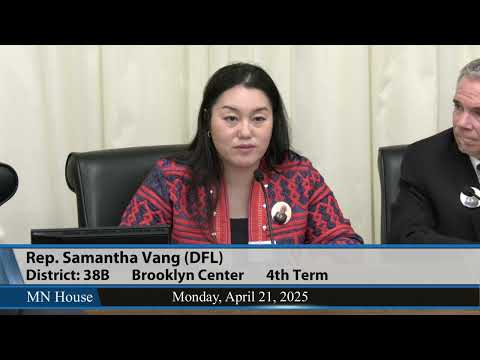
Chair Vang, co-chair of the Legacy Committee, told the committee that "this bill allocates about $779,000,000 in projects in every corner of our great state," saying the package funds clean water, habitat, parks and trails and arts and cultural heritage. The committee then had nonpartisan staff walk members through the bill spreadsheet.
The bill is organized across four Legacy funds. Brad Hagemeyer of the House Fiscal Analysis Department said the bill follows recommendations from advisory councils and the governor and provided the line-item totals: roughly $162.1 million for the Outdoor Heritage Fund (first year appropriation), $303.9 million for the Clean Water Fund, $130.2 million for the Parks and Trails Fund, and about $180 million for the Arts and Cultural Heritage Fund. Hagemeyer noted statutory reserve rules required a small cancellation to meet the 5% reserve requirement.
The Outdoor Heritage Fund article largely follows recommendations from the Lessard‑Sams Outdoor Heritage Council and, according to council executive director Mark Johnson, includes funding for land protection and easements. Johnson said, from a pre-adjustment printout, the council's figures were "approximately $22,500,000 for protect-and-fee with PILT, about $16,500,000 for protect-and-fee without PILT, and about $44,500,000 for protect-and-easement" projects.
House Research attorney Janelle Taylor and policy analyst Mary Davis outlined two discrete policy changes in the bill. Taylor said one provision (page 45, section 13) would require the Clean Water Council to break its recommendations out by fiscal year rather than as a biennial total. Davis described two arts-related policy provisions: the bill would require applicants for Arts and Cultural Heritage Fund grants to provide a recent IRS Form 990 and would prohibit using arts-and-cultural funds for capital construction except in limited circumstances (care collection in museums, accessibility modifications, exhibits and art installations). Davis summarized those changes as additions to existing statute governing arts and cultural heritage grants.
Members asked for specifics about particular line items. Representative Barrack asked whether the Outdoor Heritage Fund included land acquisition; Taylor confirmed there are several appropriations that could be used for acquisitions. Representative Pinto asked about children's museum funding; Chair Vang and Hagemeyer said this year's approach shifts some longtime direct appropriations into competitive grants and that the current proposal—$1.0 million total ($500,000 per year)—is a cut from prior levels that Hagemeyer said had been about $1.6 million per year in the last biennium.
Committee discussion also touched on an administrative transfer reported by Chair McDonald: he said treasury or revenue action required moving roughly $31 million out of legacy funds due to an earlier overpayment, a factor that contributed to tighter totals and some reductions in the bill.
After questions and discussion, the committee laid the bill over to await the Senate file; no floor vote was recorded during the hearing.
The bill text and spreadsheet contain numerous line-item appropriations, extensions and a small number of statutory or technical policy changes; chairs said the bill is intended to distribute one-time Legacy dollars without creating ongoing base spending or FTEs.
Next steps: the bill will be held by the committee pending a Senate companion and further conference negotiation if both bodies proceed.