Get Full Government Meeting Transcripts, Videos, & Alerts Forever!
Get email alerts on the State Budget Hb96 topic
No spam. Unsubscribe anytime.
Legislative changes in Ohio budget worry Talawanda board about cuts and carryover cap
Summary
Talawanda board legislative liaison warned that the Ohio House budget bill (House Bill 96) would reduce state school funding, eliminate the Fair School Funding Formula and impose a new carryover cap that could force districts to return reserves to taxpayers. Board members discussed implications for levies, bond ratings and local taxpayers.
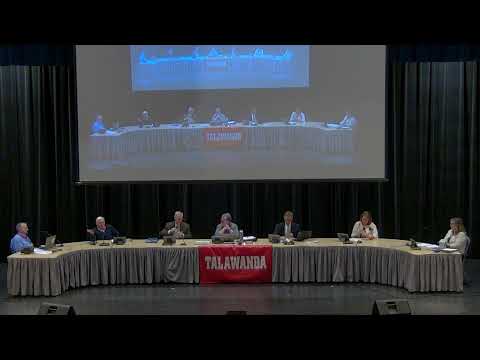
Talawanda City School District’s legislative liaison told the board on April 17 that a recently passed Ohio House budget bill, House Bill 96, would significantly reduce state support for public schools, alter long‑standing funding formulas and impose a new cap on allowable year‑end carryover funds.
Mr. Wyatt, identified by the board as the legislative liaison, said House Bill 96 ‘‘is a significant departure from the bipartisan Fair School Funding Plan, which was passed in 2021,’’ and that the House version ‘‘short changes that plan by roughly $400,000,000’’ compared with earlier expectations. He said, under the House bill, ‘‘virtually every district will see a decrease’’ in state support.
Why it matters: The board was told Talawanda already receives a relatively low state share and relies on local taxpayers for more than 70% of its budget. Members warned a reduced state share and a new calendar‑year carryover cap could force districts to return excess reserves to counties and reduce flexibility for forward funding of contracts or capital planning.
Mr. Wyatt described the carryover cap as ‘‘one of the most alarming aspects of the budget,’’ explaining it would limit districts to roughly 109 days of operating funds in reserve and require amounts over that cap to be returned to taxpayers. He said districts currently rely on reserves to manage cash‑flow timing, one‑time building projects, pandemic relief funding expirations and to smooth levy cycles.
Board members discussed practical consequences: losing the ability to negotiate multi‑year contracts or to maintain strong bond ratings, and being forced to spend reserves for short‑term needs. The liaison also noted changes in the budget that would increase funding for private school vouchers and education savings accounts while reducing direct funding to public schools.
Board members asked for clarification about different budget projections and models; the treasurer and board members said district forecasts for next year’s five‑year outlook would be difficult to prepare until state action is finalized. The board encouraged continued local advocacy to legislators as the bill moves to the Ohio Senate.