Get Full Government Meeting Transcripts, Videos, & Alerts Forever!
Get email alerts on the East Bank Iga And Public Realm topic
No spam. Unsubscribe anytime.
Metro staff say 30 acres, $100 million in capital and contracts would move to new East Bank Development Authority under proposed IGA
Summary
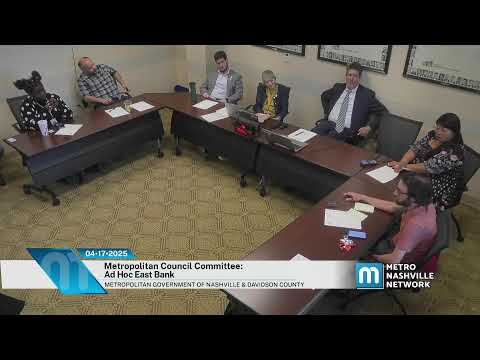
Mister Mendez of the mayor’s office told the East Bank Stadium Committee that Metro intends to transfer about 30 acres of the East Bank’s initial development area, an adjacent plaza and previously approved capital spending authority to the East Bank Development Authority under an intergovernmental agreement now scheduled for committee review on May 6.
Mister Mendez of the mayor’s office told the East Bank Stadium Committee that Metro intends to transfer about 30 acres of the East Bank’s initial development area, an adjacent plaza and previously approved capital spending authority to the East Bank Development Authority under an intergovernmental agreement (IGA) now scheduled for committee review on May 6.
The move would also assign several existing contracts — including the 99‑year master development agreement, program management and engineering contracts and agreements related to shared parking and coordination with the Titans — to the authority, Mendez said. The IGA would let the authority hire staff, set compensation for its employees and execute the assigned contracts while Metro would retain ultimate policy control over land use, debt and capital spending.
Why it matters: the package consolidates operational responsibility for the East Bank’s initial build‑out in the authority while Metro intends to retain policy control and legal limits on the authority’s powers. Metro staff described a financial “waterfall” that would pay the authority’s operating costs first, build a one‑year reserve, repay Metro for interim operating support and return any additional surplus to Metro unless the council later approves a change (for example, a taxing or improvement district) allowing the authority to retain capital proceeds.
Key details from the committee presentation
- Assets to transfer: Mendez said Metro owns roughly 130 acres on the East Bank but is proposing to convey roughly 30 acres that are subject to the previously approved master development agreement, plus an adjacent plaza and the site of the existing stadium once it is demolished. Metro retains the right to reclaim land if the authority ceases to exist.
- Contracts and funding: The master development agreement and agreements between Metro, Fallon (the master developer) and the Titans would be assigned to the authority. Mendez said about $100,000,000 of capital spending that was previously approved in Metro capital plans would be available for the authority to deploy; staff emphasized these are previously approved funds, not newly appropriated money.
- Employees: staff who previously worked for Metro on East Bank matters would become East Bank Development Authority employees; the authority, not Metro departments, would direct their day‑to‑day activities going forward.
- Governance and limits: Mendez and other presenters said the authority would not have land‑use, zoning or eminent‑domain powers, could not create debt or spend capital without Metro Council approval, and would be subject to auditing and oversight. Committee members asked about audit timing and dispute resolution language; staff said audits are required but did not provide a specific deadline in the presentation and said Metro legal prefers resolving disputes within the Metro family rather than through litigation.
- Timeline and revenue expectations: staff reiterated earlier public projections that initial buildings could be operational in the 2028–2030 timeframe, and said positive net revenue sufficient to repay Metro would likely emerge during that period, subject to construction, market and environmental contingencies. Mendez cautioned that unexpected environmental remediation or other issues could change that timeline.
Public realm, boulevard and transportation engagement
Mendez and other staff also reviewed a recently adopted public‑realm framework document (described as a 60‑page guidance document adopted by the downtown design review body) and outlined a federal‑funding‑related public engagement process for East Bank Boulevard. Staff said a required NEPA‑related open house will be held as an in‑person “open house” at Crosspointe Church (noted in the presentation as a 4–7 p.m. event) and that an online survey and two pop‑up events will follow; staff said the survey period was announced in the presentation as running “from the 20 fourth to May 15.” The presentation will be posted online for public review.
Committee members pressed staff on multimodal tradeoffs for East Bank Boulevard, including whether to provide bike lanes on the boulevard itself. Staff said every other street in the East Bank precinct will have dedicated bike lanes; the boulevard options will be shown to the public and trade off roadway width, sidewalk width and bus priority. Staff also said one of three planned downtown transit stations will be on East Bank Boulevard at James Robertson Parkway and that buses must receive substantial priority on the boulevard because it will be part of the new transit circulation.
Utilities, undergrounding and network infrastructure
Committee members asked whether utilities and communications infrastructure could be undergrounded and coordinated to avoid repeated trenching. Staff said Metro is encouraging undergrounding and that initial utility planning for Metro‑owned East Bank land includes duct banks to accommodate power and ITS (city network) infrastructure. Staff said Metro would provide conduit space and is negotiating legal and rate terms with communications providers but cannot compel private providers to use Metro infrastructure. Committee members asked whether Metro could operate a municipal commercial network; staff said Metro legal was researching that question and that state policy and private provider lobbying have historically complicated municipal retail Internet offerings.
Questions and concerns raised by committee members
Committee members asked about: protections against operating‑expense inflation; audit deadlines and enforceability; dispute resolution short of litigation; how future Metro‑owned acres beyond the initial 30 would be considered; and what incentives the authority would have to maximize revenue if excess revenue flows back to Metro. Staff pointed to board appointment oversight, audit requirements and the council’s role in approving capital spending as controls but acknowledged operating‑expense oversight is an area the committee probed closely.
Next steps
Mendez said the IGA language has been adjusted after the East Bank Development Authority’s March meeting and that the authority will meet next Tuesday; the IGA will return to committee and is scheduled to appear before full council on May 6. Staff said the public‑realm document and relevant presentation materials are available on Metro planning or Legistar pages and that staff will share the public‑engagement graphics with committee members.
Ending note: Ben York was introduced in the meeting as the authority’s new CEO and Anna Greider as COO; both were described as having been central to East Bank planning and will lead the authority’s early efforts.