Get Full Government Meeting Transcripts, Videos, & Alerts Forever!
Get email alerts on the Operations Training Health topic
No spam. Unsubscribe anytime.
SFFD report highlights recruit academies, training drills, turnout-bag donations and behavioral-health unit temporary location
Summary
San Francisco Fire Department leaders told the Fire Commission on April 23 about recent training, recruitment and member-safety initiatives, including a planned academy graduation, multi-agency drills and a temporary location for behavioral-health services.
San Francisco Fire Department leaders told the Fire Commission on April 23 about recent training, recruitment and member-safety initiatives, including a planned academy graduation, multi-agency drills and a temporary location for behavioral-health services.
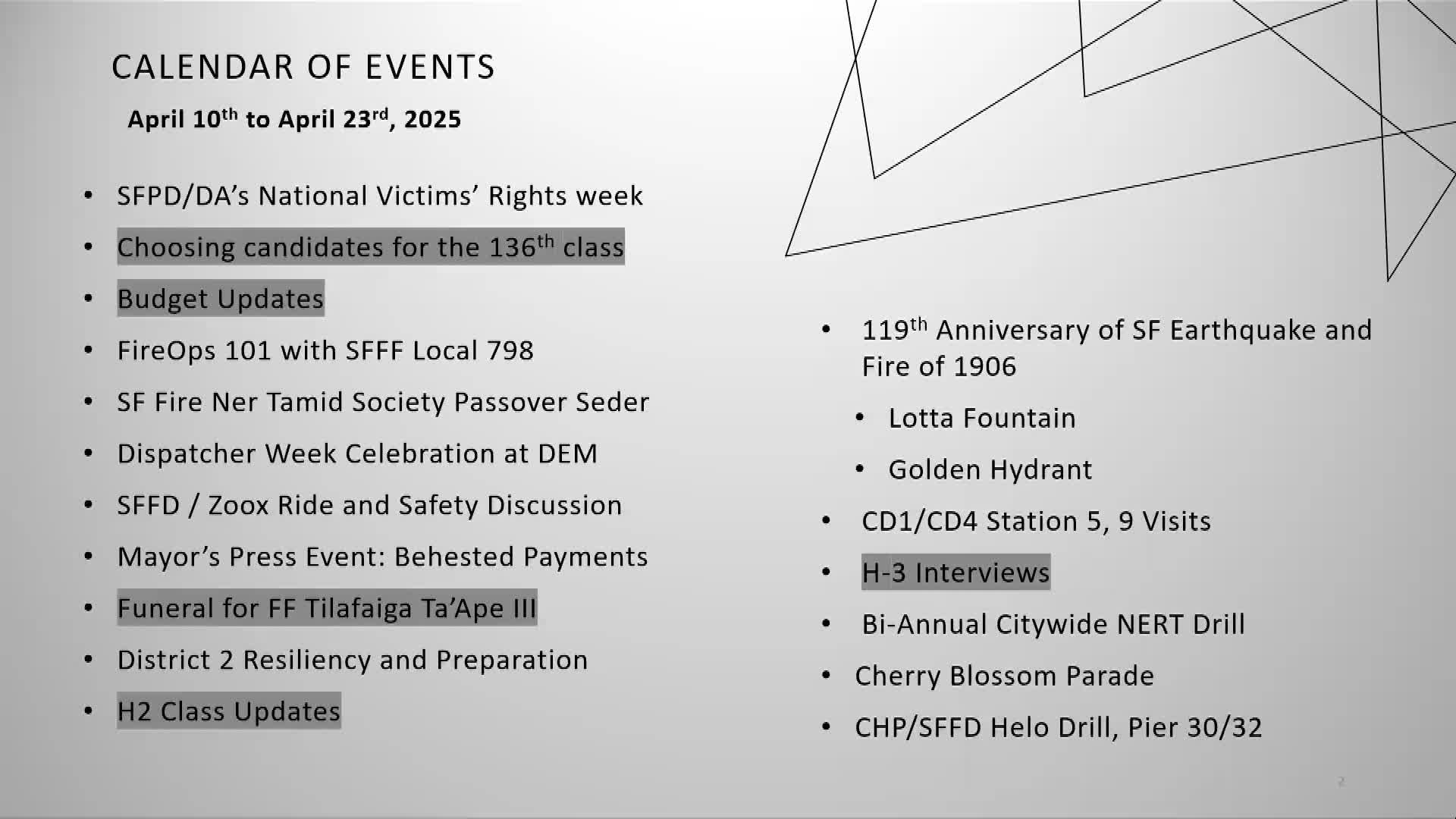
Chief of Department Dean Crispin said the department had interviewed 36 candidates for the 136th recruit class and expects the combined academy to start toward July, with the current H2 class completing testing and scheduled to graduate June 6. “They will graduate June 6. We're very excited about their graduation,” Crispin said.
The chief and staff reviewed several public training events and exercises: a Fire Ops 101 program for elected officials that included an auto-extrication station, structural collapse and a burn room; a multiagency helicopter rescue drill with the California Highway Patrol that simulated a capsized boat and water rescues; and a citywide Neighborhood Emergency Response Coalition (NERC) drill with about 150 volunteers.
Crispin credited labor and community partners: Local 798 helped sponsor training, the San Francisco Fire Credit Union provided lunch for participants, and the San Francisco Firefighters Cancer Prevention Foundation donated new turnout bags designed to contain contaminated turnout gear during transport. “These bags will encapsulate our turnouts and ensure that there's no exposure to the harmful chemicals that our turnouts carry in them,” Crispin said.
Deputy Chief Sayumi Bridal presented administrative and health updates: the department’s hygiene and health programs are active, including TB and hearing testing, nutrition and fuel-pump studies at selected stations, and a behavioral-health unit (BHU) that is currently located in a firehouse on a temporary basis. Bridal said the department is seeking a non-firehouse location for BHU to provide greater privacy and sensitivity for members seeking support.
Support-services and facilities work was also discussed: the department reported increased spending of about $1 million on a capital project in recent materials and described efforts with Public Works to group roof and facility repairs to reduce costs. Support Services noted 130 service requests initiated and 150 completed in March and that several infrastructure upgrades and new apparatus acquisitions are in progress.
Why it matters: recruitment, training and staff health programs affect department readiness and firefighter safety. Several commissioners praised outreach efforts and training programs and asked for more detail on configurations for new street teams and on how facility upgrades will be prioritized.
What’s next: staff offered to return with additional data on the fuel-pump and nutrition studies and to present specifics on facility grouping and timelines for EASE bond projects and division-of-training site plans.