DPH outlines 1,500‑bed goal, Unified Street Team and RESTORE pilot to speed people into treatment
Loading...
Summary
Department of Public Health leaders described a multi‑pronged plan to expand treatment capacity, unify street outreach teams, and scale the RESTORE conversion program that pairs beds with medication treatment for opioid use disorder.
The San Francisco Department of Public Health detailed a rapid expansion plan for behavioral health and homelessness responses that combines a consolidated, neighborhood‑based street team model, a treatment program called RESTORE that pairs immediate beds with medication for opioid use disorder, and plans to add hundreds of beds across shelter and clinical settings.
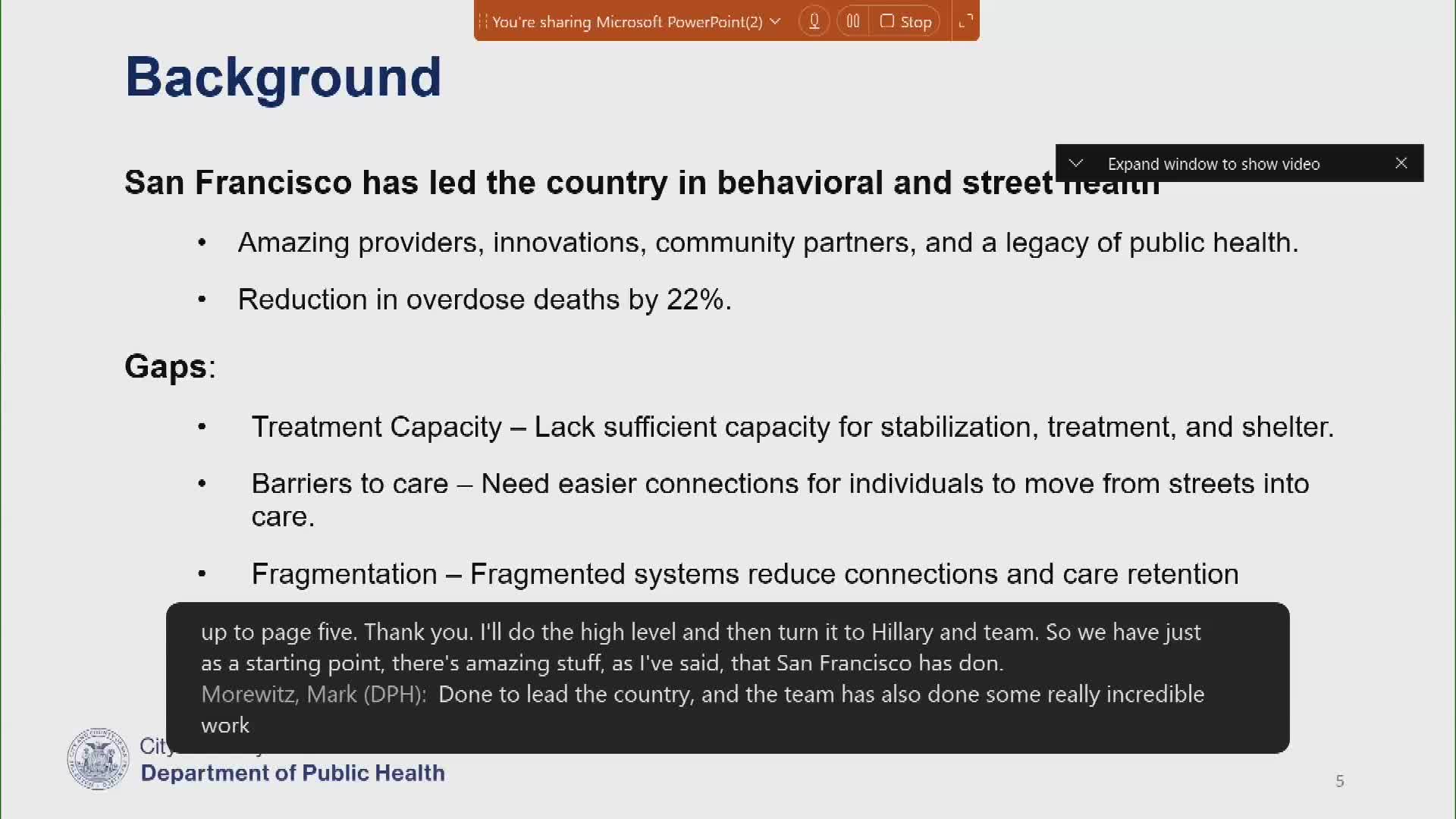
DPH Director Daniel Tsai framed the work as part of a broader goal to build a more proactive system to reduce fatal overdoses and move people from unsheltered settings into sustained treatment. He said the administration is aiming at a long‑range target described by the mayor of expanding beds and capacity citywide – a figure referenced at the meeting as 1,500 beds in the mayor’s broader plan — while improving pathways to care and retention in services.
Unified, place‑based street teams DPH described a consolidation that turns nine legacy outreach efforts into a unified, neighborhood‑based multidisciplinary street team model. The phased rollout has launched teams in the Tenderloin, Northern Station and Mission neighborhoods; each team includes clinicians, social workers, nurses, community health workers and peer specialists, and coordinates with other agencies (Department of Homelessness and Supportive Housing, Fire, Police, Public Works) and a night navigator program. The teams focus on shared priority client lists and use cross‑agency huddles to escalate cases.
RESTORE pilot and residential expansion Leaders described RESTORE as a low‑barrier program that offers a bed and a structured treatment plan coupled with medications for opioid use disorder (buprenorphine or methadone). The Adante Hotel pilot in the Tenderloin began with about 35 beds and DPH plans to expand capacity at that site to 73 beds, identify additional sites outside the Tenderloin, and scale toward three sites with roughly 200 total capacity when fully implemented. Program metrics cited in the briefing: roughly 380 clients served so far, about 88% started medication for opioid use disorder, and roughly 50% moved to another stable location after participation.
Wider bed pipeline and timelines DPH presented a near‑term pipeline of sites and projects that it expects to open in 2025 and 2026. For 2025, officials estimated the city would open between about 135 and 285 beds across multiple projects (some DPH‑led, some in partnership with HSH). Projects cited include a Stabilization Unit at 822 Gary (anticipated to begin serving clients imminently), expanded emergency stabilization units, Epiphany Center transitional housing for women, tiny homes at Gerald Commons and additional city and state funding applications for locked or subacute beds. Some pipeline projects are contingent on state capital grants, including proposals submitted under the Proposition 1 capital program.
Why it matters: Officials and commissioners emphasized that expanding clinical capacity and creating faster, easier entry points into treatment are necessary to reduce overdose deaths and improve outcomes for people with co‑occurring mental‑health and substance‑use disorders. Commissioners asked how the city will ensure programs can hire staff and maintain quality; officials said hiring has been improving and that the department is using batch recruitments and contracting strategies to fill roles.
Ending note Commissioners and public commenters praised peer outreach and long‑term neighborhood engagement as central to success. The commission requested continuing updates on bed openings, RESTORE outcomes and workforce progress as the programs scale.