Get Full Government Meeting Transcripts, Videos, & Alerts Forever!
Get email alerts on the Land Use Development topic
No spam. Unsubscribe anytime.
Planning commission upholds PMND for 570 Market; project approvals continued for more design review
Summary
The Planning Commission affirmed the department's preliminary mitigated negative declaration (PMND) for the proposed 29-story hotel at 570 Market St., rejecting appeals on CEQA grounds by a 5-2 vote, then continued entitlement hearings on design and conditional-use matters to July 10 for further review.
San Francisco ' The Planning Commission on May 1 upheld the Planning Department's preliminary mitigated negative declaration (PMND) for a proposed 29-story, 211-room hotel at 570 Market Street, determining that technical mitigation measures would reduce construction impacts to less-than-significant levels. The vote to affirm the PMND was 5-2, with Commissioners Imperial and Moore voting no.
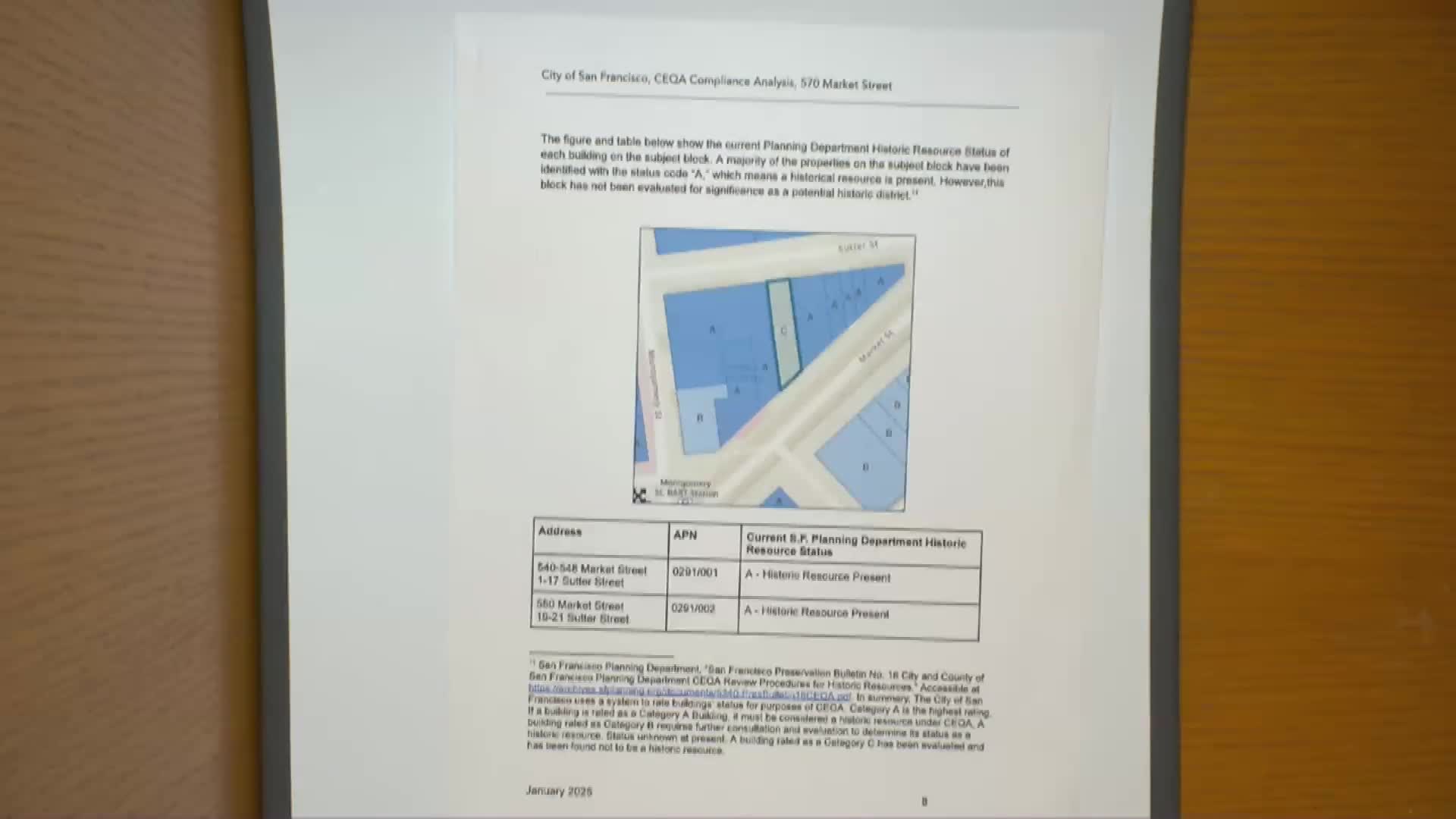
The PMND had been appealed by owners of adjacent buildings, including legal representatives for 44 Montgomery Street and the Chancery Building, who argued the environmental review failed to analyze potential geological, vibration, noise, historic-preservation and shadow impacts adequately. Appellants provided expert letters contending construction vibration and settlement posed a risk to nearby historic structures and that certain acoustical assumptions understated noise impacts.
Planning Department environmental coordinator Ryan Shum told commissioners the department conducted supplemental analyses on geotechnical, vibration and air-quality issues after receiving the appeals and that mandatory building-department reviews and specialized mitigation would address site-specific risks prior to issuance of permits. Shum said the building department's later, statutory review of construction- and permit-level engineering is the appropriate stage to ensure geotechnical and structural safety, and that Caltrans/FTA vibration guidelines are advisory thresholds used to trigger monitoring and mitigation.
Appellants' counsel argued a strict "fair argument" standard required an Environmental Impact Report (EIR) because they said project plans lack the detail needed to evaluate settlement and vibration risk for neighboring historic buildings and called for a more detailed public review. The appellants submitted expert letters on vibration and acoustic modeling and raised concerns about truck and tour-bus loading on nearby Sutter Street.
After extended debate on the PMND, the commission voted to reject the appeals and affirm the PMND, 5-2. Commissioner Braun, who moved to uphold the PMND, urged the department's already-required mitigation and construction-level reviews be taken seriously; several commissioners asked staff to ensure monitoring, pre-construction surveys, vibration plans and regular reporting are enforced during construction.
Separately, the commission then considered project entitlements (downtown project authorization, conditional-use authorization and a zoning-administrator variance for elevator penthouse height). Following design discussion and public comment (including numerous labor endorsements and community supporters), commissioners said they wanted additional design analysis and clearer renderings showing the project's relation to adjacent buildings, light wells, and publicly accessible open spaces.
The sponsor and design team agreed to revise materials and provide more detailed massing and context renderings, including a three-dimensional model showing the adjacent 44 Montgomery and Chancery Building relationships. Commissioners continued the entitlement hearings to July 10 to review the revised design materials and directed staff and the sponsor to return with the updated analyses.
Why it matters: The PMND decision clears the way for later discretionary approvals if the commission approves the entitlements, but the continuance shows commissioners want more context-level design detail and stronger documentation of mitigation and monitoring protocols before final actions on the project's height, setbacks and loading arrangements.