Get Full Government Meeting Transcripts, Videos, & Alerts Forever!
Get email alerts on the Building Regulation topic
No spam. Unsubscribe anytime.
Planning commission backs amnesty for property owners tied to DBI fraud, excludes firms on expanded compliance list
Summary
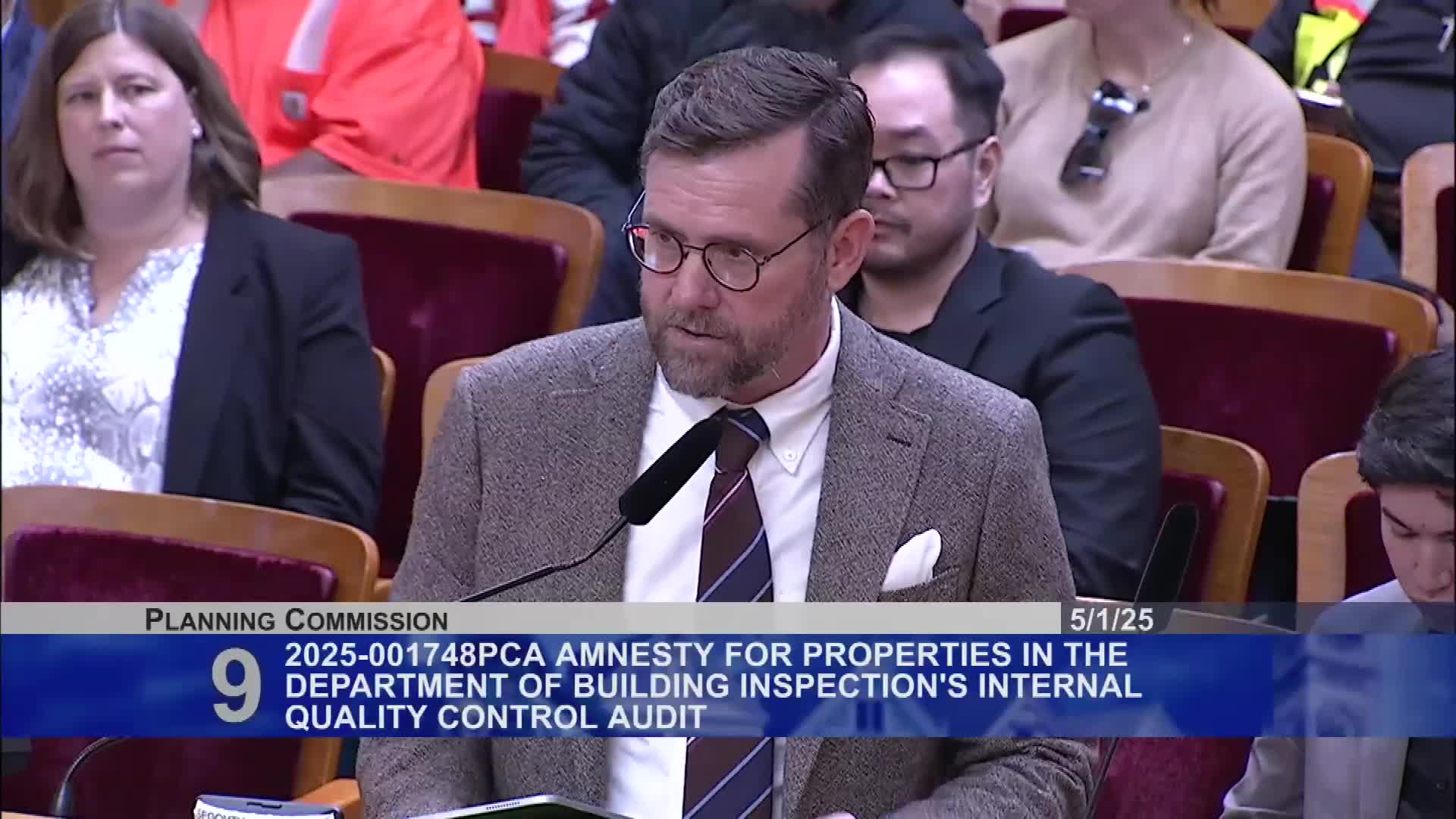
The Planning Commission voted 6-1 to recommend an ordinance that would waive planning code violations and certain fees for owners caught up in the Department of Building Inspection's (DBI) internal audit related to the Santos/Curran frauds, while excluding applicants already on DBI's expanded compliance-control list.
San Francisco ' The Planning Commission voted 6-1 on May 1 to recommend a city ordinance creating an amnesty program for property owners caught up in the Department of Building Inspection's (DBI) internal quality-control audit tied to crimes committed by consultant Rodrigo Santos and former DBI inspector Bernie Curran.
The measure would waive specific Planning Code requirements and related fees for properties identified in DBI's audit, allow property owners to refund fees already paid to comply, and provide a pathway to legalize certain as-built conditions while preserving life-safety enforcement under the Building Code. Supervisor Aaron Peskin's office (Supervisor Mandelmann in the hearing transcript) introduced the ordinance to the commission.
The initiative responds to DBI's audit of nearly 5,500 properties, a review sparked after criminal convictions of Santos and Curran. At the hearing, Supervisor Mandelmann told commissioners: "The ordinance before you will provide relief to scores of property owners who were unwittingly and through no fault of their own swept up in the sad and sorry saga of Bernie Curran and Rodrigo Santos." He summarized the audit findings and described sample homeowner impacts, including owners who faced tens of thousands of dollars in unexpected fees and design work to bring property work into compliance.
DBI legislative-affairs manager Tate Hanna told the commission the department identified the inventory of properties and had issued notices of violation (NOVs) for the owners the amnesty would apply to; DBI also paused some enforcement while the ordinance advanced. Hanna said DBI would not waive any Building Code life-safety requirements and that owners would still need to correct structural and safety problems: "We cannot waive any building code requirements."
Commission discussion focused on the scope and transparency of the audit, whether the legislation could inadvertently benefit bad actors, and whether applicants who had been flagged for repeated noncompliance should be eligible. Commissioner Vice President Moore pressed for the commission to receive more detailed lists and categorization of the audited properties before action; other commissioners said delay would further burden innocent owners. As a compromise, commissioners added the condition that any applicant who is currently on DBI's expanded compliance-control list ' a list of designers or applicants subject to extra oversight for prior violations ' would be ineligible for amnesty.
Commissioners also asked DBI and the sponsor to expand outreach so owners with NOVs understand their options and the ordinance's five-year sunset. The commission recorded the 'recommendation to approve with that exclusion and committed to forwarding the item to the Board of Supervisors' Land Use Committee with the commission's recommendation for the amended ordinance.
The motion passed 6 to 1, with Vice President Moore voting against. The commission's action is a recommendation to the Board of Supervisors; the ordinance would still require Board approval and the mayor's signature.
Why it matters: DBI's audit followed criminal convictions for construction-related fraud and improper inspections. The amnesty seeks to reduce the financial and administrative burden on homeowners who bought properties unaware of earlier unpermitted work, while preserving life-safety requirements and excluding applicants with repeated enforcement issues.