Get Full Government Meeting Transcripts, Videos, & Alerts Forever!
Get email alerts on the Septic Maintenance Review topic
No spam. Unsubscribe anytime.
Committee delays resolution urging state review of three-year on-site system pumping requirement
Summary
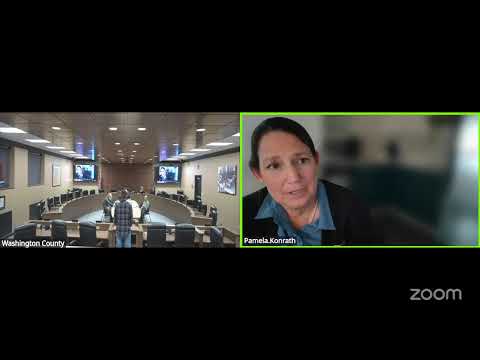
After an extended staff presentation and member discussion, Washington County’s committee postponed consideration of an advisory resolution asking the state to reexamine the three-year septic pumping/inspection requirement.
Washington County’s Land Use and Planning Committee postponed action on an advisory resolution that would ask state officials to review the statutory three-year maintenance (pumping/inspection) requirement for private on-site wastewater treatment systems.
Brett Scherrer, introduced to the committee as the county’s interim assistant natural resources director, presented background on the maintenance program and cited Wisconsin statute 145.205(b) (as presented in his slides) which, he said, requires pumping or inspection at least once every three years unless an alternative maintenance plan is in place. Scherrer summarized technical details presented to the committee: how scum and sludge accumulate, tank sizing is set by bedrooms and estimated flow calculations, a five-year inspection cadence can apply for seasonal residences, and licensed maintainers or pumpers may perform visual inspections that can extend the interval.
Public comments and calls to staff — summarized by county staff — included concerns from septic pumpers and maintainers that many homeowners do not properly maintain systems; pumpers reported seeing clogged filters, bio-matting and high-strength wastes that are costly for treatment plants to accept. Pumpers and some committee members argued those field observations support continuing the three-year cycle; others said the statutory requirement appears to date from the 1970s and lacks recent evidence and modern-technology considerations.
Committee members debated options: sending the resolution forward as written, creating an expert work group (plumbers, pumpers, homeowners, state agencies) to gather evidence, or postponing for amendments and additional input. Multiple supervisors said they want clearer wording (for example, avoiding the word “deregulation”) and more local stakeholder input before sending an advisory resolution to the state.
A motion to postpone consideration until the committee’s next scheduled meeting carried on a voice vote. Committee staff asked the public and stakeholders to submit written comments and proposed language changes for staff to compile and circulate before the next meeting.
Ending: The committee scheduled further consideration for the next meeting date; staff will collect public and professional feedback and work with supervisors to refine resolution language.