Get Full Government Meeting Transcripts, Videos, & Alerts Forever!
Get email alerts on the Zoning Parking Reuse topic
No spam. Unsubscribe anytime.
Zoning board finds West Chew medical office use not abandoned, clears building for nonmedical offices and grandfathered parking
Summary
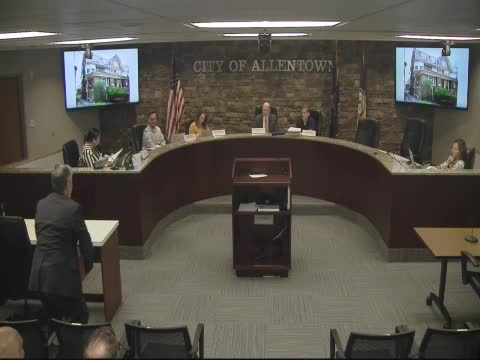
The Allentown City Zoning Hearing Board on April 28 found that the former medical office at 1726–1730 West Chew Street was not abandoned and may be used for nonmedical professional offices; the board also determined 31 grandfathered parking spaces for the site.
The Allentown City Zoning Hearing Board determined April 28 that the former medical office at 1726–1730 West Chew Street has not been abandoned and may be used for nonmedical professional offices, and it found a 31-space grandfathered parking deficit that will carry forward for the site.
The decision follows testimony from the property owner, Camille Satoof, and the building—s listing agent, who told the board the three-story building (about 13,700 square feet) has sat largely vacant since the owner acquired it in 2021 and has only two on-site parking spaces. Satoof testified she and a partner spent about $25,000 attempting to acquire or secure additional parking from nearby properties, that insurance and tax costs have been high, and that multiple prospective tenants left after learning additional parking would be required. "I bought this building, and I didn't have parking," Satoof said, adding she had offered money and time to secure parking with nearby property owners.
The board—s discussion focused on two interrelated questions: whether the prior, nonconforming medical-office use had been abandoned and, if not, how to treat the site—s parking deficit under the zoning code. A zoning officer and board members read Section 660-73(e)(2) of the zoning ordinance, which preserves a preexisting deficit in off-street parking when a use changes. The board majority concluded that because there were no substantial physical changes to the property since the earlier approval and because the owner documented efforts to market and retain the use, the nonconforming office use was not abandoned.
Board members also debated how many parking spaces to "grandfather" under current calculations. Using today—s general-office parking standard (1 space per 300 square feet) as a benchmark, the board concluded that 31 off-street parking spaces would be the grandfathered figure for the site and that any future tenant whose use generated a higher requirement would need to return to the board or pursue another relief path.
Eric Shaw, counsel for the applicant, and listing agent Janice Fenner described multiple marketing efforts, including a church, a law office and other office users. Fenner told the board the property had been marketed on commercial platforms and that many prospective buyers or tenants withdrew after learning zoning would require additional parking. Fenner said fairground and hospital parking options had been pursued and rejected.
The board recorded motions to (1) determine the nonconforming office use had not been abandoned and therefore could continue as general (nonmedical) professional office use, and (2) find 31 grandfathered parking spaces for the site. Both motions were seconded and carried unanimously by the three-member panel (Chair Robert Knauer, Samantha McLean and Steve Davies). The board noted that if a future tenant—s use demands more parking than the grandfathered number, that tenant would have to seek further relief.
The board also discussed limiting operational hours as a condition (the applicant proposed weekday business hours) and emphasized that the decision preserved flexibility but did not guarantee relief for uses that would create greater parking demand.
The board admitted exhibits submitted by the applicant, including the deed dated 2021, floor plans, marketing listings and correspondence with the fairgrounds showing attempts to lease parking.
The board—s action clears the way for the owner to pursue nonmedical office tenants without immediately obtaining additional off-site parking, subject to the 31-space framework the board recorded.