Get Full Government Meeting Transcripts, Videos, & Alerts Forever!
Get email alerts on the Votes Roundup topic
No spam. Unsubscribe anytime.
Votes at a glance: Key bills passed by Tennessee House on April 17, 2025
Summary
The House took final action on a range of bills on April 17, 2025, from public-health and judicial matters to agriculture and transportation. This roundup lists each item, a short description, and the recorded floor outcome.
The Tennessee House completed final action on a number of bills on April 17, 2025. Below are short summaries of items taken up on the floor with their outcomes as recorded in the House transcript.
Votes at a glance (bill — short description — floor outcome)
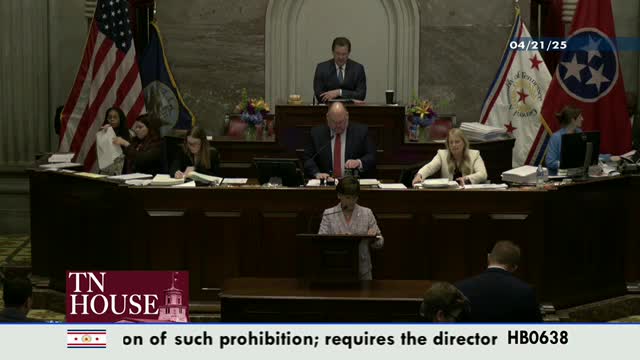
- Senate Bill 13-89 (substitute for House Bill 638) — prevents health-care discrimination based on vaccine choice for TennCare patients; amendments added for transplant/oncology/immunocompromised exemptions — Passed on third consideration.
- Senate Bill 233 (substitute for House Bill 634) — creates the conservatorship management task force to review protections for vulnerable individuals in the conservatorship program — Passed on third consideration (Chairman Clemens sponsor).
- Senate Bill 931 (substitute for House Bill 804; lab-grown protein labeling) — requires companies producing cell-culture proteins to obtain a Department of Agriculture permit and prohibits labeling lab-grown products as "meat"; $1,000 fine per violation — Passed on third consideration (Chairman Grills sponsor).
- Senate Bill 644 (substitute for House Bill 865; nursing program expansion) — allows qualified high-school students who meet requirements to begin hands-on nursing training before senior year to help address nursing shortages — Passed on third consideration (Representative Hicks sponsor).
- Senate Bill 90 (substitute for House Bill 869; lab test APIs and federal CMS alignment) — aligns state law with federal timelines for APIs and repeals the 72-hour hold on certain lab tests — Passed on third consideration (Chair Lady Rutter sponsor).
- Senate Bill 136 (substitute for House Bill 152; electronic participation) — permissive bill allowing local legislative bodies to adopt plans (by two-thirds vote) to permit limited remote participation (medical, military, weather) with a guideline of twice per year per member — Passed on third consideration.
- Senate Bill 586 (substitute for House Bill 1371; unlawful exposure) — expands unlawful-exposure statute to third parties who share intimate images; allows prosecutions beyond the original parties — Passed on third consideration (Representative Chisholm sponsor).
- Senate Bill 163 (substitute for House Bill 836; ambulance/EMS study) — directs a study on the economic impact and provision of ambulance services in counties required to provide them — Passed on third consideration (Representative Capley sponsor).
- Senate Bill 703 (substitute for House Bill 736; transportation funding study) — requires TDOT to study alternative sources of transportation funding to address revenue declines from improved vehicle efficiency and rising construction costs — Passed on third consideration (Representative Vital sponsor).
- Senate Bill 160 (substitute for House Bill 836) — creates a study of counties that provide ambulance services directly or by franchise; recorded as passed (Representative Capley sponsor).
- Senate Bill 863 (substitute for House Bill 799; TWRA commercial blind license) — directs TWRA to create a real-foot commercial blind license (hunting licensing change) — Passed on third consideration (Chairman Grylls sponsor).
- Senate Bill 871 (substitute for House Bill 1192; continuum-of-care study) — directs a study of continuum-of-care resources and how state assets can be delivered to local NGOs and 501(c)(3) organizations — Passed on third consideration (Chairman Supiki sponsor).
- Senate Bill 231 (substitute for House Bill 296; speech-therapy insurance study) — requires a study of the impact of insurance coverage for speech therapy — Passed on third consideration (Representative Love sponsor).
- Senate Bill 239 (substitute for House Bill 406; juvenile facilities survey) — creates a study to assess local juvenile detention and treatment facility availability — Passed on third consideration (Representative Reedy sponsor).
- House Bill 641 (child advocacy funding) — increases recurring base funding for child advocacy centers and forensic interview contracts (to address a 25-year underfunding) — Passed on third consideration (Chair Lady Carringer sponsor).
- House Bill 486 (public defenders) — adds five public defender positions to address workload distribution across the state — Passed on third consideration (Chairman Farmer sponsor).
- House Bill 691 (community investment tax credit reform) — changes the way the community investment tax credit is calculated so it reflects outstanding principal over the year instead of the December 31 balance — Passed on third consideration (Chairman Baum sponsor).
- Senate Bill 769 (substitute for House Bill 1140; catalytic converters) — increases prosecutorial options for catalytic-converter theft and removes language limiting punishments to fines, to allow jail time where appropriate — Passed on third consideration (Chairman Boyd sponsor).
- House Bill 99 (unlawful photography) — raises unlawful-photography offense to felony and requires registration on the offender registry; House sponsors brought victims to the well during floor debate — Passed on third consideration (Chairman Bolso sponsor).
Several other bills were taken up and received final action on April 17; the House also passed a consent calendar earlier in the session and heard substitute and committee amendments on multiple items. For bills where the transcript shows a formal recorded vote or the clerk declared the measure passed, the outcome above is recorded as "Passed on third consideration." Where the transcript did not include a clear numerical roll call in the excerpt, the outcome language reflects what the House clerk declared on the floor.
If you need the complete roll-call tallies for any specific bill listed above, indicate which bill and we will extract the clerk's minutes or roll-call entry.