Get Full Government Meeting Transcripts, Videos, & Alerts Forever!
Get email alerts on the Capital Projects topic
No spam. Unsubscribe anytime.
Clute study recommends shared police and public works campus, estimates $45 million to build
Summary
Architects presented a needs assessment that proposes a 29,600-square-foot police building and two public-works buildings on a 7.34-acre Commerce Street site, with a turnkey cost estimate of roughly $45 million and options to start design now or wait for a bond vote.
A municipal facilities study presented Thursday to the Clute City Council recommends building a shared campus for the police department and public works on a 7.34-acre site on Commerce Street and estimates construction and yard work at about $45 million.
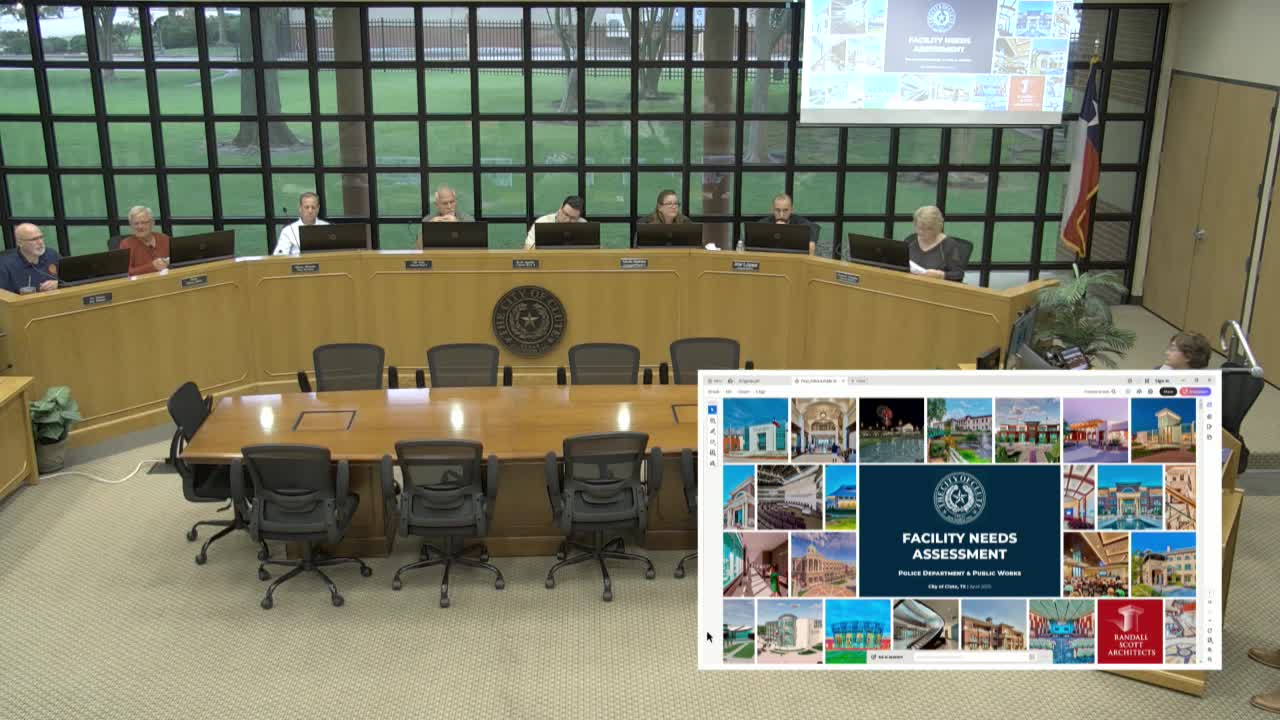
Preston Scott, a project architect with Randall Scott Architects, told the council the study looked at departmental needs, peer cities, site logistics and five-, 10- and 15-year staffing projections. Scott said the design would locate a single-story, 29,600-square-foot police building on one side of the campus and two public-works buildings — an administration building and a shops building — plus a service yard on the other side.
Scott said the turnkey cost estimate is about $25.9 million for the police building, $14.6 million for the public-works administration and shops, and roughly $5 million for the service yard that includes fuel, wash bays and material storage. He warned the council that local construction costs have been rising quickly: "If you were to start moving on this today, dollars $700 a square foot," Scott said, adding the firm’s data projects continued escalation that would raise costs several hundred dollars per square foot over the next several years.
The study presents two timing options. Option A would begin design work now so the project is shovel-ready if voters approve financing; Option B would delay design until a bond election passes, which the firm estimated would add roughly $3.2 million in escalation and push move-in more than two years later. Scott summarized the trade-off: beginning design now reduces escalation risk but means spending design dollars before construction funding is guaranteed.
Mayor Calvin Shiflett and councilmembers discussed practical constraints. Councilman Aguilar and others said the police building’s current condition makes a new facility urgent. Council members and staff noted the Commerce Street site was donated as parkland and that using it for municipal facilities would require voter approval. "That land was donated as a park by a family in the city of Clute. There has to be an election to use the property," Mayor Shiflett said.
Council members and staff also asked about neighborhood impacts, site access and shop sizing. Public comments and council questions raised concerns about noise, earlier morning operations and whether heavy trucks could use existing residential access points. Council members asked staff to work with the city’s financial advisors and bond counsel to test affordability and timing; the city manager said a financial advisor is scheduled to meet with council staff in the coming weeks to discuss financing scenarios.
Scott said the study includes a program-level listing of every space and a schedule of when projected staff increases would come online; he said the firm sized locker rooms, training rooms, evidence storage and an ICC 500-rated hardened space for first responders. The presentation also included a site plan showing shared public parking, secure fenced yards with separate gates for police (sally port access) and public works, and a training/community room off the public lobby.
No formal vote or contract award occurred Thursday. Council directed staff to continue financial analysis and to return with options on timing and bond approaches; council members noted that if the Commerce Street site is still the preferred location, the city also must prepare ballot language for a future election to allow use of donated parkland.
If the council moves forward, Scott said his firm would lead schematic design and engineering under a standard four‑phase design/construction administration contract. He told the council the design phase typically takes about 10 months and construction about 18 months.
The presentation and cost estimates will be incorporated into the city’s capital improvement planning ahead of future bond planning and a draft timeline for citizen and stakeholder engagement.