Get Full Government Meeting Transcripts, Videos, & Alerts Forever!
Get email alerts on the Law Enforcement Overtime topic
No spam. Unsubscribe anytime.
Board committee hears audit of SFPD overtime, forwards ordinance to full board without recommendation
Summary
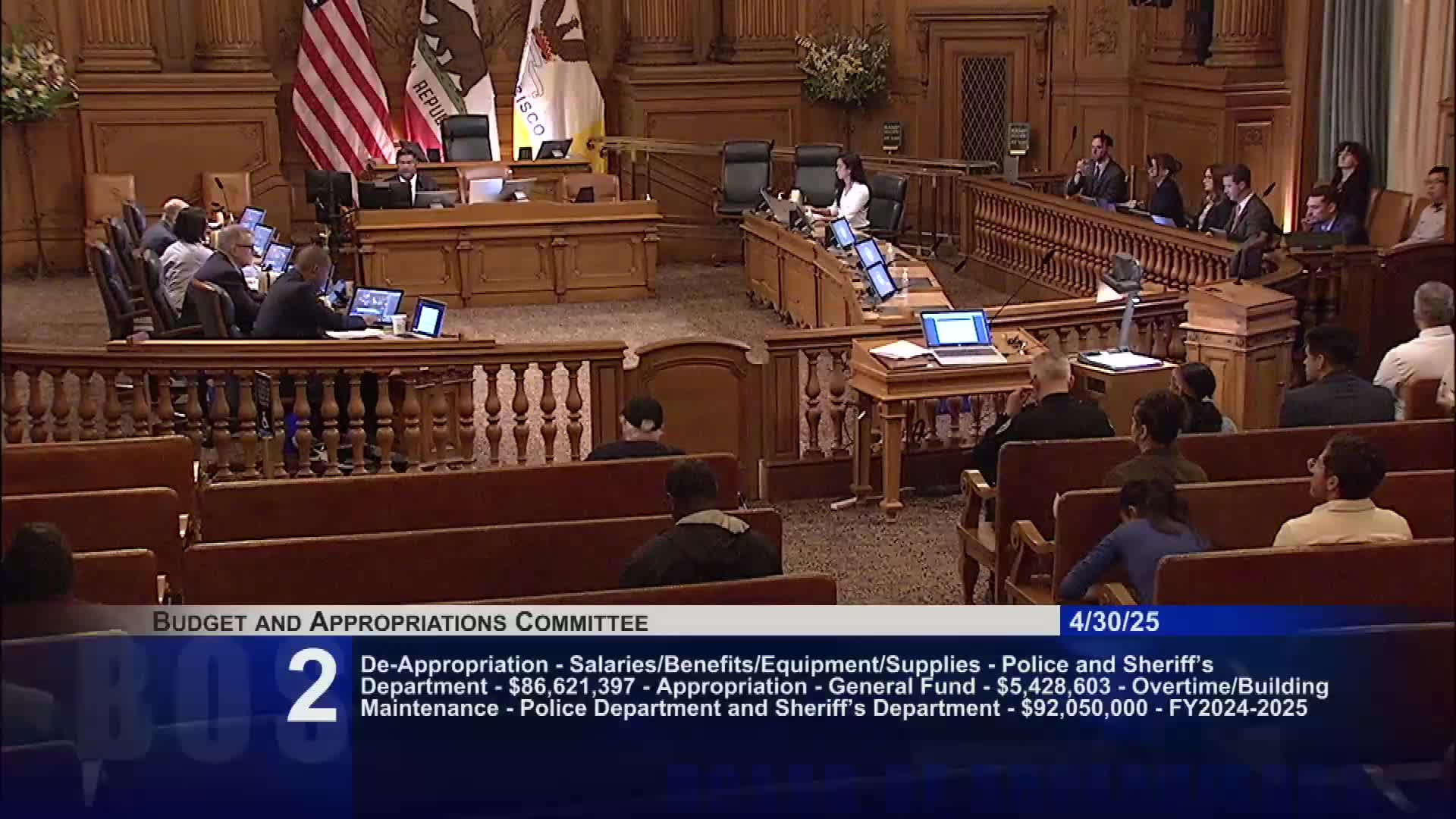
The Budget and Appropriation Committee on April 30 reviewed a Budget and Legislative Analyst (BLA) performance audit that found systemic problems in the San Francisco Police Department’s management of overtime and then moved an ordinance reallocating salary savings to pay for projected overtime at both the police and sheriff’s departments to the full Board of Supervisors without recommendation.
The Budget and Appropriation Committee on April 30 reviewed a Budget and Legislative Analyst (BLA) performance audit that found systemic problems in the San Francisco Police Department’s management of overtime and then moved an ordinance reallocating salary savings to pay for projected overtime at both the police and sheriff’s departments to the full Board of Supervisors without recommendation.
The audit, presented by Nick Menard of the Budget and Legislative Analyst’s Office, covered overtime from July 2018 through June 2023 and identified five findings and 30 recommendations to improve oversight and controls. Menard told the committee, “We have 5 findings and 30 recommendations to improve overtime,” and said the audit found that overtime had “tripled” during the review period even as total hours worked fell with a 21% drop in sworn staffing.
Why it matters: the audit describes concentrated overtime use, rising sick leave, and weak enforcement of eligibility rules that together drive expensive backfill overtime paid from the general fund. The committee’s action on the ordinance will move roughly $86.6 million in expected salary and fringe savings into overtime lines and draw $5.4 million from the general reserve so departments can pay overtime already worked or projected this fiscal year.
Audit findings and BLA evidence
The audit reported that in fiscal 2022–23 SFPD posted roughly $108.4 million in overtime and that about 12% of sworn staff accounted for roughly one‑third of overtime hours. The BLA found sick leave per officer rose about 77% over five years and identified patterns (regular days off, weekend call‑ins coinciding with voluntary private assignments) consistent with possible misuse; Menard said the BLA found “51,000 ineligible 10b overtime hours between 2020 and 2023.” The review also found a 13% error rate in a sample of overtime cards and that SFPD spent roughly $30.8 million of general fund dollars on three “special initiatives” (Union Square Safe Shopper, Tenderloin/Triangle and tourism deployments) without clearly documented goals or performance metrics.
San Francisco Police Department response
Diana Aroce, director of policy and public affairs for the San Francisco Police Department, and Assistant Chief David Lazar acknowledged the audit and outlined steps the department has taken since the audit period ended. Lazar said the department is operating amid an “unprecedented” staffing crisis and added, “We’re in a crisis in terms of our staffing in the San Francisco Police Department.” He described new tools intended to strengthen oversight: an overtime compliance unit, an overtime dashboard that monitors activity in 24‑hour cycles, departmental notices addressing sick leave and enforcement, and decentralized station‑level budget accountability for captains.
Lazar said the department agreed with 26 of the 29 recommendations addressed to SFPD in the audit and reported “significant progress on approximately 85%” of those recommendations since the audit closed. He also described operational constraints: SFPD’s internal minimum‑staff model still has most stations below target and Lazar said the department estimates roughly 120 additional officers would be needed to substantially eliminate backfill overtime needs.
Budget impact and ordinance
Kimmy Wu, San Francisco Police Department chief financial officer, presented the fiscal mechanics of the ordinance. Wu said the department’s original fiscal year overtime appropriation of $41 million is not sufficient and that projected actual overtime would be about $97 million; the ordinance reallocates about $61 million of department salary and fringe savings to police overtime and about $30 million to sheriff overtime, yielding a revised police overtime appropriation of about $102 million (including contingency). Wu said the ordinance also provides $1 million to the Sheriff’s Department for building maintenance projects.
Sheriff’s presentation
A representative of the Sheriff’s Department reported recent hiring gains (the department said it had hired about 30 deputies since January) and said sworn staffing had grown from a low point but remains constrained. The Sheriff’s representative also said jail population has risen — the department reported a roughly 65% increase in jail population since July 2023 — and described capital and maintenance needs related to reopening dorms at County Jail 3 Annex.
Committee action and votes
- Item 1 (the BLA hearing) was moved to be heard and filed by Supervisor Siobhan Walton and seconded by Chair Connie Chan. The motion passed on a 5–0 recorded vote (Dorsey, Ingardio, Walton, Mandelmann, Chan — all aye). - Item 2, the ordinance to reallocate salary and fringe savings to overtime and to de‑appropriate certain capital and replacement items for the Sheriff, was amended on the floor and the amendments were adopted (motion by Vice Chair Matt Dorsey, seconded by Chair Chan; recorded 5–0). The committee then voted 5–0 to forward the amended ordinance to the full Board of Supervisors without a committee recommendation (moved by Vice Chair Dorsey, seconded by Supervisor Walton; recorded 5–0).
What officials and members asked for next
Supervisors at the hearing repeatedly pressed the department for stronger, measurable enforcement steps, faster technology to detect potential abuses in real time, and clearer performance metrics for special initiatives that rely heavily on overtime. Supervisor Walton said San Franciscans “deserve transparency and accountability” in how public‑safety dollars are spent. Supervisor Jackie Fielder focused her questions on the 10b program for privately funded officer assignments and on whether sick‑leave monitoring prevented officers ineligible under the MOU from working private overtime; the BLA testified that 51,206 hours of 10b appeared to be worked by officers who were ineligible under the MOU during the audit period.
What wasn’t decided
The committee’s votes do not change the underlying MOU language or departmental labor rules; several BLA recommendations the department noted would require bargaining with the Police Officers Association and the Department of Human Resources. The committee forwarded the fiscal ordinance to the full board but did not adopt those MOU or labor‑practice changes; supervisors and department leaders said they planned further discussions with the mayor’s office, DHR and the POA.
Ending note
Committee members said they will continue to press for independent, measurable proof that new controls are working. The department said it will return with updated dashboard metrics and continued collaboration with the BLA and the mayor’s office as the city prepares next year’s budget.