Get Full Government Meeting Transcripts, Videos, & Alerts Forever!
Get email alerts on the Land Use topic
No spam. Unsubscribe anytime.
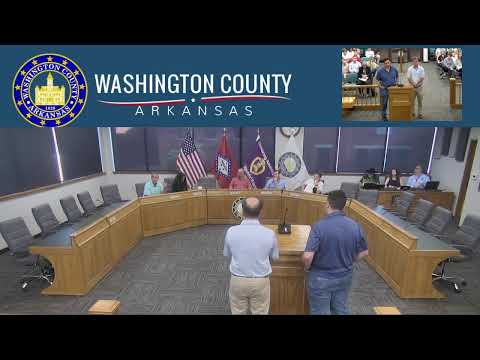
Planning commission rejects Mission Boulevard storage complex CUP after residents cite compatibility and runoff concerns
Summary
Washington County planning area commissioners voted 3–2 to deny a conditional use permit for a proposed multi‑building self‑storage complex in the Fayetteville planning area, with neighbors and attorneys citing incompatibility with adjacent residential subdivisions, water runoff and notice concerns.
The planning commission voted 3–2 to deny a conditional use permit for a proposed Mission Boulevard Secure Storage facility in the Fayetteville planning area, halting the applicant’s immediate effort to proceed to large‑scale development review.
Staff described the proposal as a multi‑phase storage development on roughly 8.3 acres north of East Mission Boulevard (Arkansas Highway 45), with 15 buildings proposed across two initial phases and a total building footprint of about 2.96 acres. The project team said it would employ one full‑time employee, offer standard office hours (Monday–Friday, 9 a.m.–5 p.m.; Saturday 9 a.m.–2 p.m.), and construct site drainage and detention ponds during the large‑scale development stage.
The staff report noted 63 written complaints in opposition and summarized neighbors’ concerns about traffic backups on Highway 45, compatibility with adjacent residential subdivisions, lighting and noise, potential crime and loitering, impacts to wildlife and water runoff into multiple ponds and creeks near the site. Staff also clarified that the property remains county jurisdictional property in the Fayetteville planning area and that any large‑scale development approvals will require separate submittals; staff noted a state legislative change affecting territory/jurisdictional planning areas would take effect about 90 days after April 16 but does not eliminate the county’s CUP process.
The applicant team was represented by George Duquesne of Blue and Associates and developer Henry Jordan. Duquesne said the developer owns other storage facilities in the region, that the company uses downward‑directed lighting and landscaping, and that road and drainage questions would be resolved in the large‑scale development process.
Multiple nearby residents and property owners — including attorneys representing families whose yards border the site — urged denial. "This is a residential subdivision," said Suzanne Clark, an attorney representing homeowners of Covington Park, arguing that the facility’s size and commercial nature are incompatible with surrounding lots and would reduce future residential development opportunities. Grace Johnson, another attorney representing adjacent property owners, pointed to Fayetteville’s moratorium on new water taps in parts of the area and referenced low areas and wetlands on parts of the parcel that neighbors say have failed perk tests.
Speakers also raised procedural objections: attorney Anita Schnee said the county notice requirements were not met for some neighboring owners and asked the commission to consider that due‑process concern. Residents cited potential negative fiscal impacts to the county if property values decline and asked commissioners to weigh the character of the neighborhood and nearby schools when judging compatibility.
After public comment, a motion to approve the CUP was made and seconded. The commission conducted a roll call vote: Anthony McNutt and Jay Piercy voted yes; Joe Maynard voted yes; Chantelle Perrier voted no; Lorna Sheckleford voted no. The motion failed 3–2. Staff told the applicant the denial can be appealed to the quorum court within 30 days.
Commissioners and staff repeated that denial of the CUP at this stage does not remove the applicant’s ability to address concerns, revise the proposal or pursue an appeal; the applicant may also submit the technical large‑scale development materials in a future application if appropriate.