Get Full Government Meeting Transcripts, Videos, & Alerts Forever!
Get email alerts on the Opioid Settlement topic
No spam. Unsubscribe anytime.
Josephine County hears applications for opioid-settlement funds; commissioners take no votes
Summary
Three organizations requested money from a roughly $1.3 million opioid-settlement balance for naloxone, ‘‘warm handoff’’ recovery support and community health worker training. The Board of County Commissioners heard presentations and public comment but did not move any of the grant agreements at the May 1 meeting.
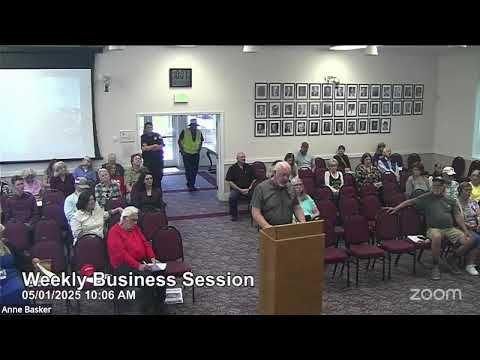
Josephine County commissioners on May 1 heard presentations for three proposed uses of local opioid-settlement money but did not approve any of the grant agreements at the meeting.
County staff said the county’s opioid-settlement account has about $1,300,000 available and that allowable uses are listed in the settlement Exhibit E — including naloxone distribution, medication-assisted treatment, programs for pregnant and postpartum women, warm-handoff and recovery services, syringe-service programs and data collection. Shawn Martinez, a county staff member who presented the proposals, described the application review process and the role of the county’s Addiction, Mental Health and Public Health Advisory Committee (AMPAC) in vetting requests.
The three applications described at the meeting were: - Mobile Integrative Navigation Team (Mint): requested $3,035,000 to expand warm-handoff programs and recovery services, including peer navigation, case management and support that can help people get to assessments, treatment or social services. Martinez said Mint would report progress to AMPAC in June and December and provide fiscal accounting to county staff. - Max’s Mission: requested $22,350 to support naloxone distribution, community training and hygiene supplies (dry kits, shower kits, dental kits and period packs). Martinez said Max’s Mission would report to AMPAC in September and March and provide fiscal accounting. - HIV Alliance: requested $12,170 for community-health-worker training and client services to remove barriers to treatment. Martinez said HIV Alliance would report to AMPAC in September and March and provide fiscal accounting.
Martinez said applicants were reviewed by a subcommittee of AMPAC that included mental-health, treatment, prevention and health-care representatives; the subcommittee asked some applicants to revise budgets and narratives to reduce duplication.
Public comment at the meeting was sharply divided. Some residents criticized programs that distribute syringes or hygiene kits, saying the materials were left in parks and public spaces. David Dapper of Grants Pass told commissioners, “Nonprofits are wanting more money. They take and take,” and called for stricter enforcement rather than distribution programs. Brian (Bridal) Weldon, speaking for ParkWatch, said he and others had been finding parks “completely littered with needles” and said some community events had moved locations over safety concerns.
Other speakers urged harm-reduction approaches. Corbin Foster, a Grants Pass resident, said he carries naloxone for family members and “I support the use of it.” Meadow Worley, a Grants Pass High School student, said menstrual supplies should be available to everyone, including people without stable housing: “Period products are or should be available to everyone.” Several other residents alternated between urging enforcement and asking elected officials to fund services and housing that address root causes.
When the board called for motions on the three grant agreements, no motions were made. Commissioners did not vote to approve or deny the Mint, Max’s Mission or HIV Alliance agreements at the May 1 session. Martinez told the board that AMPAC would continue oversight and that applicants would present program metrics and fiscal reports to AMPAC before returning to the Board of County Commissioners for further action.
The lack of a vote leaves the applications pending; applicants and AMPAC remain the next steps in the county’s review process.