Get Full Government Meeting Transcripts, Videos, & Alerts Forever!
Get email alerts on the Vehicular Homelessness And Shelter Expansion topic
No spam. Unsubscribe anytime.
HSH previews RV strategy, reports shelter capacity, new recovery and youth programs
Summary
San Francisco Department of Homelessness and Supportive Housing Director Shereen McFadden on May 1 outlined a strategy to address vehicle‑based homelessness and previewed new shelter programs and system performance data, saying the work will combine outreach, targeted incentives and expanded interim housing to make housing offers more attractive than living in vehicles.
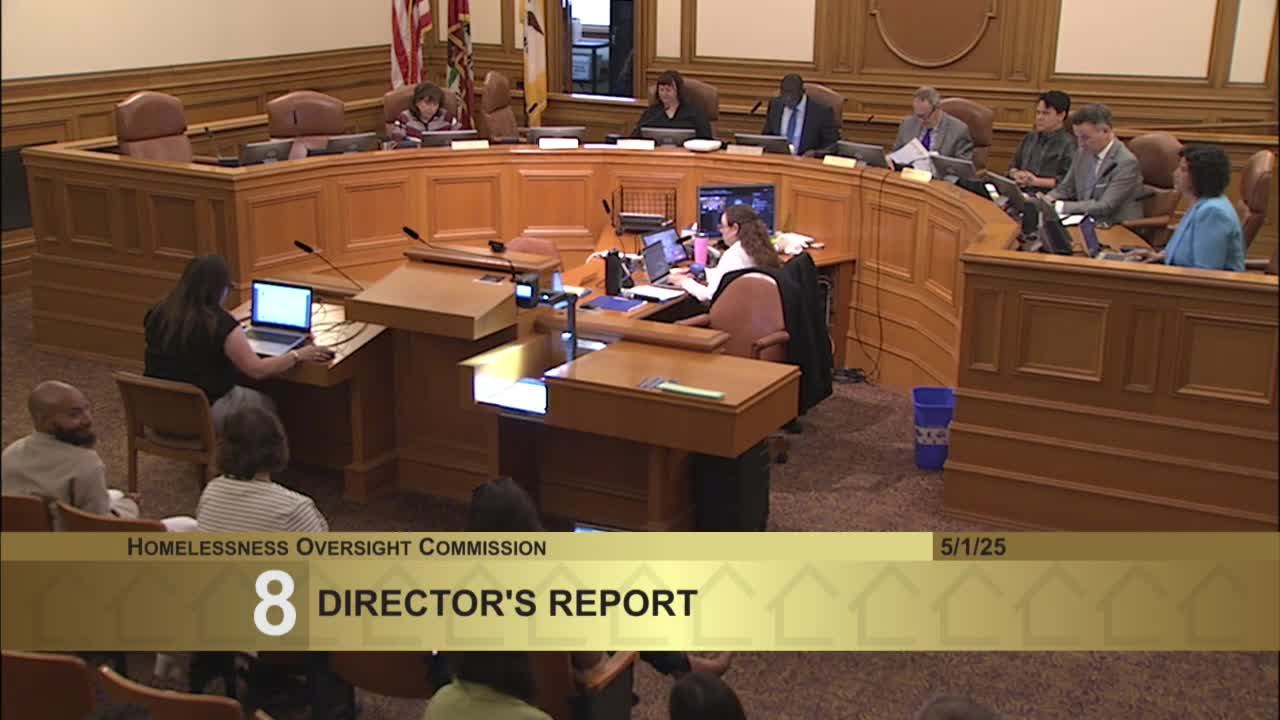
San Francisco Department of Homelessness and Supportive Housing Director Shereen McFadden on May 1 told the Homelessness Oversight Commission that the city is developing a multi‑pronged strategy to address people living in cars, oversized vehicles and RVs and previewed a set of shelter expansions and program changes aimed at preventing homelessness and increasing interim housing capacity.
McFadden said the number of vehicle‑dwelling households increased by 37% since 2022 to an estimated 1,444 households in the 2024 point‑in‑time count; a March 2025 Healthy Streets Operations Center (HSOC) field count found 472 occupied oversized vehicles. “Housing offers must be a rationally better choice than staying in a car or an RV,” she said, describing a strategy built around outreach, a dedicated RV/oversized‑vehicle task force, an RV outreach team that would pair SFMTA parking officers and homelessness outreach staff, and financial incentives such as an RV buyback program.
McFadden emphasized that the city plans to treat vehicle dwelling as a homelessness‑prevention issue and to design alternatives that preserve the autonomy and privacy people cite as reasons to stay in vehicles. She told commissioners that the city is still finalizing many operational details and will pilot interventions before wider rollout.
The director reviewed a range of system metrics for March and April 2025: HSH funds 13,511 units across supportive housing and rapid rehousing programs and moved 189 people into permanent housing in March 2025 (142 adults, 30 families, 17 young adults). On April 18 the shelter system had 3,832 guests and a 93% occupancy rate, and the site‑based supportive housing portfolio showed an 8.7% offline vacancy rate as of April 14, 2025. McFadden said the number of units offline for more than 90 days has decreased, even as short‑term offline time has risen due to turnover.
McFadden summarized the Controller’s Office assessment of the shelter system released in March 2025. She said the report found strengths in day‑to‑day collaboration between HSH and shelter providers and identified areas for improvement including staffing shortages, client supports for high‑need populations, data gaps and concerns about client experiences with meals, privacy and theft. The assessment’s client focus groups reported generally adequate safety but concerns about theft and a higher level of safety concerns among female participants.
McFadden also described near‑term and recently opened shelter initiatives. HSH is proposing to relocate the Buena Vista Horace Mann (BVHM) school stay‑over family program to Downtown High School in June to maintain the existing stay‑over model while BVHM undergoes renovations; HSH expects a possible two‑week operational gap and will work to rehouse or transfer current participants prior to closure. The department has opened Gerald Commons, a site with 60 cabins (68 beds) focused on older adults; HSH is exploring adding an 82‑bed dorm in an on‑site warehouse, 54 additional cabins or a 100‑bed sprung structure to expand capacity. McFadden noted eight cabins at Gerald Commons are prioritized for people willing to surrender RVs.
HSH is proposing a 60‑bed recovery‑focused shelter at the Sharon Hotel (226 Sixth Street) in partnership with the Salvation Army; on‑site services would include case management, treatment referrals and housing placement assistance. Funding for parts of the 1,500 interim‑bed effort reported at the mayoral level includes a mix of sources; McFadden said some sites are funded with opioid settlement funds and other state or HSH reallocated funds while additional grant applications (for example encampment grant funds) are pending.
On relocation assistance, HSH will assume management of the Journey Home program from the Human Services Agency beginning May 2025; phase 1 includes staff transfer and HSH provision of transportation and stipends, with phase 2 moving management to a competitively procured nonprofit contractor. McFadden said Journey Home will continue to connect clients to travel options and that some Journey Home clients did not previously receive a coordinated‑entry 1‑system ID but HSH expects to reevaluate enrollment processes after the transfer.
Commissioners and commenters pressed HSH on family needs and prevention. Megan Rohrer, policy director at Compass Family Services, said many vehicle‑dwelling households are families with small children and urged increased shallow subsidies, rapid rehousing and consideration of housing outside San Francisco that is transit‑accessible. McFadden and staff responded that families are visible in vehicle counts and that HSH is assessing sites both inside and outside the city; she noted legal placement outside the city is possible if a willing jurisdiction partners. Public commenters also urged HSH to include RV residents and their advocates in piloting and designing interventions and to avoid enforcement practices that remove vehicles without clear rehousing alternatives.
Commissioners asked for additional operational details and data: several commissioners requested follow‑up reporting on the RV pilot, outcome metrics from the Candlestick/VTC closures (HSH reported 17 households housed and several others pending placement in a recent update), and evaluations of prevention programs such as ERAP. Deputy Director Sarah Loker said ERAP evaluations are underway and that HSH is able to link ERAP recipients to the homeless response system post‑service for analysis.
The director closed by saying HSH is prioritizing service‑level segmentation (for older adults and high‑acuity clients), closer collaboration with the Department of Public Health on integrated services at new shelter sites, and continued coordination with the mayor’s office and other departments as the shelter expansion proceeds.