Get Full Government Meeting Transcripts, Videos, & Alerts Forever!
Get email alerts on the Parks topic
No spam. Unsubscribe anytime.
Marion County considers shifting parks standard from acreage to amenity-based measure
Summary
At a May 1 Marion County Board of County Commissioners workshop, staff outlined options to revise the county's parks level-of-service (LOS) standard from an acreage-based metric to a combined acreage-and-amenity approach and recommended codifying developer open-space and amenity requirements in the Land Development Code.
Marion County commissioners on May 1 discussed changing how the county measures parks service, weighing the long-standing acreage approach against a new amenity-focused or hybrid standard that would explicitly count playgrounds, courts and other facilities when judging park access.
Blair Knighton, a county staff member leading the comprehensive-plan workshop, said the county's current parks inventory counts 928 acres of county-managed parkland and uses a common benchmark of 2 acres per 1,000 residents as an example LOS. Knighton told the board those acreage calculations exclude lands the county does not manage (for example Ocala National Forest) and noted that large tracts such as Kearney Island and Horseshoe Lake can skew acreage-based metrics in low-population areas.
"This LOS is our LOS. This is what we come up with. This is what we want for our community," Knighton said, summarizing staff's recommendation to consider a combined acreage-and-amenity approach and to pilot amenity-based measures at a modest level before broader adoption.
Why it matters: Commissioners said rapid residential growth and the proliferation of private, amenity-rich developments have changed how residents access recreation. Vice Chairman Zalick pressed to ensure the comprehensive plan and the Land Development Code (LDC) explicitly require developers to provide usable open space or built amenities so neighborhoods do not rely entirely on county funding for small, local facilities.
Parks director Jim Coolard told the board the county has previously analyzed LOS both by acreage and by amenities. He said a 2016 master-plan exercise found that excluding large tracts produced only a de minimis change in countywide LOS but improved the ability to identify service gaps in high-growth corridors. Coolard also noted older planning choices and recent private development patterns have increased the number of private amenity centers (clubhouses, pools, HOA-run courts) in new subdivisions.
Commissioners debated how the county should credit private amenities. Commissioner Bryant questioned whether the county should count privately managed, members-only facilities toward county LOS if they're not open to the public; other commissioners noted the convenience and lower operating cost that private amenities can provide to residents inside those developments. Knighton and Coolard said staff's calculations currently count only parks the county owns or manages, not city parks or private HOA facilities, and commissioners asked staff to prepare alternative calculations that (a) remove municipal populations, (b) include city- or privately provided amenities to different degrees, or (c) adopt a combined acreage/amenity standard.
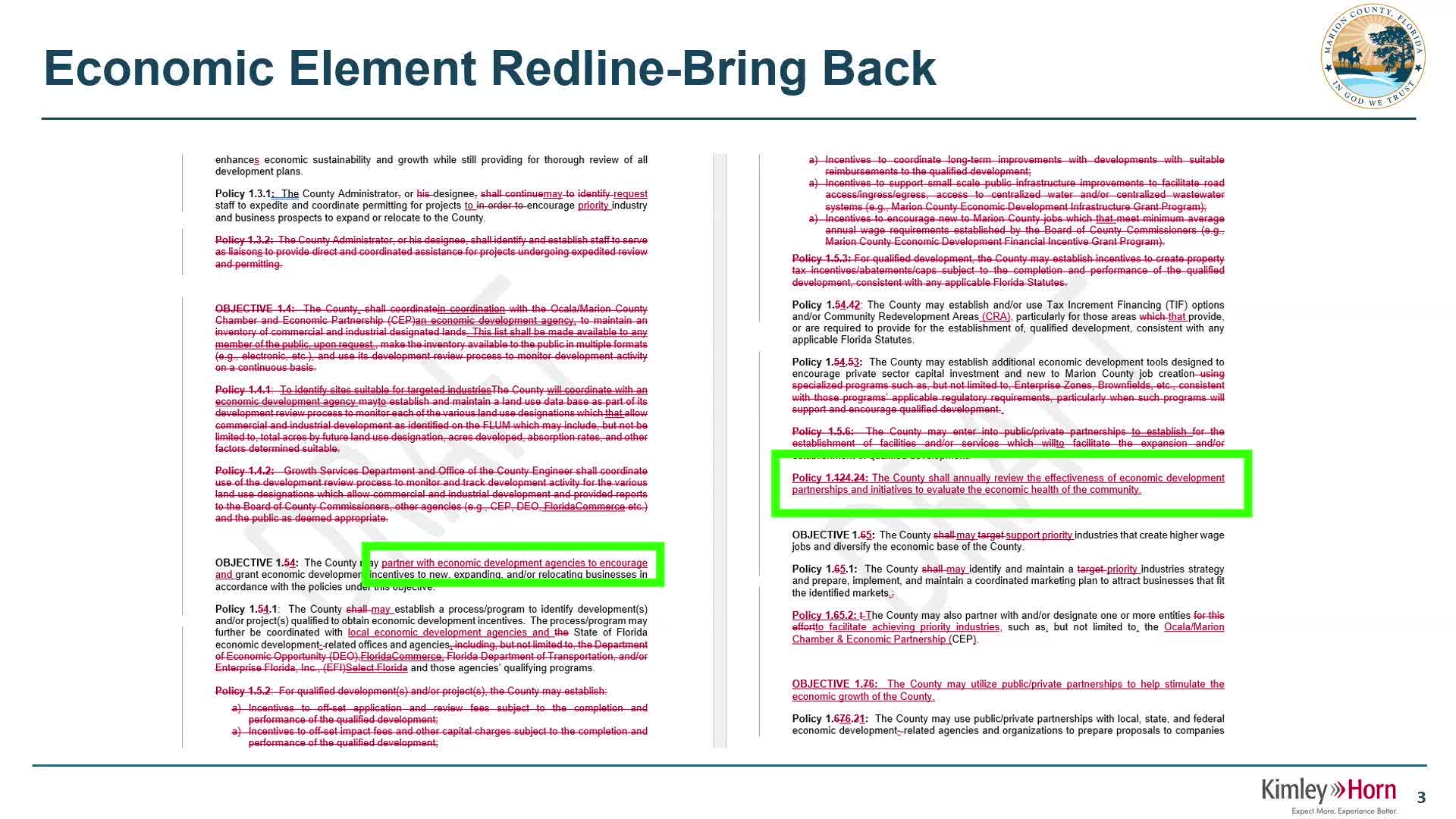
On developer requirements, the board discussed language already in the comprehensive plan that requires 350 square feet of open space per residential unit. Commissioners directed staff to refer the open-space and amenity specifics to the LDC so that the comp plan can reference code standards and so developers know expectations at application time. Several commissioners said that improved or "active" open space should be defined (for example a playground, pool, or courts) and that a portion of required open space should be required to be useable rather than purely passive or unusable buffers.
Staff presented operating-cost estimates to illustrate trade-offs between building many small neighborhood facilities versus investing in larger regional parks: neighborhood parks average about $20,000 per year to operate, community parks about $35,000 per year, and regional parks or sports complexes about $170,000 per year. Coolard said a large regional facility such as Rotary Sportsplex serves hundreds of youth per season and brings tournament activity that produces local economic benefit, but that such investments are capital- and operations-intensive.
Board members also discussed funding mechanisms used elsewhere: some counties pair developer-built amenities with regional park impact fees; others use mobility/transportation fees and separate impact-fee structures for parks, libraries and cultural facilities. Staff presented examples (Clay County, Sumter, Nassau, Citrus and St. Johns counties) to show how communities tailor LOS and fee systems to local needs.
Concerns and constraints: Commissioners raised two recurring concerns: (1) maintenance and long-term stewardship of developer-built amenities, especially in small HOA communities where insurance and operating funds can be limited; and (2) the county's limited real estate and the rising cost of land, which constrain where new public neighborhood parks can be built. Commissioners asked staff to propose definitions and a menu of amenity options tied to unit counts so standards are predictable and negotiable through the LDC rather than left to dais-by-dais negotiations.
Next steps: Staff will return with draft LDC language that defines "improved" (active) open space, clarifies what counts toward the county LOS, and presents alternate LOS calculations (county-owned only; county plus municipal inventory; and a combined acreage/amenity pilot). Commissioners signaled informal agreement to codify the 350-square-foot open-space baseline in the comprehensive plan and to move details into the LDC, while retaining the county's discretion to set its preferred LOS standard.
The workshop produced guidance rather than a formal vote; staff will prepare redlined comp-plan and LDC language for a future workshop and public review.