Get Full Government Meeting Transcripts, Videos, & Alerts Forever!
Get email alerts on the Transitional Kindergarten topic
No spam. Unsubscribe anytime.
Committee hears AB 1391 to extend TK funding to basic‑aid, community‑funded and necessary small school districts
Summary
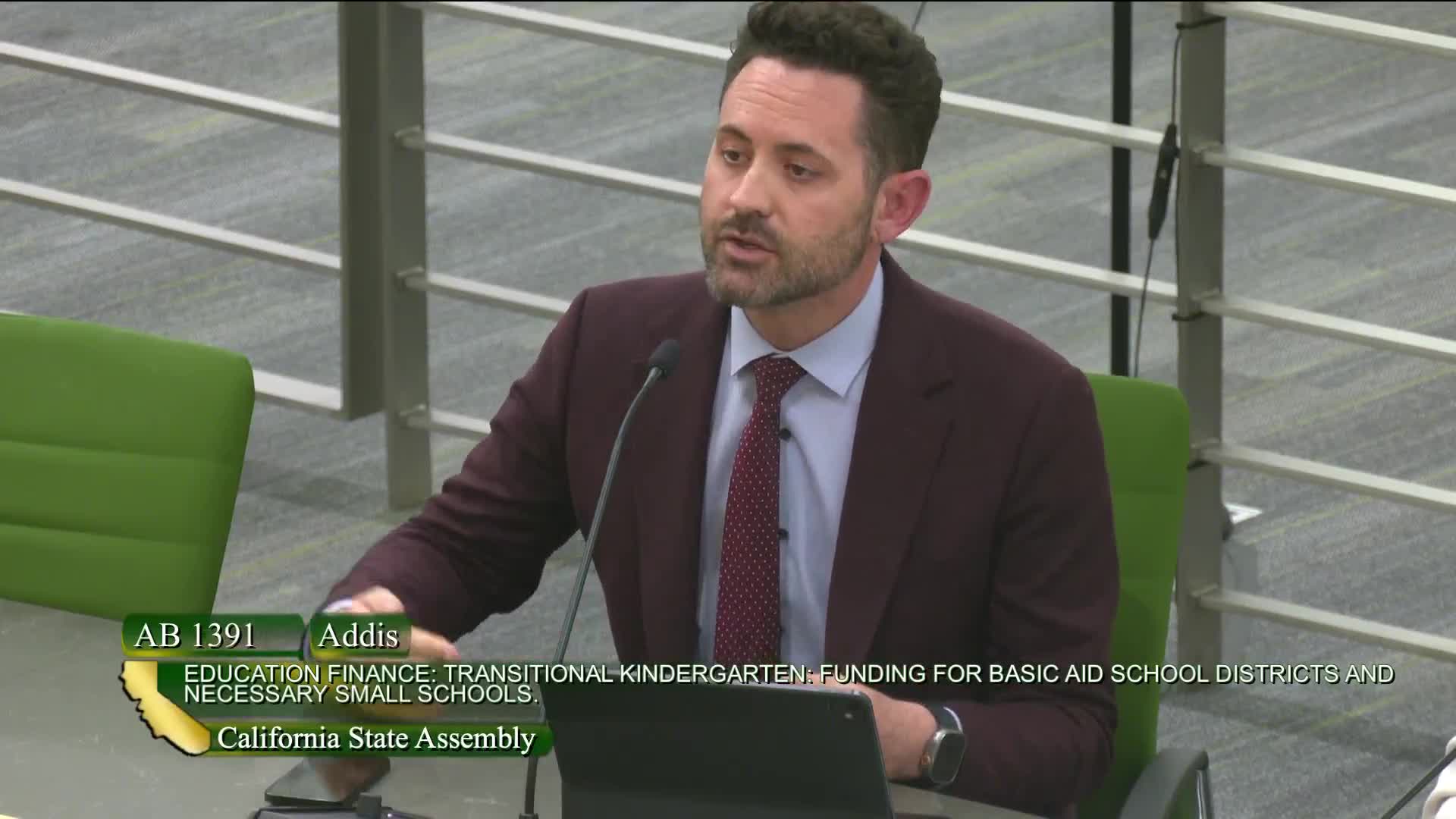
AB 1391, introduced by Assemblymember Rebecca Addis, would create a funding mechanism allowing basic‑aid, community‑funded and necessary small school districts to receive state Transitional Kindergarten funding for eligible four‑year‑olds.
Assemblymember Addis presented AB 1391, the Transitional Kindergarten Access Act, asking the committee to close an implementation gap in California’s expansion of universal TK (UTK). The bill seeks a funding mechanism so basic‑aid, community‑funded and necessary small‑school districts receive state TK funds for eligible four‑year‑olds rather than being left to absorb costs locally.
Witnesses described local examples. Monica Garcia, a TK teacher in San Luis Coastal (a basic‑aid district), said her district serves low‑income families and families working in service industries; because San Luis Coastal is basic aid and marginally above its LCFF target it faces budget pressure and had issued layoff notices while trying to stand up TK. Garcia said TK allowed her staff to identify a student’s speech needs and secure services early.
Barrett Snyder of the Small School Districts Association described technical features: necessary small schools operate under a statutory, non‑LCFF formula and by design were not captured by the LCFF distribution that has been used so far to distribute UTK funding. He said the governor’s Prop 98 expansion created statewide funds for 4‑year‑old attendance but the distribution currently flows through LCFF and therefore does not follow students in districts funded outside LCFF.
Supporters argued AB 1391 is a targeted fix so UTK funds “follow the child” where statutory funding status prevents local receipt of the new Prop 98 allocation. The bill had broad support from small‑district advocates, teacher groups and local superintendents; witnesses urged the committee to adopt the bill so basic‑aid and small districts can provide TK without layoffs or cutting other programs.
Several committee members praised the policy goal but urged caution about potential funding disparities. Chair Marisucci and others noted basic‑aid districts vary widely; a few basic‑aid districts generate very high per‑pupil funding and would receive additional TK dollars under a carve‑out, potentially widening funding gaps. Assemblymember Addis asked the author to continue negotiations and to consider financial equity protections. The chair flagged a separate process: the Commission on State Mandates is also due to review TK‑related mandate issues next month, and suggested careful coordination.
No formal vote was recorded in the portion of the transcript provided. Members expressed support for the idea but requested further policy and fiscal analysis and discussions with budget staff to ensure the proposal does not unintentionally widen disparities among districts.