Get Full Government Meeting Transcripts, Videos, & Alerts Forever!
Get email alerts on the Education Technology topic
No spam. Unsubscribe anytime.
Committee moves AB 1053 to require teacher and paraprofessional input on educational technology adoption
Summary
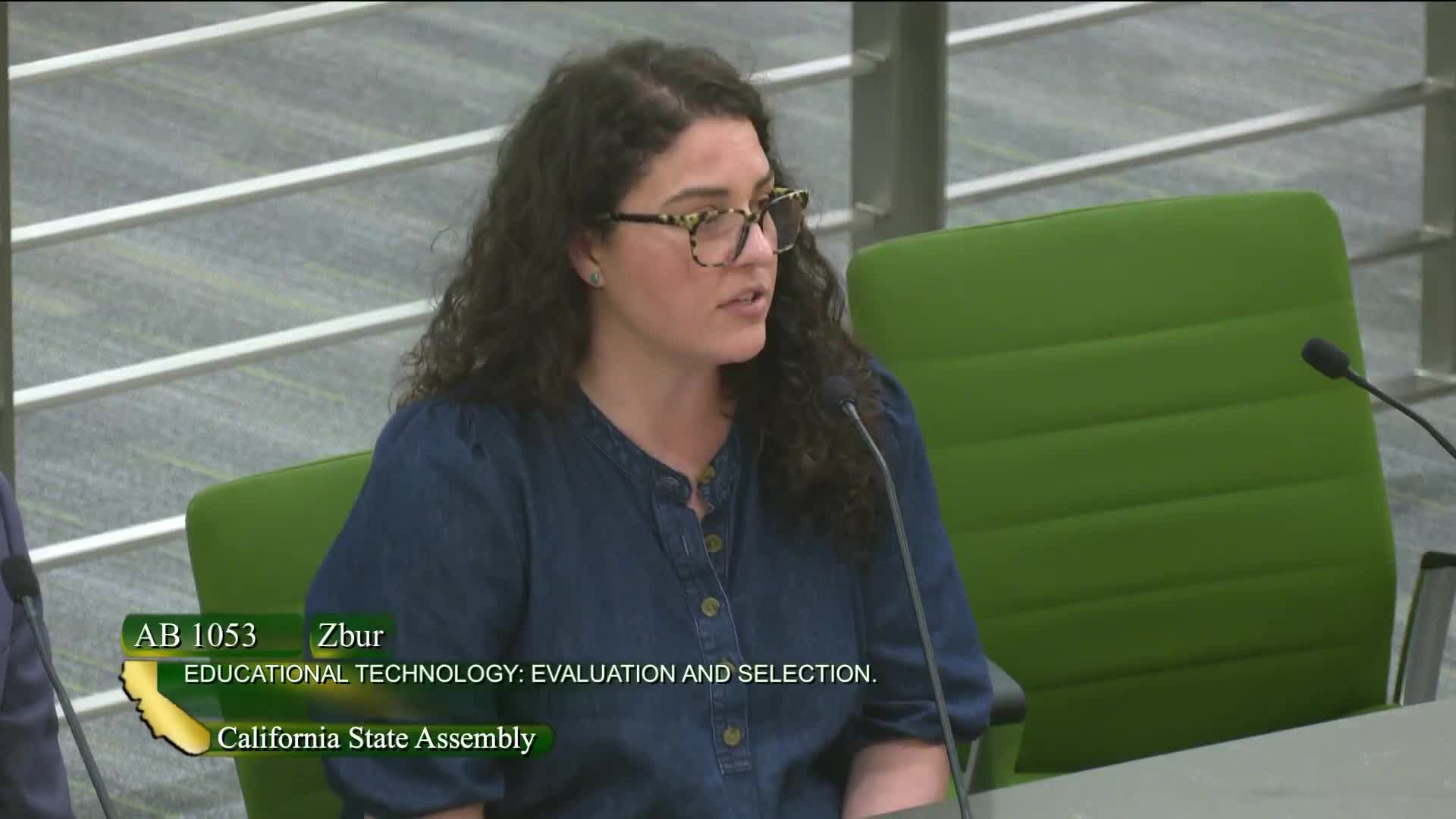
AB 1053 advanced to Appropriations after supporters argued that districts adopt educational apps and software without sufficient teacher input. County offices, school business officials and CTOs warned the bill’s current language is too broad and could create new local mandates without funding.
The Assembly Education Committee voted to pass AB 10 53 as amended to Appropriations, a bill that would require local education agencies to provide for “substantial” teacher and paraprofessional involvement — and promote parent and community input — when evaluating and selecting educational technology (ed‑tech) used in classrooms.
Assemblymember (Bill) Zibur, the bill’s author, said digital instructional materials and classroom apps are now ubiquitous but that there is no standardized local process requiring meaningful educator input before adoption. Tristan Brown of the California Federation of Teachers described examples in which administrative adoption of hall‑pass systems and virtual‑reality headsets disrupted instruction and increased teacher workload; the sponsor said the bill is intended to provide districts with guidance and to require the State Superintendent to post best practices.
Several county offices, the California Association of School Business Officials, the chief technology officers’ group and school business officials testified in respectful opposition. Their concerns focused on the bill’s broad definition of “educational technology,” which in committee testimony could sweep in attendance systems, gradebooks, notification tools and other software; they said the bill, as written, could force repeated substantial engagement processes across multiple operational systems and redirect staff time and funds from classrooms.
Opponents urged the author to narrow the bill’s definition and to limit the new process to instructional applications or to adopt a funding mechanism to support the staff time required for the “substantial” involvement the bill mandates. The author told the committee he was committed to narrowing scope in negotiations. Committee members emphasized the practical problem the bill seeks to fix — teacher workload, fragmented apps and inconsistent parent experience — and several members signaled conditional support, asking the author to continue working with opponents.
A motion to pass AB 10 53 to Appropriations carried; the committee recorded a roll call and left the item on call, reporting four recorded yes votes. The author said he would continue talks to narrow the bill’s scope and avoid unintended consequences for district governance and non‑instructional systems.
If enacted, AB 1053 would also require the Superintendent of Public Instruction to post best practices and resources to help LEAs evaluate and select ed‑tech, and would make teacher/paraprofessional involvement a required element of the local evaluation process for covered educational technologies.