Get Full Government Meeting Transcripts, Videos, & Alerts Forever!
Get email alerts on the School Safety topic
No spam. Unsubscribe anytime.
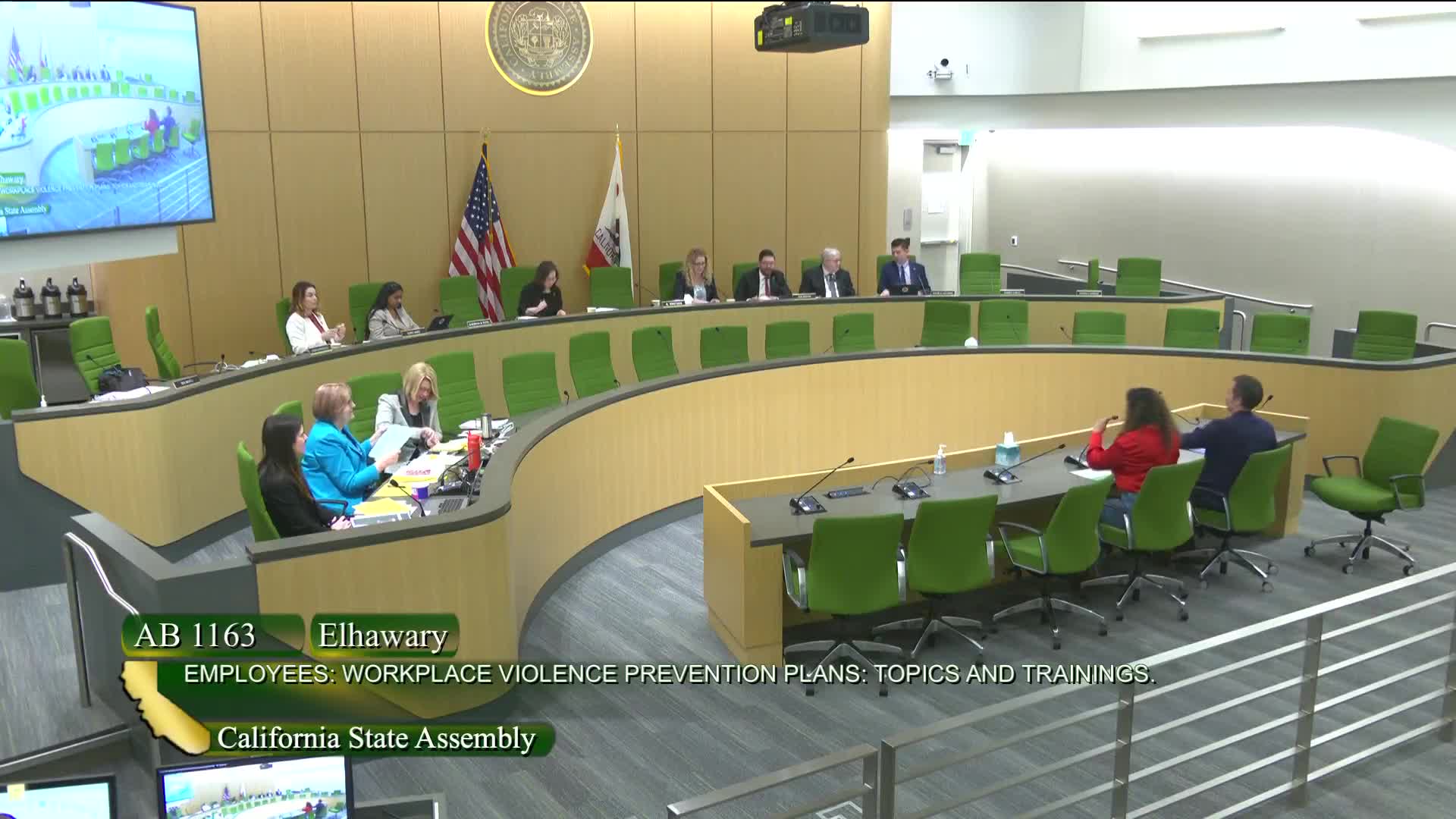
Committee advances AB 1163 to require school de‑escalation training for TK–12 staff; opponents seek clarifying amendments
Summary
The Assembly Education Committee on Tuesday advanced AB 1163, requiring the California Department of Education to develop school‑appropriate de‑escalation training for TK–12 staff and permitting its inclusion in existing workplace‑violence prevention programs.
The Assembly Education Committee advanced AB 11 63 (commonly cited as AB 1163 in testimony), a bill intended to ensure TK‑12 staff receive training in de‑escalation techniques tailored to the school setting. The bill, as amended in committee, directs the California Department of Education to develop guidance or training on de‑escalation techniques and allows this content to be included in existing workplace violence prevention training. The committee passed the bill as amended to Appropriations on a roll call recorded in the transcript as three recorded yes votes; the item was left on call for absent members.
Author Assemblymember El Hawari said the measure builds on 2023 workplace violence law and focuses on practical de‑escalation skills rather than behavioral plans. Mitch Steiger of the California Federation of Teachers, sponsor of the measure, told the committee many educators have experienced violent incidents and that targeted de‑escalation techniques could reduce injuries and prevent escalation.
Cassie Mancini of the California School Employees Association supported the bill. The Association of California School Administrators (ACSA) registered opposition to the version in print but indicated the committee amendments addressed several of its concerns; ACSA’s Dorothy Johnson said the bill had previously treated students with neurodiversity as workplace hazards and needed balancing language. Community college representatives asked that the bill’s scope not impose new requirements on community colleges; the Community College League of California registered respectful opposition and asked to work with the author to remove community college coverage.
Committee amendments removed a real‑time Q&A requirement, clarified that training could be virtual and that the curriculum must align with existing statutes and guidance on student behavior and restraint, and dropped language that could be read as requiring physical restraint instruction. After the amendments, several opposition witnesses said the revised language was a step forward but that they would need to review the changes before withdrawing their opposition.
Assemblymember El Hawari said the bill is about preparation, prevention and care. The sponsor and author urged an aye vote; the committee recorded a motion to pass as amended to Appropriations. The transcript shows recorded ayes from Marisucci, Hoover and Addis and the committee left the item on call with three votes recorded in favor.
If enacted, AB 1163 would require CDE to develop de‑escalation content for TK‑12 staff that could be provided as part of existing workplace violence prevention training or as a short standalone module; the bill as amended does not require in‑person delivery, allows virtual formats, and ties training content to existing student‑behavior statutes and guidance.