Get Full Government Meeting Transcripts, Videos, & Alerts Forever!
Get email alerts on the Charter Schools topic
No spam. Unsubscribe anytime.
Assembly committee advances AB 84 to tighten audits and oversight of charter schools after A3 fraud cases
Summary
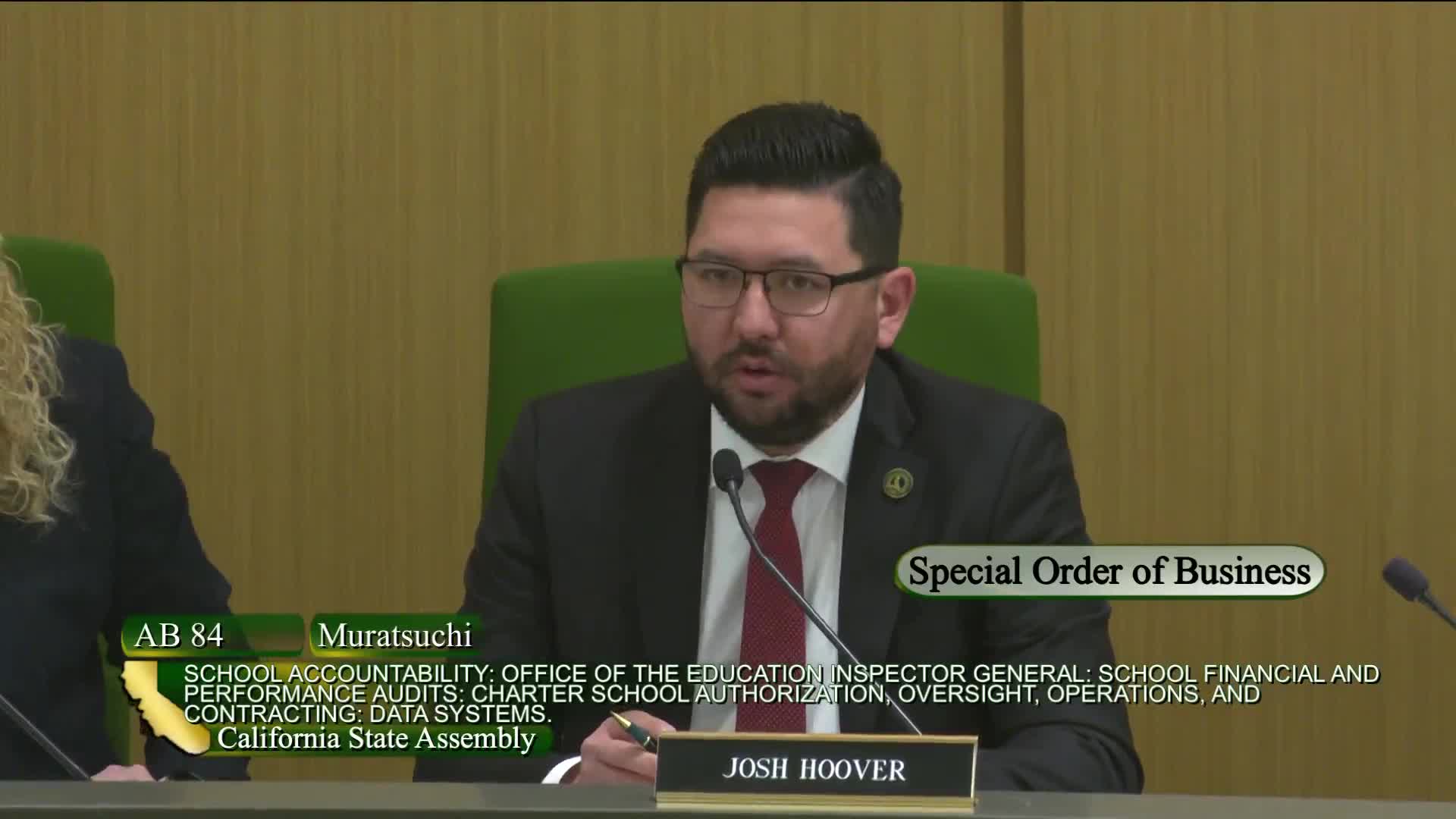
The Assembly Education Committee on Tuesday voted to pass AB 84, a measure to standardize audits and tighten oversight of charter schools and non‑classroom‑based programs, advancing the bill as amended to the Appropriations Committee.
The Assembly Education Committee on Tuesday voted to pass AB 84, a measure to standardize audits and tighten oversight of charter schools and non‑classroom‑based (NCB) programs, advancing the bill as amended to the Appropriations Committee.
Supporters said the bill responds to documented fraud, including the A3 charter network prosecutions, and implements recommendations from the Legislative Analyst’s Office (LAO), the state Fiscal Crisis and Management Assistance Team (FCMAT) and a State Controller task force. Opponents, including many charter school leaders and parents, said the measure is overly broad, will divert classroom dollars to oversight, and will unduly burden legitimate programs such as blended and independent study models.
The bill’s author, Assemblymember Marisucci, said AB 84 targets “bad actors” and implements three goals: strengthen audit and accounting practices statewide, reduce documented fraud among NCB charters, and reform school district oversight consistent with LAO and FCMAT recommendations. Mike Fine, CEO of FCMAT, told the committee AB 84 would remove audit language from charter petitions and explicitly apply uniform audit statutes and auditor‑training requirements to all local educational agencies (LEAs), including charter schools.
Cassie Mancini of the California School Employees Association, a cosponsor, said the bill would standardize audit procedures and improve authorizer oversight and the NCB funding‑determination process. Mancini and other supporters told the committee that the LAO found gaps in current funding determinations — notably that some NCB charters submit only a single year of expenditure data — which can hide improper use of LCFF dollars.
Witnesses from the California Charter Schools Association, represented by CEO Myrna Castrejon, and Green Dot Public Schools’ CEO Christina De Jesus testified in opposition. They said AB 84 would impose substantial new costs and oversight fees, potentially diverting more than $200 million annually from classrooms, and that the bill could punish legitimate blended and independent‑study programs. CCSA urged a more targeted approach and cited alternative legislative proposals.
Public testimony at the hearing included lengthy opposition from dozens of parents, teachers and charter representatives who said the bill would harm students served by flexible and home‑based charter programs, including medically fragile students. Supporters and cosponsors, including California Federation of Teachers, California Labor Federation and the Consumer Federation of California, urged the committee to act to prevent repeat fraud.
Committee members pressed the author and witnesses on two main tensions: (1) parity in audit standards between charters and traditional districts, and (2) how to strengthen authorizer capacity without creating perverse fiscal incentives for authorizers. The author said committee amendments already address capacity for small authorizers that can demonstrate staffing sufficiency and that she is open to further negotiations over oversight fee levels.
The committee adopted a motion to pass AB 84 as amended to the Appropriations Committee. The record in the hearing transcript shows the motion was moved by Assemblymember Bonta and seconded by Assemblymember Patel. The chair announced the bill “out” after the roll call produced a five‑to‑one margin in favor (5 yes, 1 no) and left the item on call for absent members. The transcript identifies the following recorded votes during roll call: Marisucci (aye), Hoover (no), Addis (aye), Bonta (aye), Lowenthal (aye) and Patel (aye).
The bill text, as presented, would: explicitly apply K‑12 audit statutes and auditor training/oversight to charter schools; revise the NCB funding determination process to account for the amount of in‑person instruction; require charter authorizers to demonstrate capacity to oversee large NCB charters; and implement other technical changes consistent with LAO/FCMAT recommendations. The author said she will continue discussions with charter groups and other stakeholders before the bill reaches the floor.
For now AB 84 moves to Appropriations as amended. Committee members and witnesses flagged remaining negotiation points: the size of any authorizer oversight fee increases, additional statutory guardrails tying fee revenue to specific oversight activities, and protections for rural or small authorizers who can demonstrate capacity to oversee charters.