Get Full Government Meeting Transcripts, Videos, & Alerts Forever!
Get email alerts on the Water Infrastructure topic
No spam. Unsubscribe anytime.
Dare County fast-tracks $16 million replacement of Roanoke Sound water line
Summary
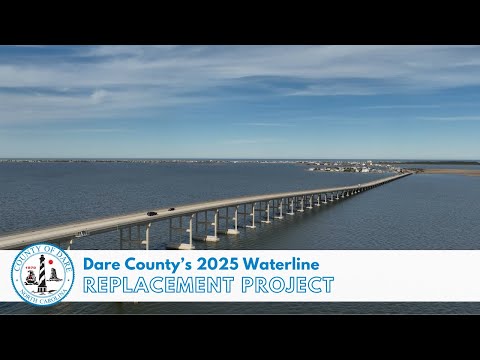
After damage discovered in December 2024, Dare County replaced a 1978-era undersea water line beneath the Washington Bomb Bridge with a deeper, larger-diameter pipeline in a project completed in April 2025, county staff said.
Dare County officials fast-tracked replacement of a damaged undersea water line beneath the Washington Bomb Bridge, installing a larger, deeper pipe in a $16,000,000 project completed in April 2025, county staff said.
The replaced pipeline originally installed in 1978 was a 16-inch diameter, 7,500-foot line that links the Skyco water plant on Roanoke Island to the North Reverse Osmosis plant in Kill Devil Hills. County staff said the North plant can deliver as much as 3,000,000 gallons of water per day during peak summer demand.
County staff described the December 2024 discovery of damage to the original pipe as the reason officials moved to proactively replace the line rather than risk a failure that could affect residents and the county's tourism-based economy. Officials said the February 2025 start date was accelerated so the work could finish by April 2025.
The replacement work installed a larger, more durable pipeline set about 80 feet beneath the Roanoke Sound floor, county staff said. The project used 30-inch poly pipe that crews joined on land by heating and fusing sections together. "They fuse all that together as, as they go . . . when you get done, you have an internal and an external bead that kind of rolls out when they're fusing it with the hot plates together," said Staff member 2, a staff member (first referenced here) describing the fusion process.
Crews used a bore-and-pull method to place the pipe. Staff member 3, a staff member, said crews drove 180 feet of casing from one side and about 205 feet from the other, then used two drill rigs to meet in the middle with a 12-inch pilot hole that was enlarged in stages to approximately 48 inches. The team then pulled the pipe through the bore; staff described the pull as a continuous operation that could take 14 to 18 hours without stopping to reduce the risk of the pipe getting stuck.
Before commissioning, team members air-tested the assembled pipe between 60 and 80 psi, monitoring for leaks for about an hour, Staff member 2 said. After testing and pressure monitoring, crews "bleed off that air," the speaker added.
Project design included redundancy, county staff said. The replacement pipe was chosen at a larger diameter so the new line could serve as a casing: if the pipe were later damaged, the county could run a new line inside the replacement pipe and still meet summer demand, staff said.
Speakers gave differing lifespan estimates for the new pipe in the transcript. One staff speaker described the material as having a "lifespan of 100 plus years," while another described the design as offering a "hundred and 50 year lifespan." The county did not provide a formal lifespan warranty or an agency citation in the transcript.
The county described the project as intended to prevent an interruption to the water supply that would affect residents and tourism businesses; the transcript did not specify the funding source for the $16 million cost.
Questions about warranty terms, the funding source for the project and any follow-up inspection schedule were not specified in the provided remarks.