Get Full Government Meeting Transcripts, Videos, & Alerts Forever!
Get email alerts on the Energy Policy topic
No spam. Unsubscribe anytime.
Ohio House concurs with Senate changes to energy bill, clearing Sub. H.B. 15
Summary
The Ohio House agreed to Senate amendments to Sub. H.B. 15 after floor remarks from sponsors, voting 94–2 to concur. The bill includes tax provisions for new generation equipment, a school energy loan fund, changes to power-siting timelines and PUCO reporting requirements.
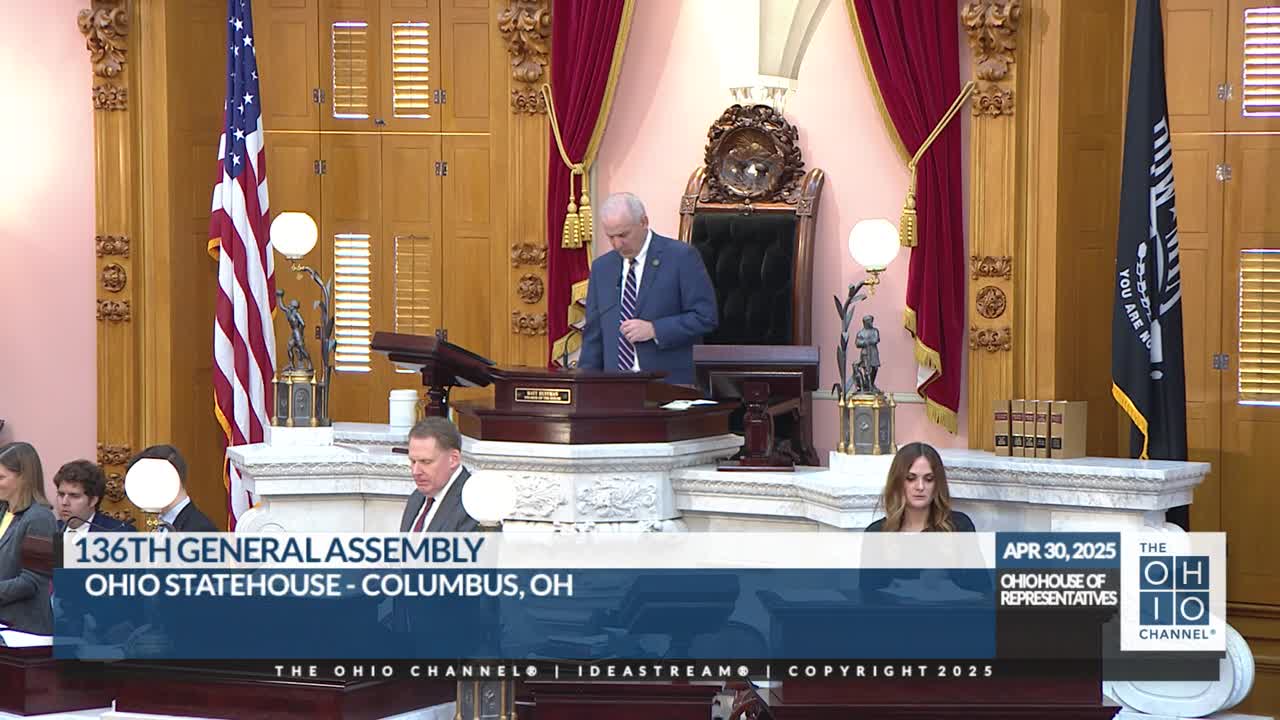
Columbus — The Ohio House of Representatives voted to concur with Senate amendments to Substitute House Bill 15 on the floor Tuesday, approving the technical, multi-part energy measure 94–2.
The bill, a rewrite of earlier House energy legislation, makes multiple changes lawmakers said are intended to shore up reliability and lower costs. Representative Jon Klopfenstein, the bill sponsor, told colleagues the measure adds a 7% tangible personal property tax rate for specified new generation and energy conversion equipment, creates a loan fund to help certain schools pay for energy conservation projects using leftover monies from the solar generation fund, and requires the Ohio Power Siting Board to complete adjudication of cases within 150 days after an application is deemed complete.
"Sub House Bill 15 is highly technical. It's received input from countless parties throughout the committee process in our respective chambers," Representative Klopfenstein said on the floor. "We know that PJM has issued significant warnings ... that we are heading towards an energy shortage crisis across its entire market as soon as next year 2026. ... Sub House Bill 15 is a great step in this important process."
Ranking member Representative Glassburn said the bill contains consumer protections and opportunities to add more generation quickly. "Energy costs will be lowered upon, the signing by the governor, and there will be additional energy generated that will be reliable for consumers," Glassburn said.
Representative Holmes, who spoke as chair of the House Energy Committee, framed the vote as the product of bipartisan, interchamber work and thanked agency staff. "The mission of the Ohio House Energy Committee is to ensure Ohio citizens have reliable, resilient, and affordable energy forever," Holmes said.
Key provisions described to the chamber include: - A 7% tangible personal property tax rate for qualifying new generation and energy conversion equipment. - Creation of a school energy performance contracting loan fund administered by the Ohio Facilities Construction Commission, to be seeded by remaining balances from the solar generation fund after project payments are made. - A 150-day completion requirement for Ohio Power Siting Board (OPSB) proceedings once an application is deemed complete. - Requirements for utilities to submit adjustment dates and reconciliation proposals to the Public Utilities Commission of Ohio (PUCO) within specified time frames. - Protections preventing entities from shutting down baseload generation under certain circumstances.
Sponsors emphasized the bill is technical and the result of negotiation with stakeholders and the Senate. Representative Klopfenstein said the Senate removed and revised some provisions and added clarifying language about which projects qualify for the tax rate and the loan-funding mechanism.
The House prepared and proceeded to a roll-call vote; the clerk recorded 94 affirmative votes and 2 negative votes, and the chamber announced the Senate amendments were agreed to.
Implementation details — including the method for calculating transfers from the solar generation fund, the scope of equipment eligible for the reduced tax rate, and the precise PUCO filing deadlines — were described in floor remarks but will be detailed in the bill text and implementing rules.
The bill now heads to the governor for signature or veto action.