Get Full Government Meeting Transcripts, Videos, & Alerts Forever!
Get email alerts on the Statelegislation topic
No spam. Unsubscribe anytime.
Assembly environmental committee advances a package of water, public‑health and product‑safety bills
Summary
The California State Assembly Environmental Safety and Toxic Materials Committee on Thursday advanced a package of bills addressing tribal water uses, water affordability, product safety and hazardous‑waste handling. Most measures were referred to fiscal review with authors and stakeholders asked to refine several technical provisions.
The California State Assembly Environmental Safety and Toxic Materials Committee advanced a group of bills covering water policy, consumer safety and hazardous‑waste management during a multi‑hour hearing. Committee members voted to move most measures to the next fiscal committee for further review, but several items drew extended public testimony and requests for amendments.
The package addressed a range of issues: statutory recognition of tribal water uses (AB 362); a statewide low‑income water rate assistance program (AB 532); age verification for anti‑aging skin products (AB 728); rules to let schools and household hazardous waste sites accept and recycle confiscated vape pens (AB 998); regulatory studies of copper‑based antifouling boat paints (AB 773); fee relief for geothermal hazardous‑waste streams (AB 1031); exemptions to streamline photovoltaic (PV) module recycling (AB 846); a first‑in‑the‑nation proposal to phase out particularly harmful ultra‑processed foods from school meals (AB 1264); a ban on intentionally added plastic microbeads in certain rinse‑off and cleaning products (AB 823); a requirement that the State Water Resources Control Board hold public hearings and vote on CWA §401 certifications for hydroelectric projects (AB 1373); a public‑health bill limiting youth access, marketing and packaging for kratom products and proposing a potency cap for 7‑hydroxymitragynine (AB 1088); and a proposal to add large commercial properties to a statewide stormwater permit to expand capture and treatment options (AB 1313).
Votes and next steps
Most bills were moved forward on motions to “do pass” to the Assembly Committee on Appropriations (or to Utilities and Energy for AB 532). Several motions were taken with the understanding that authors and stakeholders would continue negotiating amendments on the floor or in fiscal committee. Committee staff left some roll‑call votes open for absent members where noted.
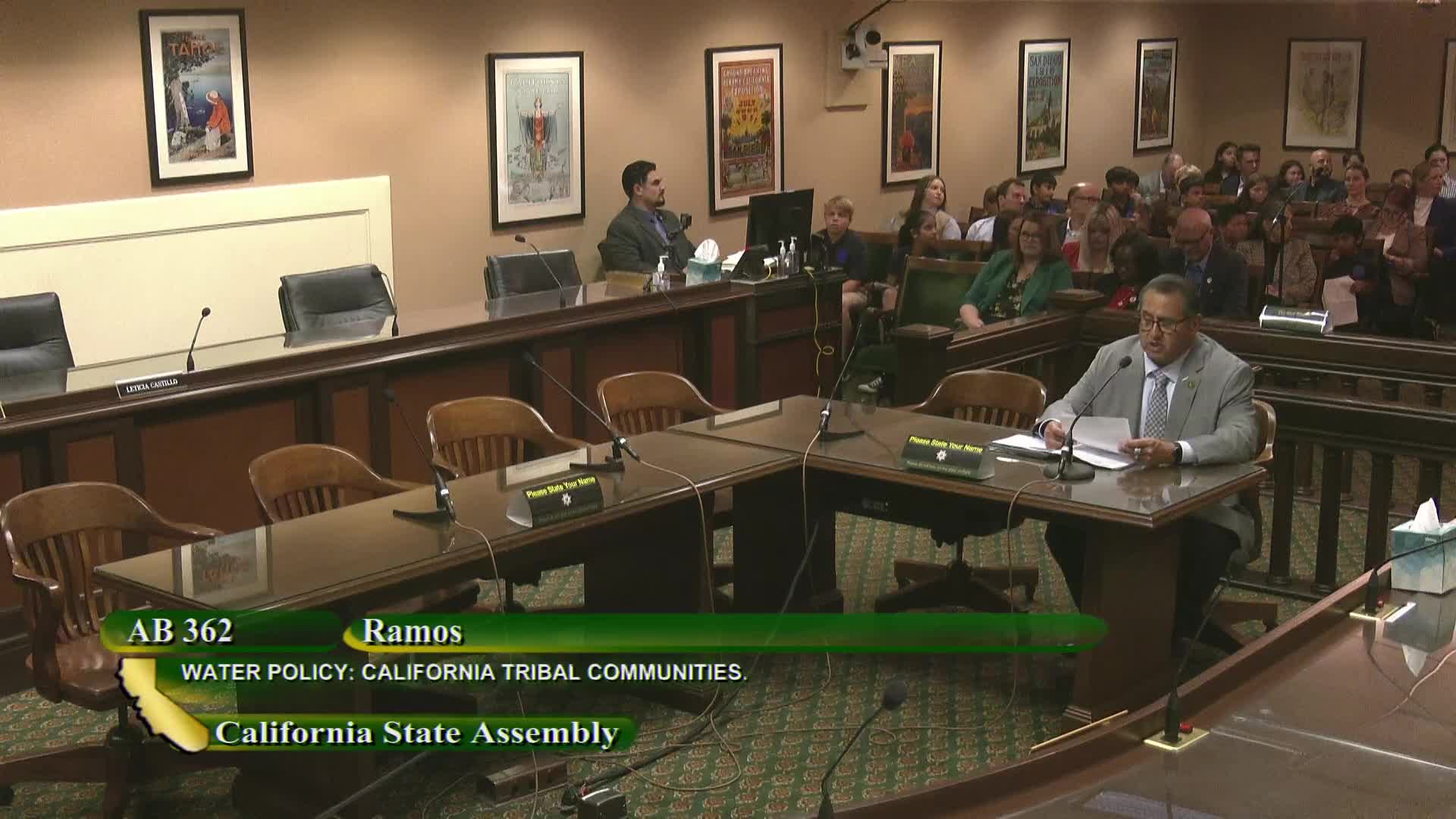
Votes at a glance (committee action at this hearing) - AB 362 (Ramos) — Tribal beneficial water uses: Due passed to Appropriations (moved; continued negotiations noted on CEQA language). Public supporters included Melissa Tayaba (Shingle Springs Band of Miwok Indians) and multiple tribal and conservation organizations; opposition came from the Association of California Water Agencies and agricultural stakeholders who asked for clarifying amendments. (Action advanced.)
- AB 728 (Lee) — Age verification for anti‑aging skin products sold to minors: Due passed to Appropriations (committee recommended “aye” with members requesting narrower definitions and clearer carve‑outs for medically indicated acne treatments). Testimony included an 11‑year‑old witness describing skin injuries and experts for both the Children’s Advocacy Institute and the California Society of Dermatologists, who warned the bill could block medically useful over‑the‑counter acne products. (Action advanced; authors said they will refine definitions.)
- AB 532 (Ransom) — Statewide low‑income household water assistance (CA‑LIHWAP): Due passed to Utilities and Energy. Sponsors and municipal utilities supported the bill as a way to provide sustained bill relief and to clarify authority for local urban retail suppliers to operate affordability programs. (Action advanced.)
- AB 773 (Dixon) — Copper‑based antifouling paint: Due passed to Appropriations. The bill directs DPR and the State Water Board to coordinate studies and set timelines for reevaluation of low‑leach paints and for shared methods to address elevated copper concentrations in harbors, bays and marinas. City officials and recreational boating groups supported the bill; technical questions about other metals and long leach lifetimes were raised. (Action advanced.)
- AB 998 (Hadwick) — Household hazardous waste and vape pens: Due passed to Appropriations. The bill would allow schools to deliver confiscated vape devices to household hazardous waste (HHW) facilities, allow HHW facilities to disassemble devices for safer recycling, and consolidate duplicative reporting. County and rural representatives supported the measure. (Action advanced.)
- AB 1031 (Gonzalez) — Geothermal hazardous‑waste fees: Due passed to Appropriations. The measure targets DTSC fee structure for certain low‑risk geothermal waste streams to lower barriers to geothermal and lithium‑related projects in Imperial County and other regions. Local officials and renewable‑energy producers testified in support. (Action advanced.)
- AB 846 (Ward) — PV module recycling / hazardous‑waste exclusion: Due passed to Appropriations. The bill would allow non‑hazardous PV modules to be managed as universal waste or be transferred to approved recyclers under federal transfer‑based exemptions, and permits DTSC to set alternative management standards for reuse and recycling. Industry groups and recyclers supported the bill. (Action advanced.)
- AB 1264 (Gabriel) — Phase‑out of particularly harmful ultra‑processed foods (UPFs) from school meals: Due passed to Appropriations. The bill would create a statutory definition for UPFs and direct state scientists (with UC experts) to identify a subcategory of “particularly harmful” UPFs to phase out of school meals by a future date. Supporters included medical and public‑health groups; food‑producer associations and several agricultural organizations urged narrower drafting or alternative approaches. (Action advanced; authors signaled willingness to refine definitions and to work with industry.)
- AB 823 (Berner) — Ban on plastic microbeads in personal‑care and cleaning products: Due passed to Appropriations. The bill would ban sale of non‑rinse personal‑care and cleaning products that contain intentionally added plastic microbeads starting Jan. 1, 2029 (not retroactive). Public‑health, environmental and municipal wastewater districts supported it; some trade groups moved to neutral after amendments. (Action advanced.)
- AB 1373 (Soria) — CWA §401 hydroelectric certifications: Due passed to Appropriations. The bill requires the State Water Resources Control Board to hold a public hearing and a board vote for 401 certifications for hydroelectric projects rather than delegating authority to staff. Irrigation and water districts in the Central Valley testified that draft staff conditions could impose operational requirements the districts could not meet; supporters said the change increases transparency for decisions that can affect water supply for decades. (Action advanced.)
- AB 1088 (Baines) — Kratom regulation and youth protections: Due passed to Appropriations. The bill would set a minimum purchase age of 21 for kratom products, require child‑resistant packaging and bans on youth‑targeted marketing, and propose a cap on 7‑hydroxymitragynine potency (the bill included a 2%‑of‑total‑alkaloids approach that generated substantial debate). Law‑enforcement groups and proponents of stricter controls supported the measures; members of the kratom industry and patient advocates urged removal or revision of the 2% potency cap and asked for more science‑based regulatory work. The author and opponents agreed to continue discussions on potency tests and enforcement. (Action advanced.)
- AB 1313 (Pappen) — Statewide commercial stormwater permit: Due passed to Appropriations. The bill directs the State Water Board to develop a statewide commercial stormwater permit focused on large commercial properties to expand on‑site capture and off‑site compliance options. Supporters said the measure would distribute responsibility equitably and incentivize green infrastructure; cities, utilities and business groups raised legal and administrative concerns about statewide scope, implementation complexity, costs, and potential private enforcement. (Action advanced with ongoing stakeholder negotiations.)
Why the hearing mattered
Several bills elicited extended testimony that clarified trade‑offs. AB 728 (skin products) drew widely divergent expert views: pediatric and children’s advocates described product packaging and social‑media marketing that they say target young users and recounted injuries; dermatology medical groups warned the bill could restrict access to over‑the‑counter treatments (eg, adapalene) used for acne and other medical conditions. The committee recommended the bill move forward with the author and stakeholders asked to refine definitions and carve‑outs.
AB 1088 (kratom) drew a sustained debate over how to define and regulate concentrated 7‑hydroxymitragynine products versus traditional kratom leaf preparations. Law‑enforcement and public‑health witnesses argued for potency limits and age restrictions; user and industry witnesses warned that a single numeric cap (the bill’s 2% formulation as debated) could create a market loophole that allows high‑dose products through alternate formulations and urged policy shaped by ongoing toxicology and clinical studies.
AB 362 (tribal water uses) and AB 1373 (401 certifications) focused on water governance and procedural changes intended to expand tribal consultation and public oversight; water‑agency groups and agricultural stakeholders asked for technical edits and clarity on how new duties would interact with existing law (including CEQA and the Porter‑Cologne Water Quality Control Act).
What the committee did not decide
Most bills were advanced to fiscal review (Appropriations) or the assigned fiscal/subject committee. Committee members repeatedly left the record open for ongoing negotiations and asked authors to report back with refined language on contentious technical points: CEQA implications and exemptions (AB 362); a narrower, enforceable definition of “anti‑aging” products (AB 728); specific milligram or testing standards for kratom potency (AB 1088); and the appropriate legal mechanism and scope for a statewide commercial stormwater permit (AB 1313).
Speakers (selected; testimony and attributions recorded in the transcript) - Committee: Chair Connolly; Vice Chair Stan Ellis; Members Bauer‑Kahan, Castillo, Lee, McKinnor (McKenner/McKenna in transcript), Pappen, Ramos (author of AB 362), and others. - Authors and primary witnesses: Assemblymember Ramos (AB 362); Melissa Tayaba (vice chair, Shingle Springs Band of Miwok Indians); Max Gomberg (technical witness); Assemblymember Lee (AB 728); Scarlett (11‑year‑old witness); Ed Howard (Children’s Advocacy Institute); Dr. Jason Castillo (CalDerm); Assemblymember Ransom (AB 532); Andrea Abbergell (California Municipal Utilities Association); Danielle Coates (Rancho California Water District); Assemblymember Dixon (AB 773); Chris Miller and John Kapler (Newport Beach); Assemblymember Hadwick (AB 998); John Kennedy (RCRC); Assemblymember Jeff Gonzales (AB 1031); Ryan Kelly and Barry Bean (Imperial County); Assemblymember Ward (AB 846); Evelyn Butler (Solar Energy Industries Association); Assemblymember Gabriel (AB 1264); Scott Faber (Environmental Working Group); Assemblymember Berner (AB 823); Dr. Tracy Woodruff (UCSF); Assemblymember Soria (AB 1373); Stephanie Dietz (Merced Irrigation District); Assemblymember Baines (AB 1088) and multiple law enforcement supporters; and Assemblymember Pappen (AB 1313).
Authorities and legal references raised in testimony - Clean Water Act, Section 401 (CWA §401) — discussed in AB 1373 testimony and in the description of state water‑quality certification authority. - Porter‑Cologne Water Quality Control Act — cited by witnesses in water‑quality and tribal‑use testimony (transcript rendered it phonetically as “Porta Colon”). - California Environmental Quality Act (CEQA) — referenced in AB 362 debate over analysis requirements and exemptions. - Proposition 218 — referenced in AB 532 affordability discussion as local legal context affecting utility programs.
Clarifying details captured from committee record - AB 362: Author and sponsor asked for continued negotiation especially on CEQA language; one regional water board had already adopted enforceable tribal water‑use protections in one watershed, the transcript said. - AB 728: Author said bill does not target acne medications or prescription products; dermatologists warned adapalene (an OTC retinoid) is FDA‑cleared for minors and used for acne care. - AB 532: Bill envisioned both local urban supplier authority and a CA LIHWAP administered by the Department of Community Services and Development (CSD); many municipal and regional water agencies supported the approach. - AB 773: Bill requires DPR reevaluation by 12/1/2028 and joint studies by 6/1/2027 to coordinate regulatory approaches for copper leaching and harbor concentrations. - AB 998: Bill would allow schools to deliver confiscated vapes to HHW facilities, permit safe disassembly at facilities to separate batteries, nicotine cartridges and electronics, and streamline duplicative CalRecycle and DTSC reporting schedules. - AB 1031: Sponsors said DTSC hazardous‑waste fees have been a cited cause for suspending geothermal projects in Imperial County; supporters provided projected local tax and income figures for several canceled projects. - AB 846: Bill creates a transfer‑based exemption mechanism for nonhazardous PV modules when transferred to certified recyclers and directs DTSC to consider alternative management standards for reuse and repair. - AB 1264: Author proposed a two‑step process: statutory definition of UPFs and an expert‑led process (state scientists + UC experts) to identify a subcategory of “particularly harmful” UPFs to phase out of school meals; dozens of public‑health groups supported the policy; industry asked for narrower scope and alternatives. - AB 1088: The potency‑cap debate centered on whether a percentage (2% of total alkaloids) inadvertently creates a loophole permitting dangerous concentrated products; opponents requested a milligram‑based cap or more scientific basis before a numeric limit is imposed. - AB 1313: The bill would apply to large commercial properties (5 acres or larger impervious area threshold was discussed) and contemplates on‑site capture, off‑site compliance credits and regional projects; cities and water agencies asked for alternatives to a single statewide NPDES approach and raised concerns about administrative complexity and costs.
Meeting context and engagement - Items heard: 12‑plus substantive measures, with a consent block at the start of the hearing. - Public engagement: widespread — each bill drew a mix of sponsor witnesses, nonprofit advocates, trade groups, local government officials and individual testimony. - Implementation risk: varied by bill — AB 1031 and AB 532 depend on federal/state program coordination and local fiscal capacity; AB 1313 raises high implementation complexity; AB 728, AB 1088 and AB 1264 require technical rulemaking or scientific guidance to implement.
Next steps
Most bills were referred to Appropriations for fiscal review, or to Utilities and Energy (AB 532). Committee members repeatedly requested that authors and stakeholders negotiate clarifying amendments before the bills reach the floor or a fiscal subcommittee. Several authors publicly invited additional stakeholder meetings and requested the committee be kept informed of negotiated language.
Ending
The committee’s actions advanced a sweeping group of measures that will now be reviewed for fiscal and policy details. Several items — notably AB 728 (skin products), AB 1088 (kratom), AB 1313 (commercial stormwater) and AB 362 (tribal water uses) — remain in active negotiation and are likely to see further substantive drafting changes as they move toward the Assembly floor and the fiscal committees.