Get Full Government Meeting Transcripts, Videos, & Alerts Forever!
Get email alerts on the Resentencing Immediate Release topic
No spam. Unsubscribe anytime.
MDOC: Recent resentencing rulings for young offenders could prompt immediate releases of hundreds; department urges transitional support
Summary
The Michigan Department of Corrections told the House Judiciary Committee that recent court rulings affecting people sentenced at age 19–20 could require the department to release hundreds of people quickly; MDOC urged the Legislature to fund transitional services for immediate discharges.
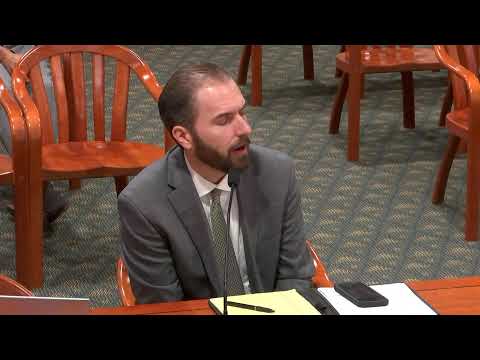
Kyle Kaminski, OS administrator and legislative liaison for the Michigan Department of Corrections, told the House Judiciary Committee the agency has identified hundreds of cases that could be affected by recent court decisions on youthful offenders and resentencing.
“We believe roughly 582 cases” may be impacted by the recent 19–20-year-old resentencing decision, Kaminski said. He added the department estimates about 300 additional cases from earlier youth-related decisions could be subject to resentencing, putting the total in the area of 900 cases — “which is significant,” he told the committee. Kaminski said some of those cases will remain covered by other life sentences and that the tally may change as courts correct records.
Kaminski described how historical credit systems affect whether a resentenced person would be immediately discharged or become eligible for parole. He summarized the different credit regimes by era: good-time credits that applied to both minimum and maximum terms, the Proposal B period (disciplinary credits on the minimum, good time on the maximum), and later eras that used disciplinary credits. MDOC staff ran a first-pass analysis and identified categories that could lead to immediate discharge if a court imposes a term of years:
- About 41 cases appear to fall into the group where good-time credits on both minimum and maximum likely would produce immediate discharge if resentenced. - Roughly 22 cases fall into the Proposal B window and could also be discharged immediately. - A larger cohort would likely become parole-eligible after resentencing rather than be immediate discharges.
Kaminski told the committee that when a court issues a new judgment of sentence that produces an immediate discharge, MDOC’s legal jurisdiction ends and the agency must physically release the person even if victim notification is still pending. He said the department can provide notice once it receives the new judgment, but it cannot hold someone past the statutory limit to allow additional notice. That dynamic, he said, creates challenges for victim notification and for arranging reentry supports.
"If we have one of these immediate discharge cases, transitional housing, employment support, social supports — if we don't provide those, we're all worse off," Kaminski said, adding that the MDOC cannot spend state money on people who are no longer under its jurisdiction except in limited circumstances (the legislature previously authorized support for exonerees). He told the committee Representative Amos O'Neil has introduced a bill to address that gap and that MDOC would support legislative action to fund transitional services for these immediate-discharge cases.
Kaminski said the MDOC is accelerating pre-release work for affected people while they remain incarcerated: prioritizing access to core programming (violence prevention, cognitive behavioral therapy), expediting vital documents (birth certificates, Social Security records, state IDs), and moving those cases up program wait lists. But he said community-based transitional supports — temporary housing, transportation, job placement and other wraparound assistance — require legislative action or contractor-funded resources, because the MDOC cannot pay for services for people it no longer supervises.
Committee members asked about victims’ notification; Kaminski said the best practice is for prosecutors and courts to engage victims during the resentencing process so victims will know the trajectory before any immediate discharge. He warned that in some cases victims have only learned of a release after the person walked out of the facility because MDOC could not legally hold the person longer.
This item was presented for committee information and does not itself constitute a policy decision. Kaminski asked lawmakers to consider statutory or budgetary remedies to fund transitional supports for immediate discharges arising from resentencing.