Get Full Government Meeting Transcripts, Videos, & Alerts Forever!
Get email alerts on the End Of Life Option Act topic
No spam. Unsubscribe anytime.
Senate committee considers making California’s End of Life Option Act permanent
Summary
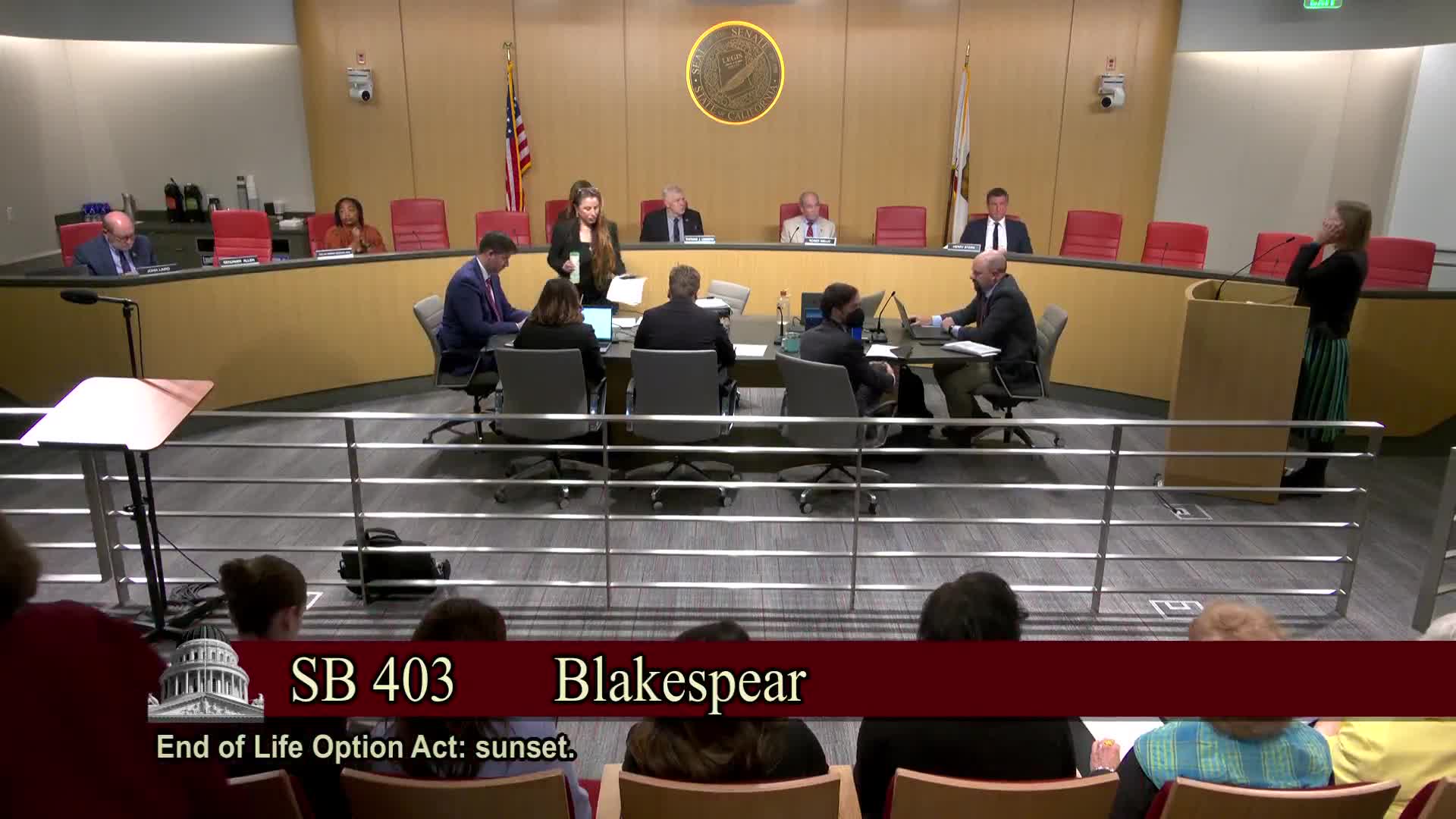
Senators heard testimony on SB 403, which would remove the 2031 sunset for California’s End of Life Option Act. Supporters — including families, clinicians and advocacy groups — said the law has operated safely for nine years; disability and civil‑rights groups urged further review before making the law permanent.
Senator Blake D. (author) presented SB 403 to remove the statute’s current sunset, making California’s End of Life Option Act permanent. The Act, first implemented in 2016, allows mentally capable, terminally ill adult residents to request a prescription to self‑administer life‑ending medication under strict safeguards.
The author said nine years of data show the law “is working as intended” and that continuing a sunset causes anxiety among terminal patients and families. “Since the law went into effect in June of 2016, a total of 4,287 people have died following ingestion of aid in dying medication under the End of Life Option Act,” the author said, summarizing the Department of Public Health reports. The bill would also direct the Department of Public Health to consult stakeholders about additional reporting details and to continue annual public reports.
Supporters included family members who testified personally about the law’s effect. Dan Diaz, whose wife Brittany Menard used medical aid in dying in 2014 and whose advocacy helped to pass the original law, told the committee he supported SB 403 so “no one else would ever have to leave their home like we did.” Medical and nursing witnesses including physicians, hospice staff and nurses told the committee they have not observed systemic abuse and that the statute’s multiple safeguards — confirmation by two physicians, two oral requests separated by at least 48 hours, a written request with two adult witnesses, and required capacity determinations — are working. Several witnesses noted that the majority of patients who used the law were age 60 or older and on hospice or palliative care at time of death.
Opponents included disability advocates, immigrant‑rights groups and faith‑based organizations, who urged caution. The California Foundation for Independent Living Centers and the League of United Latin American Citizens (LULAC) said the sunset provision serves as a legislative oversight safeguard, enabling a full evaluation of disparate impacts on low‑income, rural, immigrant and disabled communities. “Many individuals with disabilities continue to experience significant systemic barriers in accessing health care,” said Dan Okenfuss of the Independent Living Centers, noting concerns about coercion and unequal access. LULAC’s Orlando Fuentes cited disparities in Medi‑Cal access and urged a “full and public review of all relevant data before removing critical oversight mechanisms like the sunset provision.”
Committee members questioned the timing of repeal — the sunset is currently several years away — and asked whether additional public review should be required before making the law permanent. Senator Scott Wiener and others said they had cared for terminally ill relatives and emphasized the value of patient choice; other members expressed concern about data gaps, small sample size for some subgroups, and whether shortening the oral‑request interval (a change enacted earlier) affected usage.
The author said the law does not expand eligibility or lower safeguards: it preserves capacity, terminal prognosis and self‑administration requirements, and maintains required reporting. She argued that available data — annual reports compiled by the California Department of Public Health — show that the law’s safeguards have worked.
No committee vote was recorded in the transcript excerpt. The committee indicated it would continue to evaluate the bill and stakeholder input before further action.